04/13/21

Final Project: Performance Grades in Higher Education

For this final task, I decided to research performance grades. This topic is meaningful to me personally as someone who’s always worried too much about grades. Inspired by the course readings, I decided to use this opportunity to research grades as technology – What information do they really carry about a student? Who needs this information? Are grades even good for students? How about teachers? Are there alternative options?

In terms of the form or representation, I chose to create a video to move away from the more habitual written form, and leverage the affordances of a documentary to showcase some of the concept maps and charts I created while doing the research.


Did you grow up in a family where you were praised for bringing As or maybe a numeric equivalent grade? Did you and your family members get stressed and upset if you got a C or a D? I know I did. In fact, I finished school with honours without really learning much. One thing I did learn really well though was how to get a good grade. Am I completely over that addiction to grades now, 20 years later? Unfortunately no. This documentary is my personal attempt to get a bigger picture and get myself out of this grade addiction.

04/4/21

Linking Assignment – Lori Jonesy

Click on the image below to access Lori’s blog.

Authoring Tool

Lori is using UBC Blogs as an authoring tool. Her webspace is full of subtle design decisions that express her personality and unique approach to the learning process. 

Starting with the cover image and the quote she selected to repsent her mission, the logo that she designed, and the About page with a video introduction – all of these elements convey Lori’s work ethics, her energy, and commitment to excellence in everything she does.

Literacies

Lori’s understanding of UDL (CAST, 2018) and multimodalities (New London Group, 1996) comes through in the way she developed her About page. Her introduction is represented in a variety of forms – video, textual, and audio. 

In fact, throughout the website, Lori consistently leverages the affordances of hypertext to add multiple of pathways for her readers to explore (Bolter, 2001). Her writing is thorough and scholarly, yet engaging and fun. Almost all of her posts are supplemented with youtube videos on related topics. I am not sure if she has seen some of these clips before or if she takes extra time to research and find just the right pieces for each of her posts, but I really admire this added depth and a variery of topics that I, as her reader, can move on to. I also feel inspired to embed more videos to my blogs now. Lori’s students are lucky to have such a committed and fun teacher! 

Mode-Bending Assignment

It is not surprising then that Lori chose to make a video as a means of her re-imaged What’s In Your Bag assignment. A variety of video-making and editing skills come though in the film. Her skillfully-written script and and the artfulness and liveliness of the presentation reveal the many layers of Lori’s personality.

References:

Bolter, J. D. (2001). Writing space: computers, hypertext, and the remediation of print. New York, NY: Routledge.

CAST (2018). Universal Design for Learning Guidelines version 2.2. Retrieved from http://udlguidelines.cast.org

The New London Group. (1996). A Pedagogy of Multiliteracies: Designing Social Futures. Harvard Educational Review66(1), 60–93. https://doi.org/10.17763/haer.66.1.17370n67v22j160u 

04/4/21

Linking Assignment – Dierdge Dagar

Click on the image below to access Dierdre’s blog.

Authoring Tool

Borth Dierdge and I chose to use UBC Blog as our webspace. Dierdre keeps her webspace design minimalist and free of excessive use of images or colors. Even the hyperlinks are subtle and do not interfere with the continuity of her narrative (Bolter, 2001). This design choice makes exploring her blog really easy on the eyes which I can appreciate given the amount of data we deal with daily.

Something that made it a bit hard for me to explore Dierdre’s posts was the absence of the menu.  To help with navigation, Dierdre’s older posts are grouped in monthly archives, and there is also a possibility of scrolling down through her older posts. 

Finally, I can’t help but notice that Dierdre’s posts are relatively long and very beautifully composed. This, to me, coupled with the above-mentioned design choices, represents Dierdre’s love for writing and text, as well as her literacy in using the written word to communicate ideas.

Network Assignment

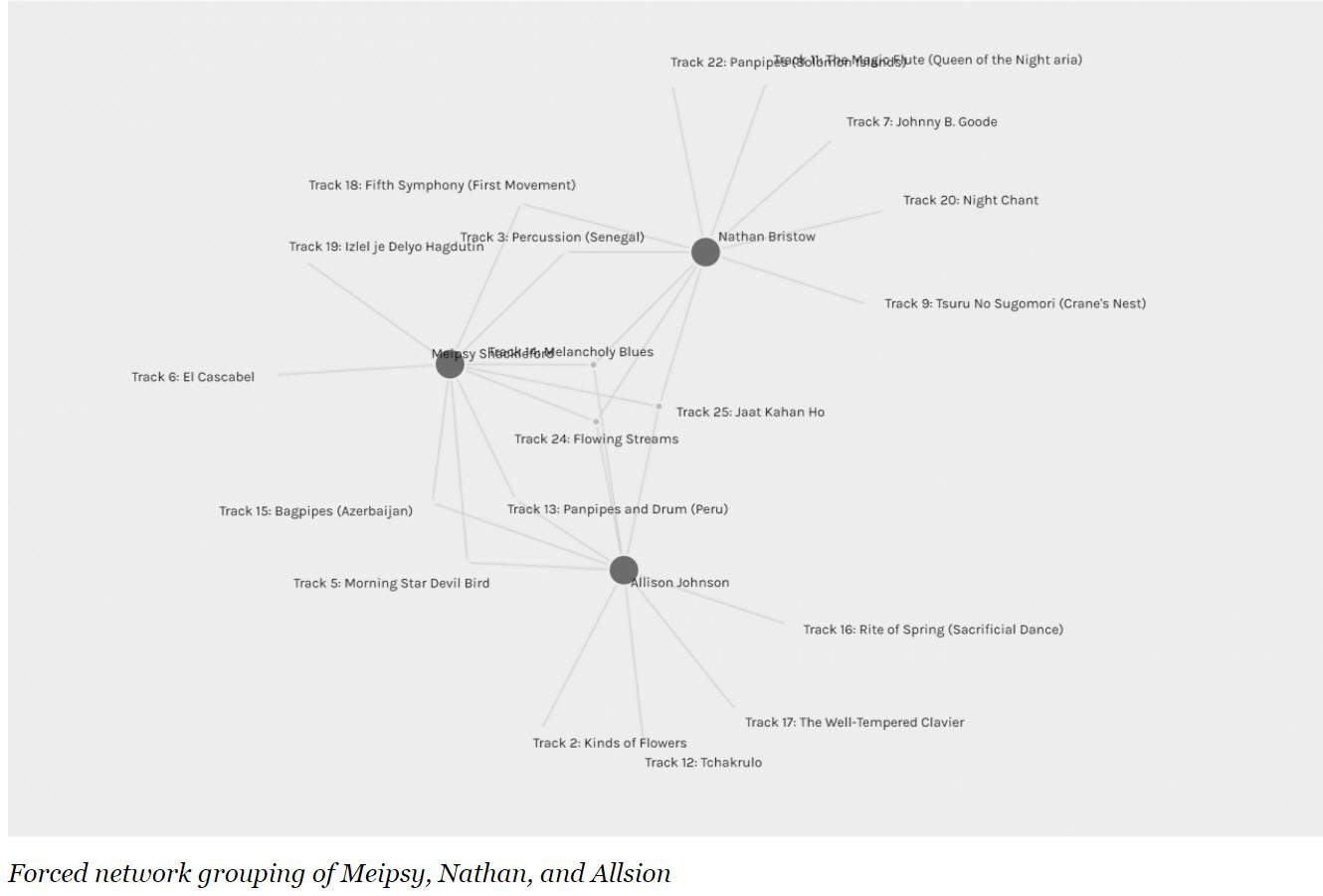
I related to Dierdge’s interpretation of the Palladio networks in a number of ways. Both of us were puzzled by the way the Palladio algorithm divided us into subgroups and spent some time studying the connections in different groups and searching for answers. In her exploration of the connections between the participants, Dierdre went even farther as she also created some forced connections between the group members:

In her analysis of the WHYs behind the song choices in her subgroup, Dierdre found several connections, such as all of the group members being high school teachers and having similar song elimination criteria. This goes in contrast with my group, where the four members seem to have been grouped based on the differences, not similarities. 

References:

Bolter, J. D. (2001). Writing space: computers, hypertext, and the remediation of print. New York, NY: Routledge.

04/4/21

Linking Assignment – Meipsy Shackleford

I’ll be honest, for my last Linking Assignment post, I was set to look for a coursemate in either of the course streams who selected the same or similar song criteria for Task 8 – Golden Record Curation. Having spent quite a bit of time on that task in week 8, I became somewhat biased to the criteria that I had selected, and I felt quite surprised to learn that the people in my subgroup did not follow the same or similar criteria (not even close!). So I started searching for a ‘soulmate’ by looking at the blogs, one by one, with not much luck. That is until I saw the magnificent cover image on Meipsy’s blog! The deep green of the trees, the wind in the hair of Meipsy and her children up on the mountain slope – all told me I did not have to search any longer! As we’ve learned in the course, images are also technologies of meaning, able to create immediacy between the author and the reader (Bolter, 2001), and I think Meipsy uses the pictures on the Home and About pages very effectively to tell a story about the person behind the blog.

Click on the image below to access Meipsy’s blog.

Golden Record Curation

When reading Meipsy’s Task 8 post, she also found curating the list of 10 songs to be challenging. While my approach was to save the music of underrepresented cultures, Meipsy prioritized making a “good first impression of Earth”. Meipsy also listened to the podcast about the process of selection of the original Goldern Record songs and came to the conclusion that while the process of the debate was probably intense and lively, the resulting list is still biased to western songs. Further, something that we both have in common is that we were touched by the speech of Dr. Rumsey and her question ‘What can we afford to lose?’. Influenced by the music, the course readings, and Dr. Rumsey’s talk, Meipsy decided to choose the 10 songs to represent “a global diversity of music from around the world while also trying to show the various temporal diversities of sound of voice and types of instrumentation.” In contrast, I focused my selection on the songs of the Global South while also keeping in mind the distribution of the songs on the map.

To sum up, both of us seemed to have enjoyed the task and the process of searching for optimal and not-too-biased selection criteria, resulting in 5 songs in common – maybe not the most impressive quantitative closeness, but well-supported with the thoughtful approach to WHY.

References:

Bolter, J. D. (2001). The Breakout of the Visual. In Writing space: Computers, hypertext, and the remediation of print (2nd ed.). Mahwah, N.J: Lawrence Erlbaum Associates. doi:10.4324/9781410600110


04/4/21

Task 12 – Speculative Futures

I enjoy quality science fiction, but I am by no means a writer, so this task was quite a challenge for me. In my search for ideas, Dunne & Raby’s (2013)  framework proved to be a helpful guide. Following the authors’ recommendations, I tried to make my narratives simplified and open to interpretation.  One of my narratives was also inspired by the HyperHuman design (Core77 Design Awards 2019, n.d.), as it shows how AI could help us, humans, see through our biases and preconceptions and amplify our strength and potential.

My two speculative narratives are about the future of teaching and learning. In one, AI does all the marking for teachers, freeing their time for more important and creative work. In the other one, it assists students who study online and suffer from imposter syndrome. In a way, both of the futures are preferable (Dunne & Raby, 2013), but “for whom, and who decides?” (p. 4). Listen and decide for yourself…

Scenario 1: Feedback Wizard

Scenario 2: Marker Wizard

References:

Chapman, A. (2017). Using the assessment process to overcome Imposter Syndrome in mature students. Journal of Further and Higher Education, 41(2), 112-119.

Core77 Design Awards 2019. (n.d.). HyperHuman. https://designawards.core77.com/speculative-design/86821/HyperHuman

Dunne, A. & Raby, F. (2013). Speculative Everything: Design, Fiction, and Social Dreaming. Cambridge: The MIT Press. Retrieved August 30, 2019, from Project MUSE database.

Parkman, A. (2016). The imposter phenomenon in higher education: Incidence and impact. Journal of Higher Education Theory and Practice, 16(1), 51.