Categories
Uncategorized

Neil Young’s Pono – an iPod Rival?

According to the Rolling Stone, Neil Young’s company Pono plans to introduce a line of portable music players, a music downloading service and technology that converts digital signals to analog sounds. This digital to analog conversion technology would provide an unparalleled accurate representation of original recording sessions. As somewhat of an audiophile, I am excited by this news. Although I love my iPod and my iPhone, MP3’s fail to provide the richness and warmth of a live recording.

However, Apple is clearly dominating the MP3 download and player sales markets. Is there room in the market for Pono?

Neil Young believes Pono can help preserve the artistic integrity of music, but artists have little control over the way consumers listen to their music.

I think Pono will need to target the niche market of audiophiles to succeed. Here is why…

  • Electronic music is becoming more popular (do dubstep listeners really care about music sound quality?)
  • Fewer and fewer recording artists are using tape, instead they are using digital recording systems such as pro-tools
  • I do not think improved audio quality will add value to typical music consumers even though Red Hot Chili Peppers bassist Flea mentions “It’s not like some vague thing that you need dogs’ ears to hear. It’s a drastic difference.”
  • Switching costs are high as consumers likely have extensive MP3 libraries and would need to re-purchase higher quality songs
  • Consumers are content with the status quo of MP3’s and devices like the iPhone that conveniently integrate music into their daily routines

Some artists such as Jimmy Page believe that their music is best experienced in an analog format.

Pono has the ability to encourage a very narrow market of vinyl listeners to transition into the digital age. The bottom line is this is an awesome concept and I would probably buy a Pono. However, I do not see Pono rivaling the success of Apple’s iPod. In the event that Pono becomes overwhelmingly successful, I believe Apple will buy Pono’s technology, release higher quality iPods and expand the iTunes store to sell higher quality audio files!
Categories
Uncategorized

Walmart Breaks iPads

https://www.youtube.com/watch?v=L_DLJK4o2YM

This video is on its way to becoming a viral video. So, where are you going to purchase your next iPad or other electronic device?

Assuming you will pay the same price, are you more inclined to go to Walmart or The Apple Store?

I would assume The Apple Store…

Having employees film videos that reflect negatively on their parent company employer is nothing new. Remember the guy who took a bath in the Burger King sink?

In class, we have often talked about fostering the development of positive user generated content. What can corporations do to restrict negative employee generated content?

I’m sure most large corporations have policies on taking unauthorized photos and videos, especially during working hours. But It seems that all employers can do in a situation like this is after the fact damage control by disciplining employees and attempting  to reassure customers.

Perhaps if the employees were tossing around a football instead of an iPad, viewers may have been left with the impression of Walmart providing an enjoyable work environment!

Categories
Uncategorized

Apple’s Passbook – The Future of Interactivity and Individualization

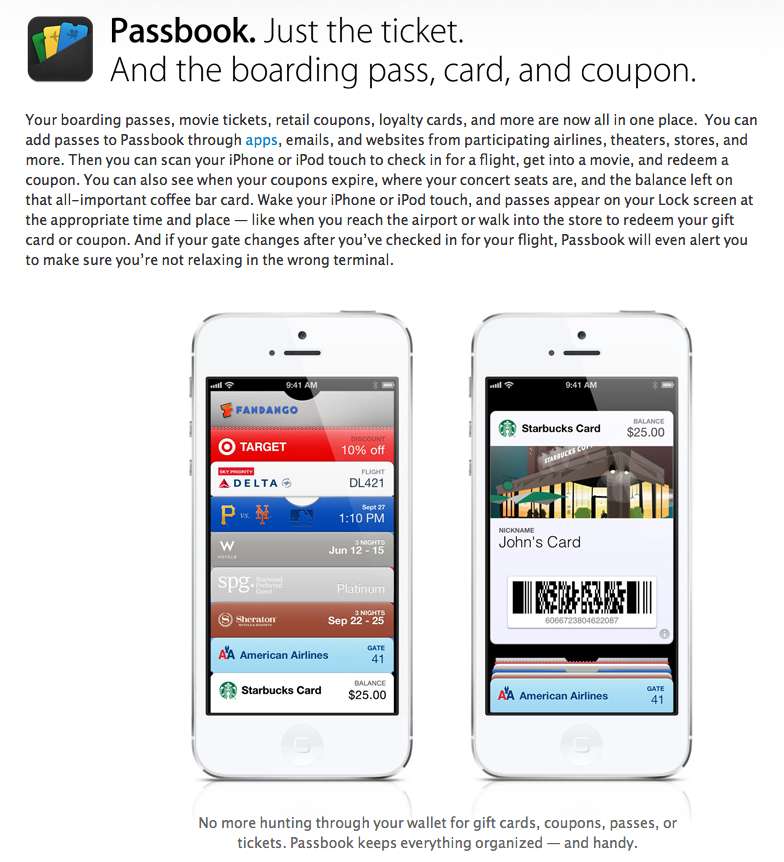
Passbook has the potential to become an organized, centralized digital wallet for consumers. Aside from providing unparalleled convenience to users, this application provides excellent opportunities for marketers. Furthermore, since passbook is installed as part of iOS6, there are few barriers to get iPhone users to adopt this technology and system.

So it seems like Passbook is a great service for corporations like Target and American Airlines, but what about smaller businesses without substantial advertising and software development budgets.  can they benefit from Passbook?

Yes, they can. According to Trendline Interactive, passes (coupons, giftcards, tickets etc) can be created for free from websites such as PassSource. Combined with existing distribution networks (such as e-mail lists and SMS subscriptions), passes can be distributed as links. At this point, some people may ask why use a pass instead of a traditional print at home coupon?

Aside from being more environmentally friendly and more difficult to misplace, passes can be utilized to provide interactivity and unparalleled metrics. Moreover, it is easy to deliver different passes or offers to already categorized consumer segments. Finally, passes can be programmed to issue reminders based on date, time and location! Once the pass is used, companies can even instantaneously follow up with customers about their experience!


Categories
Uncategorized

Will the act of Googling remain synonymous with searching the internet?

Google

Ask any person with the vaguest familiarity of a computer or “the internet” to Google something and they will know exactly what you are requesting. In case you have been living in a cave or just not paying attention to the relatively recent technological revolution, the act of Googling is synonymous with performing an online search.

So how exactly did Google become the market leading search engine we all know, love and use today?

Google keeps a timeline of their accomplishments and evolution here.

Some events that stand out to me are: Google becoming the world’s largest search engine in June 2000 and the Oxford English Dictionary adding Google as a verb in June 2006.

Although Google is one of many online search engines, does anyone actually routinely use one of Google’s competitors for routine searches?

In the United States, the Federal Trade Commission (FTC) is conducting an antitrust investigation into Google’s seemingly monopolistic market power. The results of this investigation are expected to be released in a few weeks.

Although Yahoo and Bing provide search alternatives, they fail to threaten Google’s supremacy and market dominance. In July 2012, the almighty Google captured approximately 66.8% of the search engine market. Bing controlled 15.7% and Yahoo just 13% (Search Engine Watch).

In a recent Forbes magazine article, Hal Singer posits that Google’s largest competition comes from companies such as Apple, Amazon and Facebook rather than traditional search engines.

Singer’s supports his opinion by citing this recent New York Times article.

Even though Google generally dominates the online search market, Amazon and Google are “waging a war to become the pre-eminent online mall“ (New York Times). Currently, it seems that Amazon is winning this war.

  • “Forrester Research found that a third of online users started their product searches on Amazon compared to 13 percent who started their search from a traditional search site; and
  • comScore found that product searches on Amazon have grown 73 percent over the last year while shopping searches on Google have been flat. (Forbes) “

Google realizes they must take action to retain searches related to the lucrative eCommerce and shopping categories. Look for Google Product Search to become a more prominent part of the Google experience in the near future.

For the past decade, Google has been the premier online search destination for pretty much anything related to the World Wide Web. I expect innovations like Apple’s voice activated Siri to become more commonly used further threatening Google’s dominance.

Also, with Facebook poised to enter the search engine market, expect to see more intense competition in the next few years. Ultimately, as consumers, regardless of what corporations fail and succeed, a more competitive landscape will lead to enhanced innovation pushing boundaries of what was previously conceived as possible. Perhaps a delayed FTC investigation of Google would yield dramatically different results.

Spam prevention powered by Akismet