This page briefly describes a recommended process for a formative peer review of teaching. This process should be adapted to meet the unique needs of your Faculty, Department and/or situation.
This site focuses on the classroom observation of teaching as the main source of information for the peer observation. We recognize that other sources of information include, but are not limited to: teaching materials, feedback on student work, instructor’s teaching philosophy, and a teaching portfolio. The text below is largely from the perspective of the reviewee.
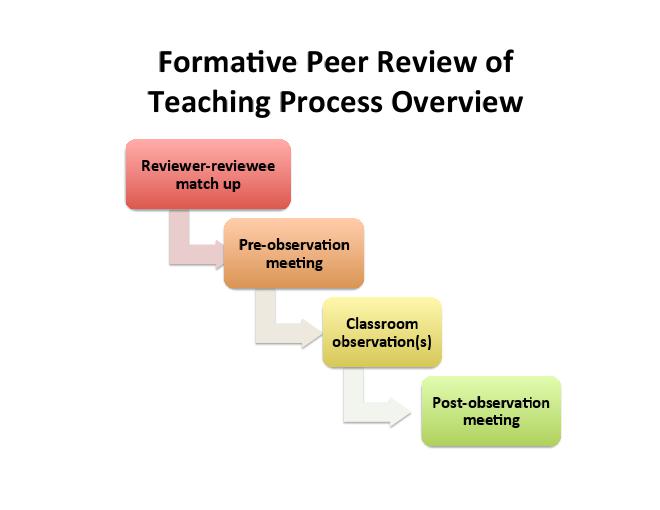
Based on the literature, the recommended summary steps for a formative peer review of classroom teaching are as follows:
1) Reviewer-reviewee match up
The formative peer review of teaching is typically a confidential process focused exclusively on the reviewee’s goals as an instructor. As a reviewee, you will want to think carefully about what you want to “get” from the review and then consider who might help you grow in that area.
Once you have identified your goals and one or two potential reviewers, approach them and ask them if they would be willing to help you/work with you. In addition to providing your colleagues with a list of potential classes to observe, you may also need to educate them on the process you are hoping to follow (see below) and why. If the reviewer is unable or unwilling to engage in a process that works for you, then you may want to consider a different reviewer.
Once the reviewee and reviewer pairs have been established, then you are ready for next steps:
2) Before the classroom observation
- The reviewee further reflects on their goals for the review.
- The reviewee decides which course will be observed and prepares a list of classes the reviewer can choose from.
- The reviewee plans and prepares for the class as they normally would.
- The reviewee prepares to brief the peer reviewer about the course and the class that will be observed.
- The reviewer considers what they would like to ask the reviewee at the pre-observation meeting (the reviewer may want to send these questions to the reviewee ahead of the pre-observation meeting).
- Approximately one week before the classroom observation, the peer reviewer(s) and reviewee meet to discuss the reviewee’s goals for their growth as an instructor and their plans for the class to be observed. This meeting is typically called the “pre-observation meeting”.
- See here for questions you may want to discuss (reviewees may want to read this to help them prepare)
3) Conduct the classroom observation of teaching
Some details to consider:
- Where will the reviewer sit?
- Will the reviewee introduce the reviewer to the class? (if so, what will you say about the situation?)
- Will the reviewer stay for the whole class? If not, when would be an appropriate time to leave?
- Will the reviewer and reviewee touch base after the class, or only at the post-observation meeting?
4) After the classroom observation (the post-observation meeting)
- Within one week of the classroom observation (ideally), the reviewee and peer reviewer will meet for approximately an hour to discuss the classroom observation and the peer reviewer’s notes/reports. (Note: It is a good idea to book this meeting during the pre-observation meeting or even before.)
- See here for a list of possible questions to discuss during the post-observation meeting.
- Together, the reviewer and reviewee can make a plan for further professional growth to address the topics/issues that came up during the observation and ensuing conversation.
- The reviewee may choose to use the notes/reports to guide future curriculum or professional development. The reviewer’s report may be included in a teaching dossier as part of a tenure and promotion process. The reviewee should check with the reviewer whether the latter wants to have their name associated with the review notes.
End of Module 1. (See you at the workshop!)
Please visit the resources section for more links and information.