Do world events affect market outcomes?

The markets have been rather favorable recently, as the average price of most of the indexes, or Portfolios, have gone up in recent days.  But what has been causing this? Was it George Papandreou’s decision to drop the Greek referendum on Thursday, or the announcement of the G20 to increase the funds that the International Monetary Fund has to spare?  It can be hard to pin point what it was that made the price go up, but something must have strengthened the confidence of investors in recent days for this development to have happened.

However, recently there have been coming troubling news from Greece’s largest neighbor, Italy.  There borrowing rates have hit new highs and people fear that Eurozone’s third biggest economy might be on the verge of collapsing any time soon.  The news brings the Eurozone’s back to being terrible, as the Greek problem had taken a seemingly favorable turn.   This will most likely have a negative effect on the markets as investors become discouraged about the future of the Euro and its countries.


Euro Crisis Explained

Sources Used

G20

Italy

Greece

Bailout

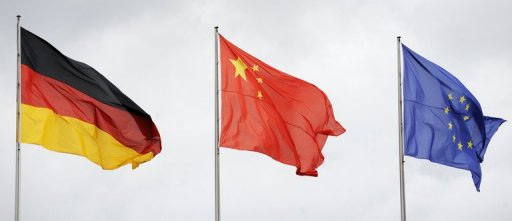
The article from the Forbes webpage explains the deep and unsettling problem that is facing the world economy.  Europe, which is on the brink of collapse, as its leaders desperately try to keep together the currency union that was deemed from the start to have difficulties, wants China to swell the EFSF.  However, China might be unwilling to do so as it would basically be throwing money out the window, as the bailout fund is only a temporary solution to the problem.  But seeing how China is so dependent on European exports and currency investments, it is hard to see how Hu Jintao and the communist party can avoid getting involved.

What most likely needs to be done is just stop trying to postpone the inevitable crash of some economies in order for the system as a whole to recuperate from the imbalance that is the world economy.  It is going to be rough and unpleasant but inevitable anyway so by spending these mass amounts of money is not helping anybody in the long run.


Netflix’s U-turn

On September 18th Netflix announced that it would be splitting its services in two, into Netflix with the online streaming services and Quickster with the DVD by mail service.  As suspected by Netflix this infuriated some customers, many of who were already angry by the 60% price increase introduced this summer.  However, Netflix has now announced that it will not be slitting thus cancelling all plans with Quickster.


Now my question would be why would Netflix even try to do this in the first place?  People obviously value the fact that they can get both services at the same place.  So the obvious answer is that Netflix feels like it would be profitable to do so, as both services have different cost structures so the decision from that standpoint would make sense, even though it would cost them a few customers.  However, it seemed to backfire with a lot more people than they expected dropping their account, but the correct number of which has not been released until October 24th.

So now as Netflix makes a U-turn it can be predicted that it will greatly influence the price in their stocks, as these types of actions do not help the confidence of the investors.


Article from NY Times: http://mediadecoder.blogs.nytimes.com/2011/10/10/netflix-abandons-plan-to-rent-dvds-on-qwikster/?ref=business

Article from Business Week: http://www.businessweek.com/news/2011-10-10/netflix-retreats-from-plan-to-split-dvds-from-web-streaming.html

China’s potential backfire

As China keeps its position as the world leader in economic growth while the US, Europe and Japan continue their downward spiral, China might run into some future problems.  The current system favors the giant state run banks and the firms that drive its growth, which in turn are driven by the savings of the middle class.  However, there might be a problem arising, as in order to continue with their astronomical growth, China needs to form a consumer class that buys more products from the world market.  Figures in fact show however that consumer spending is down to 35% from 45% of the G.D.P in a year, as consumers cannot keep up with the rising prices as their savings have such low interests rates that they cannot keep up with inflation.


The communist party introduced in their latest five-year plan that they planned to increase consumer spending.  However, that can be a double-edged sword as the banks highly depend on the savings of the households.  In addition to the banks, the central bank of China is also dependent on these savings, as it needs the funds in order to make its investments in foreign exchange markets.


The link from the NY Times: