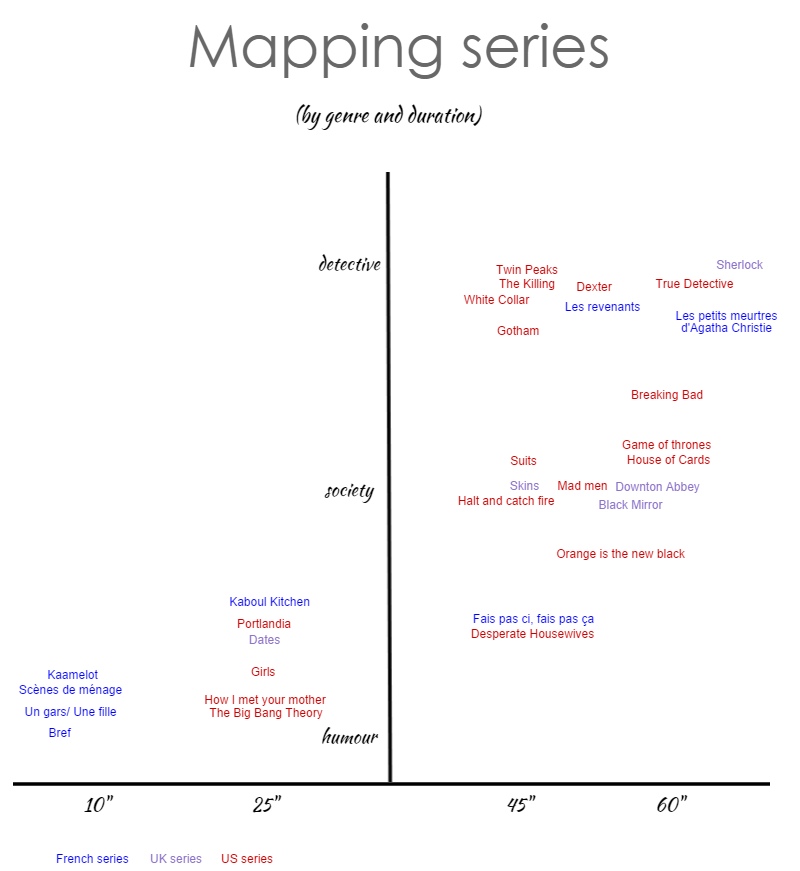
 Comment and I will update the map with your suggestions.
Categories
TV series – perceptual map

Comment and I will update the map with your suggestions.

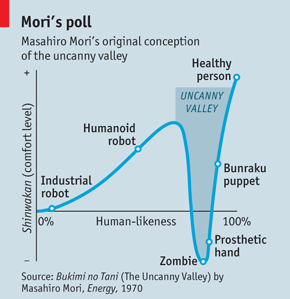
The British TV series by Charlie Brooker explores the side effects of the 21st century’s drug: our black mirrors (TV, computer, monitor, smartphones, etc). Each episode brings the viewer to a future not too far from his current life, taking a thread of technology and pushing it to its limits. It is always spot on, not too satirical for us to believe in it and dark enough to make us feel uncomfortable. Maybe the reason why Black Mirror moves us so much is because it flirts with the uncanny valley. The principle of the uncanny valley is that any human representation getting to close to a real human would bring discomfort. It is the same with the series. This representation of our reality is getting so close to what we perceive might happen in the very near future that we feel discomfort. This feeling is put to good use as it makes us think about our current society. For instance some try not to look constantly at their smartphone like drug addicts, to the extent that a word was created: JOMO, joy of missing out, the opposite of FOMO, fear of missing out.
Techno-paranoia is an ever coming back motto that divides the world between tech-lovers and tech-skeptics. A third category should arise, the tech-questioners, citizens who are not satisfied with the status quo of the lazy “so what?” and who wonder what would be the potential consequences. This is why I feel Black Mirror is such a clever show, because it makes us think.
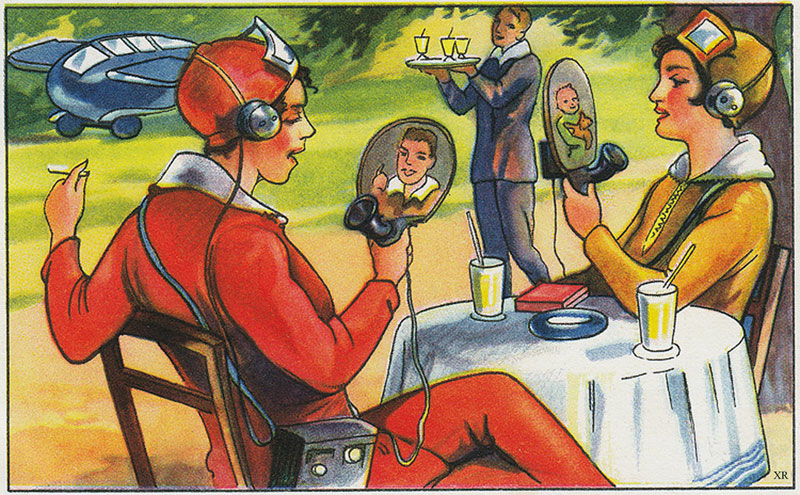
Even though we clearly see the benefit of the progress in technology (not only in terms of communication but also for social and ecological purposes), we cannot shake the feeling that this time the reality is catching up with the fiction. Alright, cars cannot fly yet. But biometry, data collection, wearables, the Internet of things get us very close to SciFi movies (Blade Runner, Metropolis to only name a few). Similarly a century ago or so people were also trying to understand how the future would look like. For instance a German artist in the 30s invented Skype or Facetime:
Superheros and dystopian movies told us to ask ourselves a simple question: what if these technologies were put to bad use or at least to extreme use? And this reminds me of the last Disney, Big Hero 6, where the hero invents a brilliant technology, the microbots…. but in the hands of a hurt father it becomes a weapon. And as a friend of mine pointed out, that is not discussed by any of the protagonists in the movie. Only the villain is punished and there is no shared responsibility. What happen to “with great power comes great responsibility” (quote from Uncle Ben in Spiderman)? Maybe this is an outdated slogan, only good for the Cold War era when the risk of blowing up the planet with a nuclear bomb seemed to be a possible outcome. Should it be “watch out for black mirrors”?
A very insightful link for the French reader: here.
Black Mirror: the explanation of each episode and unofficial trailer.

I have been wrestling quite a bit in the past months with the idea of the VOD being the new model to enjoy a movie… but I can’t get my mind around it. I am among the religious movie-goers for whom pressing pause, small screen, surrounding noise, comments would just kill the magic of that suspended moment that the film represents. But I need to step aside from my own habits to try and understand the current trend.
Context
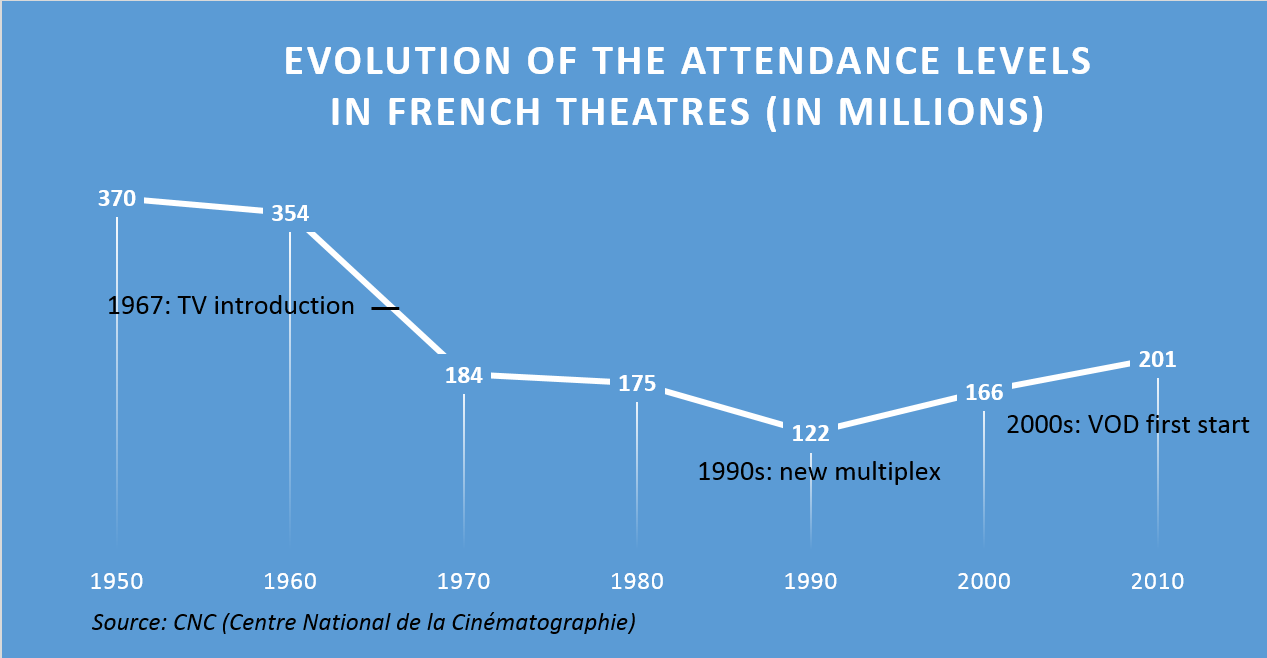
Netflix’s arrival in France in September 2014 was synonymous of fear and regrets (for not having taken action earlier). Canal+ seems to have reacted best by improving its existing VOD offer, CanalPlay. We will see in the coming months how it is going to impact the theatre attendance levels. France is still a nation of movie goers as shown on the graph. The impact might prove stronger on TV watchers though as the setting is the same.
The movie experience
We are talking about two very different experience for the film viewer. In the theatre the viewer is surrounded by the reactions of all the other spectators. These reactions can go in the same direction or the opposite, fostering a sense of belonging for the former or a sense of misunderstanding/frustration for the latter. This interaction enriches the experience of the movie-goers as they share directly on the film in a way. Moreover the size of the screen (always bigger with IMAX for instance), the comfort of the chair, the lack of parasite noise and light (hence the disruption created by pop corn chewing or cell phone screens) contribute to making the spectators forget where they are in order for them to better merge with the film universe.
On the other hand the VOD offers a more practical experience: it is cheaper, there is no need to go out, it takes place at home (synonym of reassuring and comfy environment), there is no annoying spectator around and the movie can be paused at any time. This is certainly a valuable change in the film consumption habits as it becomes more accessible to more people. Nonetheless the magic dies with the ritual encapsulated in the “salle obscure”.
(NB: it is rather significant that the only word to describe the room where the movie is projected is called in English “theatre”, no magie in it compared to the French “dark room”).
The studio perspective
If the future of movies lies in the VOD then it means that they will be screened on computers or on home TV (that are getting bigger and bigger for that reason as well maybe). Would any studio be interested in investing millions in a movie to achieve a certain industry standard in terms of image quality, if it were to be only screened on such a small screen? Knowing that the past few years trend was, for the American majors, to produce more and more visual effects driven movies for booming budgets, will that model be sustainable without the theatrical release? For instance Amazing Spider-Man cost $258 millions… but it generated $890 millions worldwide in box office. This remains a dangerous bet and the loss can reach the hundred millions. For instance it amounted for $69 millions for the Green Lantern in 2011 for a production budget of $110 millions. Such an escalation of visual effects performance does not guarantee the success of films and the studios survive just by offsetting the loss of one movie with the success of another. It might have been the same business model all along, though this time the amount of money involved are quite different.
Shifting from the theatrical model to the VOD model is thus unlikely to take place all at once. Furthermore financing a movie with VOD revenue is impossible today. The revenue generated are too low and not indexed on the success of a film on the same scale (a successful film will cost more for Netflix to acquire, but not to the same extent as millions of spectators going to the theatre). As of today rules have not been set clearly on VOD, rules that would create a viable and durable model for movie financing.
What movie do we want to watch?
Eventually the question comes down to the kind of movie we want to watch. Blockbusters require (or seemed to require, it might evolve) large screens. These films, because they offer “new sensations” and are visually breath-taking, still attract people to the theatre. On the other side of the spectrum, the independent movies seem not to require such intensive technology and can be seen at home. This distinction is highly arguable. First it is a question of individual perception on the movie experience one is seeking. Second dividing movies along these broad lines of blockbusters vs independent movie (a term that refers to two very different realities in France and in the United States) is irrelevant.
Ultimately my concern is what kind of movie are going to be produced in the long term if VOD grows, what will be the impact of the introduction of such a technology/service on the offer of available movies. I strongly agree with Pauline Kael, movie critic for the New Yorker in the 60s and 70s, who bridges the divide between high brow culture and mass culture with the concept of entertainment. Movies should be entertainment and the stress should be put on the story. No matter how you categorize a film, and even how you view a film, as long as the story holds.