The NSA and its role in the cyber war

The now infamous leaks of Edward Snowden on the extent of NSA surveillance shed light on the role the organization plays in the gathering of information to further US capabilities to combat its enemies. It has been theorized that the NSA is a defensive mechanism, as it uses its extensive resources to monitor threats and to document groups/individuals in order to prevent occurrences before they happen. However, it is likely that fighting terrorism is merely a fraction of what the NSA does, as the organization is involved in an international surveillance and intelligence race. The NSA is not a purely defensive organization in this sense, and is part of a debate on whether the US government should hoard vulnerabilities in the Internet or disclose and fix them.

One of the recent examples is the Heartbleed bug in the OpenSSL software library. Essentially it is a mistake made in programming that allows outsiders to enter and exploit that vulnerability, thus emphasizing its potential for offense and defense. Unpublished vulnerabilities are valuable as people can be compromised unknowingly and the discoverer can use it at his will. When someone discovers an unpublished vulnerability, he can choose to use it defensively or offensively. Defense entails alerting the vendor so they can patch it, in fact many vulnerabilities are discovered by the vendors themselves. Offensively however, the vulnerabilities can be used to attack anyone and even the vendor would not know about it until hackers are using it extensively. This is a security issue that has the potential to bring significant amounts of money as people who discover these vulnerabilities can sell them for attack purposes.

In regards to the NSA, they have two options. They can go defensively and alert the vendor, who will then fix it and thus increasing the net security across the board against attackers. However they can go offensively and use it to access foreign computer systems, which is also an important policy goal of the US. There is no middle ground as everyone uses the same software: fixing it for the US fixes it for everyone else, and leaving it exposed leaves the US exposed as they run the risk of someone else discovering and using it.(1) Indeed the latter point is made more crucial when considering the cyber “cold war” which involves foreign countries such as China. Thus the issue for the NSA concerns its actions on whether to fix and disclose vulnerabilities or to keep it a secret for its own usage.

One concept used by the NSA is “NOBUS” standing for “nobody but us”, their process regarding vulnerabilities is one where most of them are disclosed, while holding back some that only they could have discovered and used. An unpatched vulnerability puts everyone at risk but not on the same degree. Western states like the US are more susceptible due to more expansive electronic framework and intellectual property, whereas countries like China and Russia are less vulnerable giving them less incentive to see these issues fixed. Thus, fixing these vulnerabilities from a US perspective makes more sense as they improve security on a much wider bases especially considering that todays world sees more countries spending more money looking for these vulnerabilities rather than fixing them

(1)
Movie Review: The Shadow Company

The idea of a mercenary is one that has existed since the advent of warfare, and is one that has seen increasing significance in the past decade and is an industry that will probably continue to grow especially as the rules of warfare change. However, the concept of a mercenary is one that comes with certain assumptions and is associated with a romanticized form in contemporary video games and action movies that do not capture the reality of the private military industry. The documentary therefore attempts to capture a realistic, balanced picture of modern mercenaries, that on one hand is sympathetic to their cause (or, perhaps, lack thereof), their contribution in the War on Terror and perhaps the fact that they do a job that most people would not do, but on the other hand also shows the implications of the privatization of military security as a multi billion dollar industry and the ambiguous status they occupy under the law leading to ethical discussions.

Shadow Company looks at a number of interviewees, from people within the industry to academics and journalists, in order to provide a balanced view characterized by in-depth personal knowledge from the top of private security companies, as well as an objective perspective provided by people without a personal interest in the industry. An interesting point is that none of the interviewees are from the US government administration that is making emphatic use of Private Military Company’s in Iraq.

The image of mercenaries has been long associated with raping, looting and pillaging given the historical precedent started by British soldiers in the peace following the Thirty Years War. As PMCs are for hire, they are not bound by the same political, moral, or legal obligations in the same way members of national military are. Thus, the latter is often seen to have more “legitimacy” in its actions. Indeed, this can lead to situations such as Abu Ghraib, which involved a number of private contractors in the torture of the detainees. This was described as a “wild west” scenario, especially with the huge amounts of money that the industry potentially brings in. in the post 9/11 climate, PMCs have seen exponential growth and is now a multi billion (over 100$ billion) industry; thus companies compete with each other for the most lucrative contracts without undergoing significant preparation until getting the contract. This, along with the modern glorification of mercenaries in video games such as the Far Cry series and TV and movies, has led to a glorification of the PMC industry. However, it is pointed out that there are professionals in the field who only fight causes that they believe in (although not enough to do it for free), although it can lead to situations such as the planned overthrow of the President of Equatorial Guinea to be carried out by mercenaries financed by British financiers. The choice of interviewees in this regard helps the cause for private security companies as they outline incidents and examples where mercenaries have served a positive function.

As a documentary, Shadow Company highlights a reality of the US and its War on Terror that isn’t discussed at great length and does so effectively in a way that identifies a function for private security while realizing the inadequacies in the infrastructure of the industry regarding the bidding of contracts and the legal status/jurisdiction of mercenaries.

The Role of Emotion in Changing Opinions

In today’s political climate, terrorism is a buzzword that elicits a number of different emotions, reactions and perceptions depending on who you are. Thus, it is hard for people to approach such a topic objectively and impartially. This makes the topic of terrorism vulnerable to manipulation of facts and can be used to provoke sentiment of an emotional nature leading people to be irrational in supporting policies or in cultivating opinion on the matter. This year saw the emergence of the Al-Qaeda splinter group ISIS who have taken over parts of Afghanistan and Syria in a quest to establish an Islamic caliphate based on a highly traditional form of Islam. In an effort to combat groups such as this in a time where the War on Terror has been an ever pervasive issue, the US has used tactics to maintain security through such as the use of intelligence agencies such as the NSA and drone warfare to target militants hostile to the US. These are undoubtedly controversial means, which are influenced in one way or another through the highly emotionally charged topic of terrorism.

Emotion is a powerful tool that people on either side of this conflict are susceptible to. ISIS emerging as the principal antagonist in the US’s War Against Terror has come against a backdrop of violence in their newly established Islamic States. Videos emerging of heads impaled on spikes, and the beheadings of American and British journalists/care workers such as James Foley and Steven Sotloff has led to a public outcry in many countries, as well as promises from the respective leaders to see that these men responsible will be put to justice. However there remains the concern of the usage of intelligence agencies such as the NSA as well as drone warfare to maintain security. Drone warfare in particular has been singled out as particularly controversial due to the amount of civilian casualties it incurs. Articles such as this[1] have a headline stating only 4% of drone victims are members of al Qaeda, which at first glance seems unnecessarily brutal for sure a low output. However only 704 of the 2,379 dead have been identified, and 295 of these were reported to be members of some kind of armed group, which improves the numbers slightly. This is an example of how an agenda can be presented in the form of suggestive headlines and framing statistics. Given the fractional nature of US politics and the media circus that surrounds it, it is important to take things objectively and in context. While one might tend towards support for US military action in the Middle East after seeing videos like this, we should not let emotions dictate policy and let reason prevail. The US entering the Middle East again in such a short time and engaging in ground war with ISIS will boost terrorist recruitment from around the world, even if ISIS loses initial military battles.[2] US interference in the region is an example of imperialism used by the Islamic State to fuel radical sentiment. For Muslims, who see their lands occupied by Israel, bombed by the United States, and ruled by corrupt dictators propped up by the West, it is both powerful and seductive. This shows that emotion is powerful tool also used on the other side of this debate.

[1] http://www.thebureauinvestigates.com/2014/10/16/only-4-of-drone-victims-in-pakistan-identified-as-al-qaeda-members/

[2] http://nymag.com/scienceofus/2014/08/how-isis-seduces-new-recruits.html

Why the Occupy Central movement has the potential to set a precedent for affecting change

The Occupy Central movement, which has been happening in Hong Kong, came about through the escalation of student demonstrations in protest of democratic practices that allow the central Chinese government to vet Hong Kong’s top leader in the 2017 poll, contrary to the provisions specified in the Basic Law. This Basic Law serves as the de facto constitution of the autonomous region that has enjoyed civil liberties not often seen on the mainland. However instead of moving towards universal suffrage in 2017, the powers of the central government have increased with the National People’s Congress requiring a nomination committee to pre-approve up to three electoral candidates before proceeding to a vote involving the general population where the winner would then still need to be formally approved by the central government. [1] The movement has since expanded to include a wide range of people who have aimed to spread their cause on a worldwide stage during the National Day of the People’s Republic of China.

One of the defining aspects of the Occupy Central movement is the non-violent way they carry out their protests, choosing instead a campaign of civil disobedience. Unlike other countries like the Ukraine where popular protests against oppressive regimes has led to scenes of violent confrontation, the local Hong Kongers are picking up their litter, passing out food and sorting recyclable goods. [2] Despite this, the police have responded violently with the usage of pepper spray and tear gas to “control” the crowds. While it is unclear what Beijing’s next move will be, it seems that for now the central government is waiting the protestors out. It is clear that Beijing is threatened, as Instagram and Weibo (Chinese social media) have been heavily censored and/or outright banned.

It is feared that the Chinese might escalate and crack down on the protestors similar to Tiananmen. However it should be considered that it is easier to maintain control over communications and protests in isolated parts of the country like Tibet. Hong Kong, with the One China Two Systems, is an international hub with wide exposure coupled with the peaceful nature of the protests, which means that any potential reaction by the central government would be closely scrutinized. Given that China in this day and age is looking to emerge as a superpower on the world stage, it has a number of key international economic and trade deals that could be compromised as Hong Kong is a major source of these deals being a significant financial power in the region.

It is fitting that the movement had its start in time of the National Day of the People’s Republic on the 1st of October. China as a country was established in its present form through revolution against the corrupt KMT, prior to that the Chinese fought off the foreign invaders of Japan in WWII and even before that, China abolished the monarchy in the series of events following the Boxer Rebellion. China has not been wholly unflexible in the past, in fact it was when it changed its socialist ideals into a market economy when it really began to flourish. Change is a constant in Chinese history, it remains to see how it will unfold.

[1] https://www.facebook.com/media/set/?set=a.568285576633425.1073741830.565462753582374&type=1

[2] http://www.independent.co.uk/news/world/asia/hong-kong-protests-demonstrators-clean-up-and-recycle-after-night-of-clashes-with-police-9761598.html

http://www.slate.com/articles/news_and_politics/foreigners/2014/10/occupy_central_s_polite_protesters_the_hong_kong_demonstrators_are_disciplined.html?wpsrc=sh_all_dt_tw_top

Link

The question of balance of power in East and South-East Asia
Roman Recto

Kang’s writings on the subject of China’s rise and stability in East and South-East Asia center around the idea of bandwagoning; that the other states in the region will align themselves with the rising power, or threat, sacrificing potential influence for stability. This is a notion that assumes that all the states involved will cooperate with the demands of each other, perhaps even suggesting that they acquiesce to that of China, as it would be in the greater interests of the involved countries. However, it fails to consider the legitimate claims other southeast Asian countries have on the disputed territories, and assumes that the states in the region should just appease the growing behemoth of China and leaving its growth unchecked.

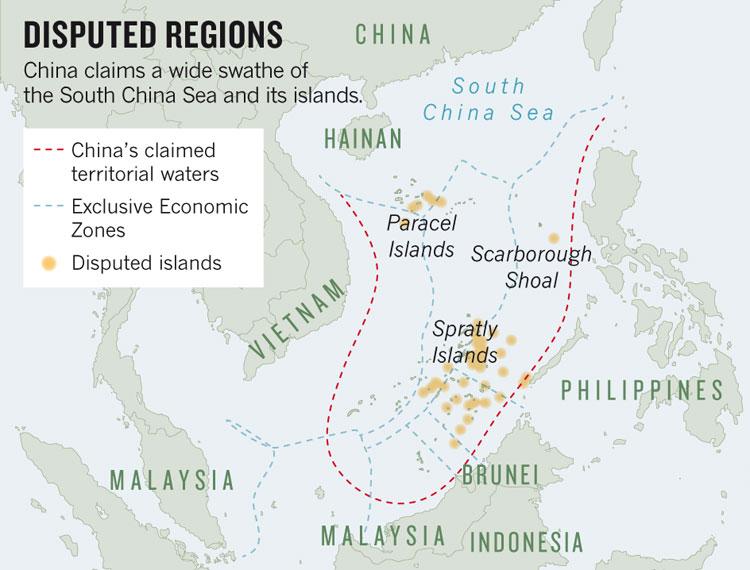
Chinese claims to disputed territories in the South China Sea is largely based on broad historical assertions, saying that its vessels had been sailing around the area as early as 2000 years ago, and also the “nine-dotted line”, a demarcation line drawn on Chinese maps as early as 1948 which encapsulates a number of islands such as the Paracel, Spratly and Scarborough shoal. Yet, a number of other countries can claim to have equal, if not more legally defined claims to one or more of these territories. The Scarborough and Spratly islands all fall within the 200 nautical mile Exclusive Economic Zone of the Philippines stipulated in the UNCLOS (United Nations Convention on the Laws of the Sea), which was ratified by both the Philippines and China.

Stability was achievable in the post-Cold War era, when the USA was the sole world hegemon with the fall of the USSR. However with the rise of China, there is a case to be made for another power bloc in the world order. Power that goes unchecked has shown to be a dangerous precedent throughout history, thus it is necessary for other countries to maintain the balance of power in the interests of their country and the international system.

One of the concerns in the region is the presence of US military exercises in the Philippines and Vietnam. It has been highlighted as one of the key causes of instability in the region, as a thorn in China’s sphere of influence. Despite the new signing of the Enhanced Defence Cooperation Agreement (EDCA) with the Philippines, it is no guarantor of conflict between China and the US. While China is concerned, the treaty is merely focused on training and disaster relief and it is unlikely that the Philippines would engage China (which spends 47x more on defense) militarily.

We are no longer in the Cold War frame of mind where nuclear weapons and mutually assured destruction are an overriding concern. The US and China are not ideologically and politically poles apart in the same way that the US was with communist USSR. In this day and age, it is through multilateral talks, with respect to international law, in which proper dialogue can be achieved.