The question of balance of power in East and South-East Asia
Roman Recto
Kang’s writings on the subject of China’s rise and stability in East and South-East Asia center around the idea of bandwagoning; that the other states in the region will align themselves with the rising power, or threat, sacrificing potential influence for stability. This is a notion that assumes that all the states involved will cooperate with the demands of each other, perhaps even suggesting that they acquiesce to that of China, as it would be in the greater interests of the involved countries. However, it fails to consider the legitimate claims other southeast Asian countries have on the disputed territories, and assumes that the states in the region should just appease the growing behemoth of China and leaving its growth unchecked.
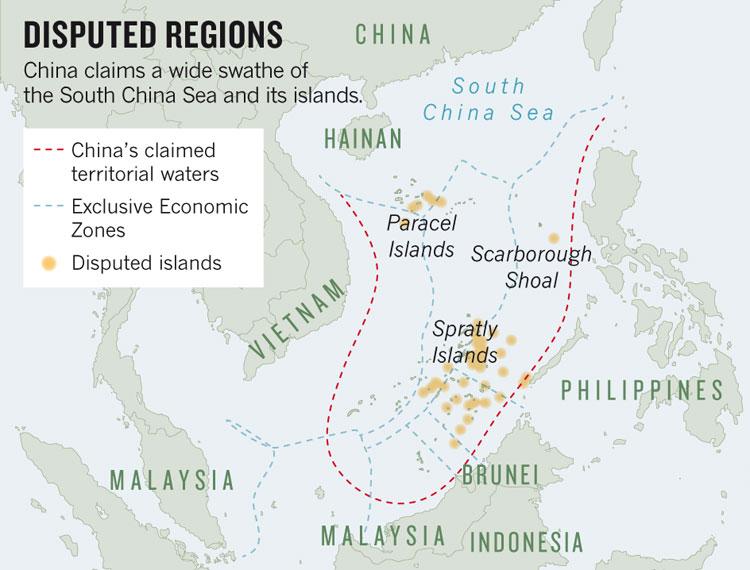
Chinese claims to disputed territories in the South China Sea is largely based on broad historical assertions, saying that its vessels had been sailing around the area as early as 2000 years ago, and also the “nine-dotted line”, a demarcation line drawn on Chinese maps as early as 1948 which encapsulates a number of islands such as the Paracel, Spratly and Scarborough shoal. Yet, a number of other countries can claim to have equal, if not more legally defined claims to one or more of these territories. The Scarborough and Spratly islands all fall within the 200 nautical mile Exclusive Economic Zone of the Philippines stipulated in the UNCLOS (United Nations Convention on the Laws of the Sea), which was ratified by both the Philippines and China.
Stability was achievable in the post-Cold War era, when the USA was the sole world hegemon with the fall of the USSR. However with the rise of China, there is a case to be made for another power bloc in the world order. Power that goes unchecked has shown to be a dangerous precedent throughout history, thus it is necessary for other countries to maintain the balance of power in the interests of their country and the international system.
One of the concerns in the region is the presence of US military exercises in the Philippines and Vietnam. It has been highlighted as one of the key causes of instability in the region, as a thorn in China’s sphere of influence. Despite the new signing of the Enhanced Defence Cooperation Agreement (EDCA) with the Philippines, it is no guarantor of conflict between China and the US. While China is concerned, the treaty is merely focused on training and disaster relief and it is unlikely that the Philippines would engage China (which spends 47x more on defense) militarily.
We are no longer in the Cold War frame of mind where nuclear weapons and mutually assured destruction are an overriding concern. The US and China are not ideologically and politically poles apart in the same way that the US was with communist USSR. In this day and age, it is through multilateral talks, with respect to international law, in which proper dialogue can be achieved.