Final Reflection Blog

I have found this course difficult at times. The style of writing is different than the way I have been previously taught in the sciences. I also find that I can lose my confidence when writing in general.

One section of the course that I found useful was the discussion of considering your audience. As a science major, I write most of my reports using jargon that may not be understood by a person outside of the field of Physics. Although this is appropriate in this situation, I am now more considerate when writing of making sure that everything included could be understood by the intended audience.

I found writing with a you attitude particularly difficult. Earlier in the course we had been advised to limit the use of excess words and the passive voice. However, when I tried to write with a you attitude, I couldn’t reconcile those two concepts. I especially found it difficult to use an active voice while following the rules. As well, in some of the assignments I just didn’t understand how I could write it in that way. It still does not feel natural to write using that method.

Another aspect of the course I struggled repeatedly with was peer reviews.  I was unsure when I was giving feedback if the feedback was appropriate and useful. As well, I found it difficult catching things that may have been obvious to other people. I did practice and asked for advice and think that my peer reviews have improved throughout the semester.

Overall, I think my writing has improved during the course. I have learned techniques that I can apply in the future after I continue practicing them.

Leave a Comment

Filed under Uncategorized

Web Folio Reflection Blog

At first when I saw the assignment I felt overwhelmed. It seemed like a lot of work and planning, especially the kind of work I find particularly difficult. I decided that it would be the most appropriate for me to adapt my current website into my web folio. I had found that when I was originally planning my website, I had not considered how easy it would be to adapt to a different style. Also, the style I had used did not fit well with the guidelines required of the web folio. However, with some changes I made it work.

A positive side of creating the web folio was looking back at the work I had completed over the semester. I had never considered presenting my work in an online forum such as a web folio. This would be a very good idea if you were fully confident in the quality of you work. As well, having an online website to present an application to a job. Depending on the intended field this could highlight useful skills and the dedication in applying to the job. This web folio has introduced me to the idea so that in the future as I produce work I could create a similar website to highlight the work I’ve produced relevant to my field.

Leave a Comment

Filed under Uncategorized

Unit Three Reflection

Unit three was a difficult unit for me. I was unable to complete my formal report draft by the deadline due to an ongoing sickness. There were a variety of factors that impacted my ability to work on the formal report. Due to the sickness, I was unable to go to University for a week. This made it hard for me to continue my interviews and get the data needed for the report. Then I became so sick I could not work on anything and spent my days sleeping. This began a couple of days before the due date and has continued up until yesterday.

When I could work on the formal report, I found myself getting stuck on how long the paper had to be. I began worrying about the quantity rather than the quality. However, I know a long report isn’t very good if the writing is poor. Another technique I have learned in this course, which is to edit out unnecessary words or phrases, has made it so I couldn’t use my usual ‘filler’ techniques. Although this has and will continue to be hard, I know it is making my writing better.

Another aspect of the report I found difficult was collecting the data. I found that as my questions were not yes or no, and they could not be ranked, I was not able to use a survey. So I chose to conduct individual surveys and I kept the results anonymous. However, this did make it harder to collect data. This could be because people tend to think that an interview would take up a lot more of their time than a survey would. Having interviews will also affect how I present my result. It is a lot harder to create images such as graphs. I am trying out several different ways of presenting the results.


Leave a Comment

Filed under Uncategorized

Reflection Blog 2

I found creating the LinkedIn profile difficult, but I expected that. I have always found it a challenge creating resumes and cover letters, and was not surprised that this was the case for the profile.  I find it hard anticipating the correct way to present myself for potential employers. However, I found the tips that LinkedIn gave very useful, especially the setup which could be done in the order suggested by LinkedIn. The research on LinkedIn best practices was also very helpful, and I plan on applying those tips in the future. I do believe that as I continue to improve my profile it will become a very useful tool for professional networking.

Once I knew the conditions for the Formal Report Proposal it was quite fun to write. I became very interested in my topic as it is directly related to something I am passionate about. I had never written a proposal in that form before, so it was very useful having the information from the textbook. I am very happy to have done this assignment as I believe it is a very useful skill to have. I know that being able to write a proposal will be important for my future career. I am at a stand still with my formal report. Thanks partly to the outline, I have most of the Formal Report sketched out. Once I am able to conduct the interviews, I can start analyzing the data. This will be the next step I will have to complete so that I can complete the report. I am slightly nervous about writing the report, because it is the long report I will have ever written based entirely off of my own research.

I appreciated completing the several types of peer reviews that I have done since the last reflection blog. Thanks to the feedback from my peers, I have started considering things more as I write, rather than only when reviewing my work. For example, as I am doing my first draft I will look at my sentence lengths, which I would not have considered before. I have learned that I tend to make a lot of similar mistakes in my writing. In future writing, I will have to keep a closer eye on those things. I had a hard time completing my first peer review. I followed some advice I was given by Erika Paterson on the next review I completed. I found that this new way of organizing the review helped me analyze the work. I am still finding peer-reviewing very hard, but I hope that  my partners find that my work has improved and is useful.

Leave a Comment

Filed under Uncategorized

Unit One Reflection

I found that writing the three kinds of definitions was very useful. It highlighted the differences between them and the situations when each would be appropriate. I believe that this will help increase the quality of my writing in many areas, as well as my ability to tailor my writing to specific audiences. I noted that when I was writing my expanded definition I used parenthetical definitions several times. I realized that this is something I have frequently done without thinking about it. Due to this assignment, I can now determine whether my use of parenthetical definitions is correct and suitable.

I found the peer editing harder than I expected. Not only because of having to examine someone else’s work, but also because my partner, Samuel, and I had approached the assignment in different ways. When reviewing, I first read the assignment and noted only the errors that interrupted my reading. Then I reread it paying attention to the finer details. This allowed me to consider specific areas for improvements that did not affect the overall readability of the work. This technique actually made me consider attempting this with my own work in the future.

I appreciated having my own work peer-reviewed. This gave me insight into my work in ways that I did not consider myself. I found that I had gotten so caught up in describing my process that I had forgotten to simplify terms that may not be common knowledge. I did not notice this myself, which I think is because I am already used to seeing the terms on a regular basis and communicating with people who know them. I know now that I must be more careful with this issue in the future. Due to Samuel’s comments  on my citation style, we ended up having a discussion about different techniques I could use when citing sources. I found it very interesting to hear about how my citation style had affected his reading of my assignment.

I found the peer review more useful than the review I had done of my work. Samuel was able to notice things that I wouldn’t have considered or even noticed. I also have learnt that the way I review the work of others could be very important to consider when editing my own work. I think the techniques I learnt in this unit will help me improve my writing and editing in the future.

Leave a Comment

Filed under Uncategorized

Assignment 1.3: Definitions of Photoelectric Effect

Introduction

The criteria of this assignment is to chose a term within my discipline and provide a parenthetical definition, sentence definition, and expanded definition. The objectives for this assignment are to understand the need for defining terms in technical writing, differentiate between the ways of defining terms, and learn how to use them appropriately. For this assignment it was assumed that the reader would have a basic knowledge of scientific terms such as electron and photon.

Parenthetical definition

The photoelectric effect (electron ejection caused by light) created doubt about the theory that light only behaved like a wave.

Sentence Definition

The photoelectric effect is the phenomena that occurs when an electron is ejected from a material after it is exposed to light.  If the energy that the electron absorbs from the photon is large enough, the electron will be ejected.

Expanded Definition

History

The photoelectric effect was first observed by Heinrich Hertz in 1887 (“Photoelectric Effect”).  The Photoelectric Effect describes how Hertz saw that ultraviolet light changed the voltage for which sparking took place between two metal electrodes (an electrical conductor). In 1902, Philipp Lenard showed the relationship between light and electricity; when a metal is lit electrically charged particles (electrons) are emitted (“Photoelectric Effect”). This event of light illuminating a material and photoelectrons being emitted is known as the photoelectric effect.

Relation to Light

It was expected that the energy caused by the movement of the electron emitted by the effect would by proportional to the intensity of the light used, however this was found not to be the case (“Photoelectric Effect”). It is proportional to the frequency of the light (which determines its colour), and intensity determines the number of electrons that is emitted (“Photoelectric Effect”).

Diagrams of the effect

The image below represents the photoelectric effect. The image is of different frequencies of light being shone at a metal plate (Elert). The light with higher frequencies produce photoelectrons with higher kinetic energy than light with low frequency does (Elert).
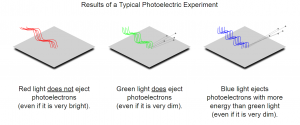
photoelectric-effect2

Figure 1: three experiments using lights of different frequency (Elert). 

Uses

The photoelectric effect has a variety of uses in lab settings, as well in industry. A device that utilizes the photoelectric effect is the photodiode. Photodiodes can detect light and measure its intensity, as well as turn light into electrical energy (“Photoelectric Effect,”). Some examples of the applications of photodiodes are described by Britannica as pollution monitoring, imaging, solar cells, and fibre optics (“Photoelectric Effect”). Automatic doors can use photodiodes as their sensor. A light is shone at a photodiode and when that light is interrupted, usually by a person walking through it, the photodiode sends a signal that opens the door (“Principle of Sensor Operation”).

References

“Photoelectric Effect.” Encyclopedia Britannica Online. Encyclopedia Britannica, n.d. Web. https://www.britannica.com/science/photoelectric-effect Accessed: 26 September 2016.

“Principle of Sensor Operation” OPTEX. n.d. Web. http://www.optex.co.jp/as/eng/infrared/principle.html Accessed: 26 September 2016.

Elert, Glenn. “Photoelectric Effect.” The Physics Hypertextbook. n.d. Web. http://physics.info/photoelectric/ Accessed: 26 September 2016.


File of the assignment:

sarah-parry-definition-assignment


Samuel Navarro’s Review of my assignment:

http://engl301.arts.ubc.ca/2016/09/28/peer-review-of-sarah-parrys-definitions-assignment/

Leave a Comment

Filed under Uncategorized

Writing Team Emails

Email 1

To: snavarroleiva@gmail.com

From: sarahparrysp@gmail.com

Date: 23 September 2016

Subject: English 301 Writing Team

Dear Samuel Navarro,

Thank you for contacting me regarding the English 301 writing teams. As we have previous experience working together during our Physics degree and I was impressed by your application letter, I would be happy to be a member of your team.
Regards,
Sarah Parry
Email 2

To: manrajathwal@gmail.com

From: sarahparrysp@gmail.com

Date: 23 September 2016

Subject: English 301 Writing Team

Dear Manraj Athwal,

Samuel Navarro Leiva informed me of the invitation you sent him regarding the writing teams for English 301. Having read through your application, I believe that our combined experience and mutual interests will create a strong team.
I have included a link to my application letter below in case you have not read it.
Regards,
Sarah Parry
Email 3

To: arash_farhadian@hotmail.com

From: sarahparrysp@gmail.com

Date: 23 September 2016

Subject: English 301 Writing Team

Dear Arash Farhadian,

I am contacting you to introduce myself as Manraj Athwal emailed Samuel Navarro Leiva about forming a writing team. Samuel Navarro Leiva and myself had already agreed to work together.
I have read your application letter and believe that the four of us will create a strong writing team. I look forward to the upcoming semester.
Regards,
Sarah Parry

Leave a Comment

Filed under Uncategorized

Memo Regarding Application Letter

Memo

To:                       Erika Patterson, Sessional Instructor

From:                  Sarah Parry

Date:                   September 19, 2016

Subject:              Application Letter


As requested, I have posted my application letter to my blog. A copy of the application letter is attached to this memo. Below is a brief summary of its contents.

  • I am a fourth year Physics student interested in Medical and Computational Physics.
  • I have experience in retail, and interested in retail management.
  • I have experience professional correspondence.
  • I have written many lab reports that have required technical detail.
  • My weakness is that I am English so my spelling and word choice can vary from North American standard.
  • I have worked in group writing projects in previous courses.
  • My learning philosophy is that to understand a concept, you must first understand its individual parts.

Please contact me if you have any questions or concerns.


301-Sarah-Parry-Application-Letter

Leave a Comment

Filed under Uncategorized

Writing Team Application Letter

Dear English 301 Students,

Please consider my application to be a member of your professional writing team, as described on the English 301 course website. I am in the fourth year of my Bachelor of Science in Physics and will graduate in May.

My areas of interests within the Physics discipline are Computational and Medical Physics. After I graduate, I plan on applying to the two-year Computer Science degree offered at UBC. However, from September 2015 until August 2016 I worked full time at a retail store. I gained experience in several positions including: DSD processer, claims associate, invoicing and personnel. It was necessary for me to produce paperwork that was accurate and professional. I am now considering applying for management positions within that company after I graduate.

In my third year at UBC, I was VP Academic of the Undergraduate Physics Society and I am currently Graduation Representative. In both positions I have had to meet deadlines and communicate with peers, professors, and professionals outside of UBC. As VP Academic, I wrote a transition document that needed to include clear and detailed instructions that could be used by people unfamiliar with the position.

A learning technique I find useful is that to understand a concept, you must first break it down in to its components. You must spend time learning each part by itself. Then by combining these pieces of knowledge, you can grasp the complete concept. This belief has helped me throughout my time at UBC, both in my physics and elective courses.

Throughout my Physics degree I have written many lab reports and research papers. I am proficient at writing reports with emphasis on details and clear instructions. I am originally from England, so my choice of words and spelling can differ from North American. In Zoological Physics, I was a member of a team that produced a project which included a formal paper. During this project, I worked individually, collaboratively with the group, and edited other members’ writing. I work mainly during evenings or at night, but will answer correspondence at any time of the day.

If you are interested in me as a member of your writing team, you can contact me through email at sarahparrysp@gmail.com

Sincerely,

Sarah Parry

301-Sarah-Parry-Application-Letter


Leave a Comment

Filed under Uncategorized