ONE FOR ONE – all the way

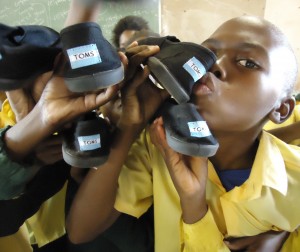
On the surface, TOMS unique ‘one – for – one’ business model concept may seem well intended. However, having said that; doubts have arisen as to whether the shoes being donated to the needy was actually a true act of CSR on behalf of the firm, or whether it was merely an ingenious marketing ploy to enable the firm to gain firm traction in the industry by differentiating its product and promoting its brand image by means of tying in the strong positive associations with ‘good deeds’ that allude to the actual brand name. Some might even argue that the one – for – one campaign serves as nothing more than a medium for which TOMS can rationalize it’s high prices for it’s footwear.

CR_009

dsc05758_2

Either way, I believe that the ‘one – for – one’ business model, in essence, was based on good intentions. That being said, I support the ‘one-for-one’ business model the firm has decided to employ.


Regardless of whether the firm is utilizing it’s business model as a marketing strategy or stepping stone to gain a larger customer base, I feel that it does forego quite a substantial amount of would-be-potential-revenue by opting to donate it to the poor, inconvenienced and needy.


While it is true that local businesses within the region (that TOMS is donating to) will invariably be impacted negatively, I feel that if the region is impoverished to the point where individuals can barely afford shoes, that receiving them for free would help ease the burden of daily expenses that come with their already-difficult-lives. In conclusion, the lives that TOMs has helped by instigating this ongoing act of kindness will help a significant amount of people.

Bib:

http://www.toms.ca/?cid=ps_cabrand&utm_source=google&utm_medium=cpc&utm_term=%2Btoms%20%2Bone%20%2Bone&utm_campaign=CA+Brand+-+BMM&utm_content=sqC4RZnPV_dc|pcrid|44861320309|pkw|%2Btoms%20%2Bone%20%2Bone|pmt|b|

Pic Bib:

http://farahdeenafisal.blogspot.ca/2014/01/shoes-you-i-like.html

https://fromhightopstocrocs.wordpress.com/tag/one-for-one/

https://sites.psu.edu/atrimbleenglish15/2013/09/15/toms-one-for-one-rhetorical-analysis-outline/

Forbes Take on REI

On one of my habitual news-feed-skimming sessions, I encountered a rather interesting article by Forbes . As an international student, even I was no stranger to the notorious ‘black Friday’ sales.

960x0

Curiously, as most shops braced themselves for the horde of customers to come, REI is doing just the opposite!


Foregoing the chance to reap substantial profits, REI has opted to close the doors of it’s 143 outlets and encourage it’s customers and employees to “life outdoors is a life well lived”


I believe that in opting to close it’s doors on one of the busiest days of the year may prove to work toward REI’s advantage as not only does REI’s employees feel valued, but so too do it’s customers (whom would naturally associate the brand to be righteous and not money-hungry). In the long run, this might even strengthen the bond between customers and the brand, as well as decrease employee turnover and higher levels of motivation (improving the internal structure of the business).

I agree with the overall opinion of the article that more firms should adopt such practices as it leads to a happier, more motivated workforce!

Pic Bib:

http://gearjunkie.com/rei-skip-black-friday-ben-steele-interview

http://www.forbes.com/sites/onmarketing/2015/11/16/banning-black-friday-reis-decision-to-opt-out-and-why-others-may-want-to-follow/

Nike’s unethical behavior feeds families?

Being an avid Nike and Adidas fan for some years now, Sharon Hsu’s blog post naturally captured my intrigue.


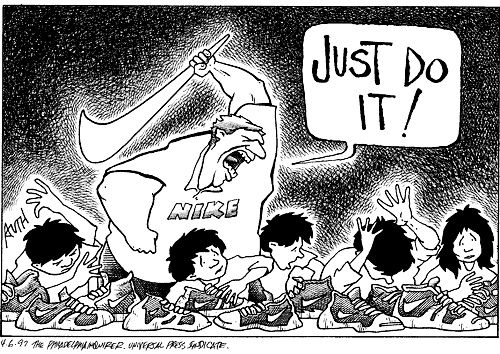
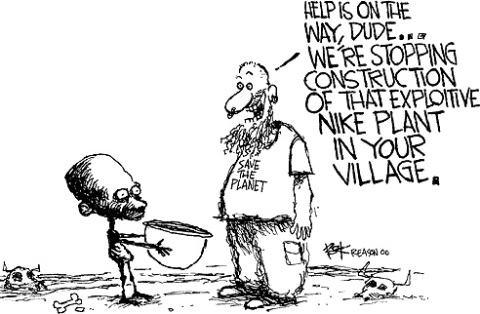
While I do agree that Nike had acquired some bad publicity in regards to it’s poorly regulated production processes (that brought to light it’s poor business ethical behavior) in the manufacturing process of it’s commodities, I feel that Nike can only be held partially responsible for it’s actions. This ‘bad reputation’ Nike has accumulated by sourcing for cheaper labor (I strongly believe) is; or was at some point; secretly practiced amongst many other big firms in many different industries. Neither Nike, nor any other large corporation was the first (and only) to commit such a ‘horrible’ act against ethical business practices.

74940fa75bc3aa8b31f648c3e35ad624

Having said that, I encourage you to think (and have an open mind) about it this way: by sourcing for labor from impoverished areas, they indirectly instigate growth in the economy as they stimulate job opportunities for the vulnerable. Children and adults, whom would otherwise be left with little to no alternatives other then to turn to the sex trade, selling their bodies for money, can now enjoy sustainable jobs.

nike-sweatshop-cartoon3

Do not be mistaken though; our general views do not differ. I did not support Nike’s actions then, and am happy as a consumer to note that Nike is trying to make an amends in the eyes of the public in regards to correcting it’s business ethical behavior and tailoring it’s manufacturing process (even if its just a little change) to improve itself as a reputable corporation.


Picture bib:

https://www.pinterest.com/pin/99571841737365646/

http://sacredcowchips.net/page/2/

100% Canadian.Lululemon love.Sales.unhappy stakeholders.


Coming to Canada and being exposed to the local favorites (brands) the city has to offer was both a delight as well as an eye opening experience for me. Drawing from my first Blog post (2nd last Blog post), I was very taken in by the local iconic brands unique to the region. Roots, Tim Hortons, Hunter Boots – and yes – the ever-popular Lululemon!

lululemon rain or shine jacket 234234

Having discovered the brand in late September, I was intrigued by how popular their wares were! People striding up and down the university walkways with their Lululemon hoods drawn close to their brow, bombarded by kisses from the afternoon rain.


Yoga pants are very popular here too, aye?


This got me thinking, with Lululem’s success and popularity amongst such a large customer base, why then did it still have such high inventory stocks left idol???


Some might justify the firm’s overproduction of their commodities to be intentional. This would allow the firm to engage in intentional ‘clearance’, and ‘warehouse’ sale events that would inevitably attract more customers with lowered prices. Other’s believe it’s negelegence and inefficiency on the part of the firm that allowed an overproduction (and otherwise known as misallocation of resources – dragging down net profits) to occur.


I side with Ritual’s ‘s point of view wherein her blog addresses the issue of Lululemon’s  misallocation of resources into the over production of its commodities. I believe the access inventory stock works as a double edged sword, Though some customers stand to gain from the promotion of sale items, the business and it’s are stakeholders ultimately threading a very fine line between making a profit or losing significant revenue. This risk would deter most potential stakeholders from investing in the future.


Bibliography:

Ritual’s Blog Post:

LULULEMON: YOGA,PEACE,LOVE, HIGH INVENTORY?

Jonathan Ratner. “Lululemon Athletica Inc Has More Inventory Problems.”Financial Post Lululemon Athletica Inc Has More Inventoryproblems Comments. N.p., 23 Mar. 2015. Web. 04 Oct. 2015


Picture bib:

http://www.luluaddict.com/2014/12/new-resolution-hobo-bag-stress-less.html

Categories
Uncategorized

Change the world, one good deed at a time

The essence of a strong positively enforced brand image can be derived from the actions and affiliations a firm decides to partake in. A prospering business (with strong moral backing) always takes into account two key concepts that play a part in decision and production processes throughout each stage of their commodities production and sales. These are, ‘CSR’ and ‘Competitive advantage’. The link between these two is none other than the company’s ability to ‘create shared value’.


Creating shared value is both highly admirable and often at times may arise in the form of some sort of social/moral donation.


Addidas had partnered with Nobel Laureate Muhammad Yunus’s micro-finance organization based India to manufacture shoes at a low cost for the poor in Bangladesh.


Similarly, the popular household name Heinz also initiated a ‘micronutrient campaign’ to both raise awareness and combat child / infant iron deficiency and malnutrition.


These acts do not benefit the company financially, with businesses many a time shelling out extra (otherwise non-distributed income) to create more values’ worth for their clients and social groups around them.

These are but two examples of how companies create shared value for their consumers and the community both regionally (Addidas) or Globally (Heinz).

In the long run, these kind acts will circulate through word of mouth and prove very effective in the way clients and observers view the brand and thus build up it’s brand image.

The sunset trade

Innovation is the lifeblood of progress! As a community we often seek to better our lives by making them easier and thus more efficient. Innovations and breakthroughs through research and technology have played a vital role in influencing the lives we lead today.


However; having said that; the question ‘what is the cost of innovation?’ comes to mind.


What is our opportunity cost as we constantly pursue the future?

Those the introduction of innovation disrupt or upset the consumer structures of related goods and how they are consumed?

The introduction of certain types of innovation may lead to a structural reform in the way by which consumers choose to consume a product. Therefore the cost of innovation can sometimes lead certain industries to become at a disadvantage, effectively uprooting them and leaving them obsolete.


The introduction of mass online storing facilities such as sound cloud, drop box and even desktop file storage space, accompanied by the transition of film cameras to digital ones, has had an adverse effect on the photo album industry.


PT Tommy (Indonesia) is a photo album-manufacturing firm.

Capturing market dominance in Jakarta, the monopoly failed to assess why it’s competitors were leaving the industry before it was too late..

It now operates in a sunset trade, wherein the industry is shrinking.

bgindex1

It is ironic how originally photo albums and cameras were both complimentary goods to one another; but with the introduction of an innovative new idea; turned tables and became foils to one another. The innovation of both the transition of film to digital cameras, accompanied by the revolution of online storage facilities brought a prospering industry to it’s knees. Photo albums became obsolete as consumers adopted the more efficient and cost saving online storage to store their photographs. Such is an important lesson, to both appreciate and be weary of innovation and all it’s splendor as well as it’s consequences.

This is a common example of disruptive innovation at it’s finest.


pic bib:

  • http://www.tmialbum1.com/

Spam prevention powered by Akismet