Here I have my thoughts on the growth of my Big Idea project throughout the term. This project went through many iterations and ended up being a more intuitive and emotional engagement with Indigenous women’s role as filmmakers than I originally intended. My Lit Review contains a lot of sources that I did not include in my final paper that I feel would be helpful for a more academic expansion of the ideas I pursued in this project.
FNIS100TermPaperShannonRobinson
Category: Academics
So far this semester this class has truly been a pleasure to attend. Taking it has allowed me to engage with exciting readings and thoughtful discussion. It has lead me to greater understanding of intellectual placement and positionality as well as strengthened my understanding of my own relationship to land and ongoing histories. It has definitely outlined many of the complexities in the relationship between the institution of the university and the Musqueam community upon whose unceded traditional territory we work and study on. It has also reminded me to be mindful of my own homeland in the traditional territories of the Blackfoot and Cree peoples of central Alberta. This is something I carry with me and work to acknowledge the territories properly. Understanding my placement on the land is central to proceeding with both the continuation of my degree and my personal practices in a responsible way. In this course, students will learn how to give a proper land acknowledgement and this is something I now always do before a presentation at the University.
FNIS 100 is a great introduction into many vey important topics. Students have the opportunity to engage with a multitude of different materials. Contents of the syllabus ranges from novels, scholarly academic papers, poetry and film and there is so much material to explore! The multiplicity of the syllabus is a great taster of the sorts of materials that await students who choose to continue in the FNIS program. Students have the opportunity to begin a foundation of decolonial analysis and are educated on everything from Indigenous law to Indigenous representation in film.
The concepts that this course provides are essential to anyone pursuing a degree (or interest) in the field of critical gender and race theory, history (particularly Canadian history, as a lot of the focus is rightfully within the context of the Northwest Coast). In short it is an amazing class packed with information and a great intro into UBC’s FNIS program.
Reflect & Connect
So far this semester this class has truly been a pleasure to attend. Taking it has allowed me to engage with exciting readings and thoughtful discussion. It has lead me to greater understanding of intellectual placement and positionality as well as strengthened my understanding of my own relationship to land and ongoing histories. It has definitely outlined many of the complexities in the relationship between the institution of the university and the Musqueam community upon whose unceded traditional territory we work and study on. It has also reminded me to be mindful of my own homeland in the traditional territories of the Blackfoot and Cree peoples of central Alberta. This is something I carry with me and work to acknowledge the territories properly. Understanding my placement on the land is central to proceeding with both the continuation of my degree and my personal practices in a responsible way. In this course, students will learn how to give a proper land acknowledgement and this is something I now always do before a presentation at the University.
FNIS 100 is a great introduction into many vey important topics. Students have the opportunity to engage with a multitude of different materials. Contents of the syllabus ranges from novels, scholarly academic papers, poetry and film and there is so much material to explore! The multiplicity of the syllabus is a great taster of the sorts of materials that await students who choose to continue in the FNIS program. Students have the opportunity to begin a foundation of decolonial analysis and are educated on everything from Indigenous law to Indigenous representation in film.
The concepts that this course provides are essential to anyone pursuing a degree (or interest) in the field of critical gender and race theory, history (particularly Canadian history, as a lot of the focus is rightfully within the context of the Northwest Coast). In short it is an amazing class packed with information and a great intro into UBC’s FNIS program.
Big Idea Prospectus
In this project I have centered my research around the history of Indigenous representation in film, with a particular focus on the representations of Indigenous women. I began my line of interest with a discussion based around Neil Diamond’s 2012 film “Reel Injuns”, which gives an archival perspective on Indigenous representations in film and the ways in which the film industry has contributed to ongoing colonial violence. Diamond’s film is functional as an introduction to concepts of Indigenous representations in the film industry, however, it is mainly concerned with the representation of a masculine Indigenous identity. This viewpoint does not challenge colonial stereotypes or serve to deconstruct colonially imposed gendered binaries. There is very little inclusion in the film of an Indigenous feminist perspective or of any perspectives that are grounded in queer theory. This not only erases Indigenous women from the history of film, but also fails to explore the ways in which Indigenous women’s contributions to film and media have worked towards resurgence and decolonial practice. My main interest in the project is to jump off from this point and develop a deeper understanding of the film industry’s representation of Indigenous women and how that relates to ongoing colonial violence. I aim to set up Indigenous women’s work in film as an act of reclaiming autonomy on the screen and subvert colonial gender hierarchies to move towards a place of healing and resurgence.
Because the focus of my project is film, much of my research consists of films that were made by Indigenous women. I plan to use these sources as a means of steering the investigation away from just the representation and explore Indigenous women’s contributions and labour in film. These films explore themes and ways of being that I feel are not touched upon in Diamond’s film. I hope to construct an argument around the idea that Indigenous women’s work in film is creating a visual language of healing. I plan to use the films such as Helen Haig-Brown’s “My Legacy” and Elle-Máijá Tailfeathers’s “Bloodland” and “A Red Girl’s Reasoning” to build an understanding of how the ongoing effects of colonial violence and intergenerational trauma work in the lives of Indigenous and effect the health of bodies and relationships and also present different narratives of resistance. My scholarly sources will help to articulate these thoughts and also provide some background for Indigenous women’s role in the film industry. I also want to look at the Embargo project, particularly its second iteration, which incorporates work from Tailfeathers and other female Indigenous filmmakers, to build a visual narrative of solidarity. Films that are part of this project, such as Alethea Arnaquq-Baril’s “Aviliaq (Entwined)” work towards a narrative of collective collaboration, mutual solidarity and visual sovereignty. In my scholarly research, I am curious to see if the narratives of love and resistance that are present in the films are explored or if these scholarly sources focus their discussion mainly on more surface questions of representation. I am interested in discussing the practice of filmmaking and its relationship to love, resistance and solidarities between Indigenous women.
Literature Review
-Beadling, Laura R. “Reel Indigenous Women’s Lives: Female Protagonists in Films by Indigenous Women” Rocky Mountain review (Rocky Mountain Modern Language Association) (2016) Vol 10 pp 133
The value of this source is that it provides a rare look at the ways in which Indigenous women depict themselves and other Indigenous women in film. This source provides a lens that focuses strictly on the self-representation of Indigenous women. It is not a response to colonial representations of Indigenous women’s identities.
-Brady, Miranda J. “Gender and state violence: films that do justice to the issue of missing and murdered Indigenous people in Canada” Feminist Media Studies (2016) Vol 16 (5) pp 918-922
This might be useful in an exploration of violence, particularly violence perpetrated against Indigenous women, in film. I am hoping that this source will provide examples of the ways in which colonial violence can be interrogated through film and media.
-Demers, Patricia. “Location, Dislocation, Relocation: Shooting Back with Cameras” from Indigenous Women and Feminism. UBC Press (2010)
This source provides insight into the ways in which Indigenous women’s filmmaking practice relates to efforts of resurgence. It explores the ways in which Indigenous women use filmmaking to connect with land, identity and community.
-Dowell, Kristin L. “Sovereign Screens: Aboriginal Media on the Canadian West Coast” University of Nebraska Press (2013)
This source would provide some contextual background information on the Indigenous film industry in Canada. This would be useful in expanding my understanding of Indigenous filmmaking and practices of representation.
-Gauthier, Jennifer L. “Embodying Change: Cinematic Representations of Indigenous Women’s Bodies: A Cross Cultural Comparison” International Journal of Media and Cultural Politics (2015) Vol 11(3) pp 283-298
-The Cave (2009)Dir. Helen Haig-Brown
This film by Haig-Brown provides an example of Indigenous self-representation in film. It explores relationship to culture, ancestral knowledge and implications of dispossession.
-My Legacy (2014) Dir. Helen Haig-Brown
This documentary film by Haig-Brown is intensely personal. It is an exploration of Haig-Brown’s ability to love while navigating the effects of intergenerational trauma and violence. This film, like others here, has a narrative of Indigenous women’s healing through love and confrontation of violence.
-“A conversation with Helen Haig-Brown, Lisa Jackson, and Elle-Maija Apiniskim Tailfeathers” Biography (2016) Vol 39 (3) pp 278
Useful source in analyzing perspectives of various female Indigenous filmmakers. Different insights into practice, production method and motivation.
-Gauthier, Jennifer L. “Dismantling the Master’s House: The Feminist Fourth Cinema Documentaries of Alanis Obomsawin and Loretta Todd” Post Script (2010) Vol 29 (3) pp 27
An exploration into the power of film in resurgence. The focus of this piece are Indigenous documentary filmmakers who have navigated a careful relationship between the film industry and their own ethical practice.
-Greyeyes, Michael. “He Who Dreams: Reflections on an Indigenous Life in Film.” Theatre Research in Canada (2008) Vol 29 pp 110-128
A performative text originally delivered as a speech by Greyeyes. This text provides a first-hand indigenous perspective on a life in the filmmaking industry. Shows how Indigenous people may work to subvert stereotype and reclaim representation through film.
-Johnson, Brian D. “Hollywood’s Shocking Reel Indians” Mclean’s (2010) Vol 123 pp 59
A mainstream review of the film “Reel Injuns.” This provides a non-indigenous reaction to the film and may contextualize the function of Diamond’s film as a subversion of colonial understandings of Indigenous identities.
-Marubbio, M Elise. “Native Americans on Film: Conversations, Teachings and Theory” The University Press of Kentucky (2012)
A book that would provide a more rooted understanding of Indigenous perspectives of the film industry.
-“My Legacy Interview with Courageous Filmmaker Helen Haig-Brown” Muskrat Magazine (2014)
http://muskratmagazine.com/my-legacy-interview-with-courageous-filmmaker-helen-haig-brown/
An interview with Haig-Brown that would provide more insight into her practice and motivations. I am becoming more interested in focusing on female Indigenous filmmakers as well as in representations of Indigenous women in film (where I am having a hard time finding academic sources for some reason)
-Randolf, Lewis. “Alanis Obomsawin : the Vision of a Native Filmmaker” University of Nebraska Press (2006)
A source that provides a comprehensive understanding of Obomsawin’s practice as a filmmaker and her relationship to the film industry.
-Ryle, Jason. “IndigiTALKS!” Cineaction (2016)
A panel featuring Canadian Indigenous filmmakers Alanis Obomsawin, Alethea Arnaquq-Baril and Tracey Deer
Another discussion between female Indigenous filmmakers providing insight into practice and representation.
-Bloodland (2011) Dir. Elle-Máijá Tailfeathers
A very important source. This film focuses on Indigenous women’s bodies and relationship to land. It is a critique of the settler-colonial exploitation of land and resources that illustrates the relationship between Indigenous women’s body and personhood and the land. Would be interesting in comparison with a colonial representation of Indigenous women’s bodies.
-A Red Girl’s Reasoning (2012) Dir. Elle-Máijá Tailfeathers
Another film that uses physicality to critique colonial violence. This also parodies action films, echoing cinematic tropes. It provides a synthesis of Indigenous perspectives and traditional or recognizable filmmaking practices.
–Thompson, Isha. “Reel Injun Shows Native People are Real Funny.” Windspeaker. Edmonton (2010) Vol 28 pp. 15
A review of the film “Reel Injuns” fromly widely circulated Indigenous publication Windspeaker. Could be juxtaposed with a mainstream review.
-Turner, Kristina. “’It’s living and breathing in this generation’: A conversation with Helen Haig-Brown” rabble.ca (2014)
‘It’s living and breathing in this generation’: A conversation with Helen Haig-Brown
Another conversation with Haig-Brown that provides more of a history behind her work. Important for contextualizing her work.
– Victor, J., PhD., Linds, W., PhD., Episkenew, J., PhD., Goulet, L., PhD., & Benjoe, D. “Kiskenimisowin (self-knowledge): Co-researching Wellbeing With Canadian First Nations Youth Through Participatory Visual Methods” International Journal of Indigenous Health, 11(1), 262-278.
This is the only research based source I have included. I think it would be interesting to include an exploration of the effects of practices of representation on the well-being of Indigenous youth to provide a more solid understanding of why representation is important.
Representation in ‘Reel Injun’
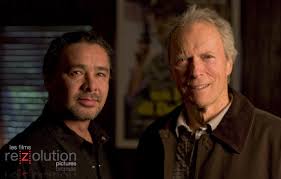
As I outlined in my Big Idea summary, the preliminary source I am using to start my research is the film “Reel Injun” from Cree director Neil Diamond. I was exposed to this film in another class and, while I found it entertaining and a good introduction to Indigenous people on film, there are several opportunities for critique or further investigation. This film follows the production of the “Hollywood Indian” through various historical periods, beginning with the very first motion pictures and leading to forms of representation in the present day. What I am hoping to use from this source is a historical outline of the Hollywood production of Indigenous identity and how these productions have served to both help and hinder Indigenous peoples’ fight for sovereignty and self-determination.

The area that I am most interested in exploring is the gulf that exists in the representation of Indigenous women and queer Indigenous bodies in film. Much of this film deals with the construction and representation of a specific form of Indigenous masculinity. This construction presents an understanding of Indigenous identities that closely adhere to settler colonial gender dynamics and doesn’t explore the decolonial power of representations of Indigenous identities that fall outside of these dynamics. This leaves very little room to establish a decolonized representation of Indigenous peoples, particularly through representations of gender and sexuality. Other than in a few short segments, the film is largely lacking an Indigenous feminist perspective or any sort of investigation into the harmful narrative of certain kinds of masculine identities. This all serves to build harmful stereotypes of Indigenous people that reach a broad audience, forming settler society’s perceptions of Indigenous peoples and inhibiting Indigenous peoples’ ability to control representation and present cultural identities and practices. Deconstructing these forms of representation works towards presenting a decolonized view of Indigenous identities. The ability to use new media to tell stories, perform identity and build healing forms of representation is an important aspect in resurgence and resistance.

In my research I hope to incorporate scholarly sources as well as other films that both illustrate the harmful nature constructions of Indigenous masculinities that enforce the colonial apparatus. I also hope to provide sources that illustrate the healing power of representation through film as a form of story telling that decolonizes gender dynamics by deconstructing or removing the forms of representation that I will discuss in my exploration of the film.
Big Idea Summary
For this project I have chosen to focus on the representation of Indigenous peoples in film and media. My main interest is in dissecting the ways in which Indigenous identities are produced and represented in mainstream film and media. A lot of my thinking comes from the film “Reel Injuns”, which works to give a brief history of Indigenous representation in Hollywood film and media. While the film does offer a strong critique and solid timeline of Indigenous representation in film, the colonial implications of these stereotypes and produced identities needs more exploration.
Using the film as a jumping off point for my thinking, I hope to examine the ways in which the production of a hyper-masculine, mythological presentation of Indigenous peoples serves a colonial agenda. I am interested in examining this subject with forms of Indigenous feminisms in mind. I aim to explore the representation of Indigenous women and queer identities and the ways in which these means of representation subvert colonial narratives and offer pathways to resurgence. I would like to compare these forms of representation with the ways in which Indigenous identities are produced in Indigenous film and media
1.Representation of women and queer identities in Indigenous film and media.
2.Relationship between Indigenous artists/producers or cultural belongings on the West Coast to the world of art consumption or institutions (such as MoA).
3.Indigenous women’s role at the forefront of direct action and resurgence movements (#IdleNoMore, #NoDAPL).