Theoretical and Professional Foundations for Nursing Practice
In NURS 300, Dr. Lydia Wytenbroek asks groups of students to choose a topic related to a course theme and present their research on that topic in a creative format of their choosing (called an UnEssay). In late November, students showcased their projects at an UnEssay Exhibition. This page documents select unessay assignments created by students in NURS 300 during the Winter 1 2025 semester. This blog site was curated by BSN student Savannah Makarowski and Dr. Lydia Wytenbroek.
“Ugh, I have to chart”: The Evolution of Charting

Documentation is an important component of nursing practice, with nurses spending 30-40% of a given shift charting. How did this come to be? This project explores the evolution of charting from ancient times to our contemporary moment. We argue that charting shaped the evolution of the role of the nurse & the evolution of the role of the nurse simultaneously shaped charting practices. When documentation focuses on medical aspects of care, rather than holistic or relational aspects of nursing care, it reflects a hierarchy in which actions and ways of knowing are the most valued (Karkkainen et al, 2025). When documentation reflects the nursing process (i.e. ADPIE or DARP charting) it demonstrates the unique contribution and value of nurses. Charting can also shape the way that nurses think and make clinical decisions. We argue that changing documentation practices over time reflect changing social mores, healthcare values, and the evolving role of the professional nurse.
Our project included a a game in which the user was given an image of a type of chart record and the user had to guess where it should be placed in a “timeline” of other charting examples.
Nursing Sisters… Where Did They Go?
Exploring Nurses’ Wartime Experiences and their Postwar Disappearance

World War Two saw an expansion in the Canadian nursing workforce. Nurses working with the Canadian army took on expansive roles due to overwhelming casualty rates. However, when they returned to Canada after the war they faced restrictions on their skills and practice. They were also encouraged to return to domestic life. Our project focuses on the limited transfer of wartime nursing knowledge and skills back to civilian hospitals after the war. We created a series of fictional letters from Lieutenant Jane Doe to her nursing colleague in Canada, which were inspired by real correspondence and oral testimonies from Canadian Nursing Sisters during WWII. The letters highlight nurses’ key responsibilities across various war fronts, such as administering penicillin, triaging casualties, treating wounds, providing psychiatric care and preforming blood transfusions. Thus, “Jane Doe” represents a compilation of Nursing Sisters’ firsthand accounts.
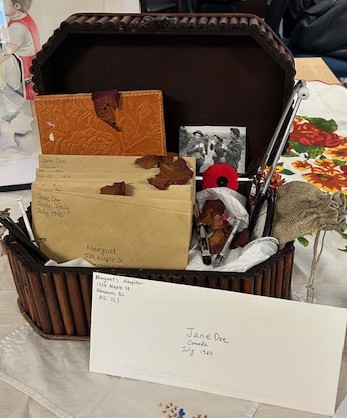
The letters written by Jane Doe serve as a contrast to Margaret’s nursing practice at a Canadian hospital which was more limited. Although Nursing Sisters achieved significant autonomy during the war, many returned to a society that pressured them to leave the profession for domestic life. Upon Margaret’s death, her daughter discovered the correspondence and writes to Jane herself; we use that letter to illustrate how damaging the post-war image of the nurse was to the profession. We also created a propaganda-inspired poster (hand-drawn!) to capture and contrast nurses’ wartime vs. postwar nursing experiences. We asked our audience to read the statement “The Nursing Sisters were…” and then write a slogan that reflects the dichotomy between the two eras. Our project acknowledges the contributions and innovations of Nursing Sisters to the profession.
The Evolution of Street Nursing in Vancouver

This project mimics the iconic street-nurse bag seen in the documentary “Beveled up.” It is designed as an “exploding box” to honor the wide-reaching impact that historical street nurses have had on present-day harm-reduction practices and the continued expansion of accessible healthcare within Vancouver, British Columbia. Also seen in the image is a shirt representing “DULF” the Drug Users Liberation Font compassionate club that has been attempting to bring in safe supply drugs to the Downtown Eastside (DTES).

The box opens into an interactive poster display of pivotal time periods to the development of street nursing consisting of: 1700s/1800s, 1970s-1990s, 2000-2010s, 2020-2025. Each time period was represented with its own stylistic elements, such as varied fonts, visuals, and layout choices to reflect the distinct stages of street-nursing evolution within that time period. It includes interactive elements, such as a scroll, a zine, a box you can open with a flipbook inside, and pockets which contain additional information.
At the center of the box sits a diorama of a mobile health clinic van commonly used to reach underserved areas, representing how street nurses provide care directly within community environments. We also included harm reduction supplies to show how street-nursing resources have evolved in response to changing health needs and what you might see in a street nursing bag.
Unveiling the Contributions of the Forgotten Nurses of World War Two

During World War Two, nurses drove major advancements in medical ethics, technology, skills and education. These contributions laid the foundation for contemporary nursing practice and the expansion of the role of the nurse. Our project argues that nursing contributions during World War Two shaped modern nursing. We created four shadow boxes which focus on innovations in nursing technologies, skills, ethics and education. For example, Bessie Blount was a nurse and an inventor of many assistive technologies, including an electric self-feeding machine for veteran amputees. Another shadow box explores the work of Marie Stromberger, who was part of the resistance movement and became the head nurse at Auschwitz so she could smuggle information in and out of the camp and deliver food and medicines to imprisoned Jewish people. The shadow box on Stromberger includes a scale (to represent justice), letters in a bottle (to represent document she smuggled out of Auschwitz) and a Red Cross emblem (to represent her nursing affiliation). Our research emphasizes the moral duty of nurses to advocate for patients. The shadow box on the US Cadet Corps explores how nursing education moved from the hospitals into the classroom, introduced the first accelerated nursing program and enabled BIPOC nurses to enroll. Finally, the shadow box on Captain Archibald, a Canadian nursing sister, shows her collecting her own blood to be repurposed for a blood transfusion.
Nurse Who?: Influential Indigenous Nurses in Canadian History
Why have Indigenous nurses’ contributions to nursing and health care been marginalized in nursing histories and professional discourse? This question was the starting point for our project. From the 20th century to the present day, Indigenous nurses have worked across clinical, community, political and educational settings often navigating discriminatory policies and colonial health structures in the process. Yet their vital contributions are often overlooked due to colonial bias, systemic racism and the historical erasure of Indigenous Peoples in mainstream narratives. We argue that the nursing profession in Canada would not exist in its present form without the vital contribution of Indigenous nurses and our project demonstrates how Indigenous nurses’ innovations, advocacy, cultural knowledge, and leadership shaped Canadian nursing.

To communicate Indigenous nurses’ contributions to a wide audience, we created a board game inspired by the format of “Guess Who?” The game board consists of 22 flip-tiles and each of these tiles features an Indigenous nurse with symbols that represent their contributions to nursing and healthcare. Players draw from a set of laminated profile cards that contain expanded biographies and are prompted to ask about a nurse’s education, work, leadership, professional affiliations, and so on. This format invites players to learn each nurse’s name and their specific contributions to nursing.
Digitalization in Nursing Practice: Implications for the Nurse-Patient Relationship

Telenursing in North America has expanded from phone lines in the mid-20th century to videoconferencing, remote monitoring devices and digital applications which enable nurses to assess patients, provide education and emotional support, coordinate care, and promote equitable access (Field, 1996; Borromeo et al., 2025). Effective virtual relationships can achieve a level of presence comparable to in-person care when nurses adapt communication strategies and maintain technical proficiency. Telehealth can enhance continuity, trust, and culturally safe care for equity-deserving populations by reducing travel barriers and increasing patient comfort. However, telehealth is not universally appropriate, particularly for individuals facing sensory, cognitive, or technological barriers, and should often supplement rather than replace in-person care. Nurses must apply clinical discretion, assess safety and privacy risks, evaluate digital health literacy, and advocate for balanced care to support shared decision-making and patient empowerment..
Cards For Humanity: Telehealth Edition: In this game, each player’s hand of response cards demonstrates how telehealth nurses must respond based on a specific set of telenursing skills. Patient cards and challenge cards aim to describe the diverse populations that telenursing serves. Each face-off invites players to discuss patient needs and optimal interventions, perhaps beyond what is explicit in the card deck.

The Building Blocks of Medication Safety: How Nursing Standards Prevent Errors

The BCCNM Medication Practice Standards highlight a nurse’s responsibility around mediation administration and help to preventative medication errors. Our group created utilized the medium of the popular game, “Jenga.” Each block represented a medication standard principle and had a real case study example in which the principle was used or ignored. As our peers engaged with the Jenga tower, they could see how removing one “block” weakens the whole structure. This visual representation demonstrates that neglecting even one standard can jeopardize patient safety. The poster board includes a brief explanation of each of the 25 principles and their role in preventing medication errors. Canadian research show substantial medication-related harm across care settings. In hospitals, 1 in 17 acute-care stays involved at least one potentially preventable harm, including medication incidents (CIHI, 2025). Nineteen percent of hospital RNs reported medication errors involving their patients occurring “occasionally” or “frequently” in the past year (Statistics Canada, 2015). Of the 26,000+ medication-incident reports submitted in 2024, incorrect dose or frequency were the most commonly cited (ISMP Canada, 2025; NIDR, 2024). Our project makes the argument that nurses need to be aware of medication administration principles and understand how they can employ strategies to prevent medication errors.
BCCNM Professional Standards: “The Burn Book”

This project explores the importance of policies that guide nurses’ social media use. This topic requires critical analysis during a new age of technology, as improper social media usage in healthcare settings impacts the safety and well-being of staff and patients. Exploring the limitations of the BCCNM policies, our group seeks to advocate for stronger policies regarding social media usage in the nursing workplace.
Our project took the form of a “Burn Book” inspired by the movie Mean Girls, featuring real documented cases of nursing social media violations. Each page included a true story of a nurse who misused social media and the consequences they faced. Although the original concept of a burn book is to spread hate and gossip, the intention of our mode of delivery is not to incite hate but to advocate for the creation of social media policies and respective repercussions. We argue that social media policies in nursing serve a dual purpose: protecting patient confidentiality while preserving professional credibility. Ultimately, these policies establish nurses as trustworthy stewards of both private health information and public health standards.