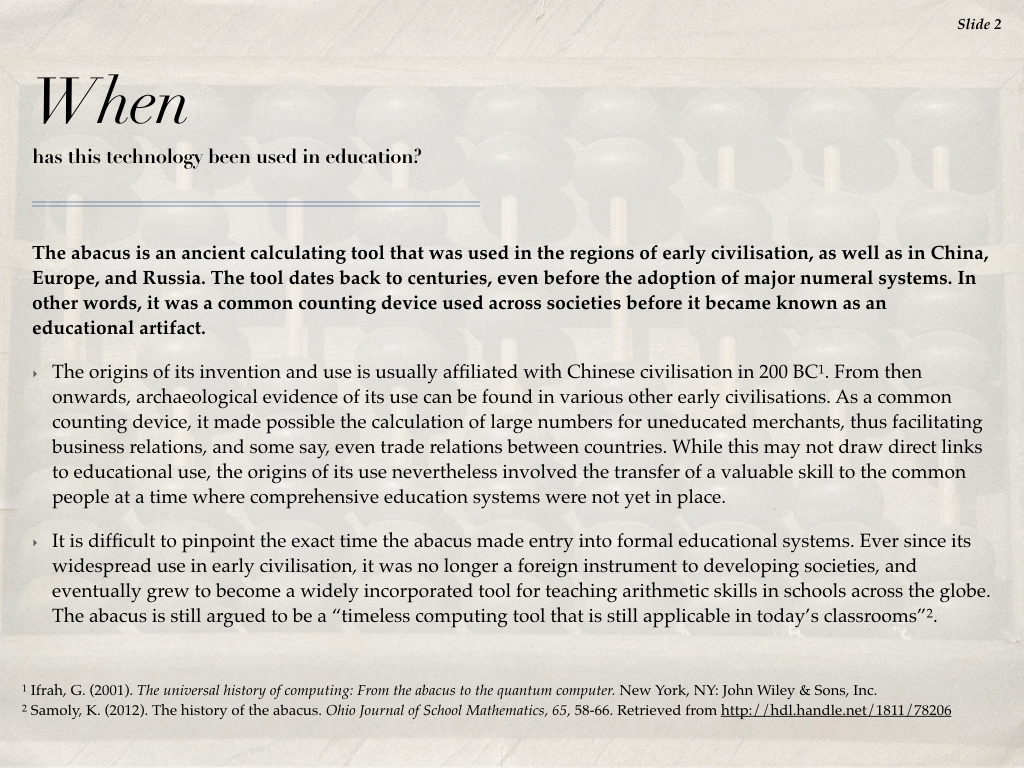
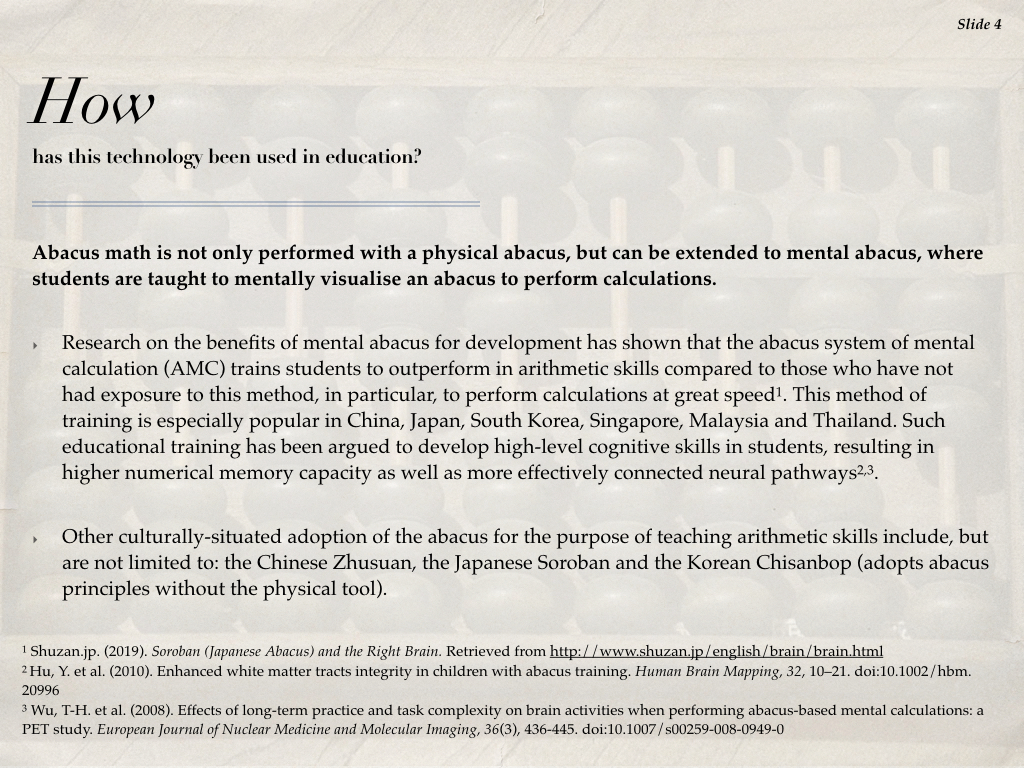
In Topic 2, I situated the abacus as an educational tool within McLuhan’s (1988) “tetrad”.
I recall struggling, in particular, with the question of what it reversed. The abacus is an ancient tool that was significantly interwoven into socio-cultural and economic practices before it became widely known and used for educational purposes. Of importance is its shift in instrumental value — it began as a dominant tool for transactional relations, to being an educational artifact following the support of brain research. Does this merely present a change of its use, or does it indicate more significant “entanglements” between humans and objects?
New materialism recognizes the “entangled and material nature of humans, discourses, machines, objects, other species, and the natural environment” (Frodeman et al. as quoted in Toohey, 2018, p. 25) in identifying the non-dualistic, non-essentialistic continuum of organic life that pervades the world we live in. Fenwick and Edwards (as quoted in Toohey, 2018, p. 27) argue that material things have agency and thus perform; acting together with other things and forces to “exclude, invite and regulate particular forms of participation”. In other words, human activity is not the sole source of governance – neither is it a fixed nor determinable quality – rather, people, animals, objects, and discourses are embedded in a perpetual process of becoming, in relation to and with one another, essentially, engaging in intra-action.
How does this affect my initial characterization of the abacus? I struggled with understanding my own interpretation of what it reversed — the reason for my limitation has now been made obvious via a new materialistic lense. I was constricted by a false duality in analyzing technological development; as if the attitudes, discourses, and even the natural environment surrounding the use of the abacus were of no significance to its value; as if it belonged to its own track of “becoming”.
Barad (as quoted in Hill, 2018) promotes a diffractive method of analysis situated within an agential realist ontology which asserts that reality is continuously (re)constituted through material entanglements. In attempting to compare the abacus to what it reversed as a form of fixed “best practice”, I had failed to consider the open-ended material-discursive realities that surrounded its use; conditions that materialized in the moment. Thus, to ask “what if other methods had taken root?” is not merely a consideration of possible alternatives, even more, it questions the non-human power and performativity that pervaded and maintained the “assemblage” that is the abacus, as a tool entangled in processes of becoming between both human and non-human entities that had given rise to particular, situated, provisional outcomes.
References
Hill, C. (2018). More-than-reflective practice: Becoming a diffractive practitioner. Teacher Learning and Professional Development,2, 1-17. Retrieved from http://journals.sfu.ca/tlpd/index.php/tlpd/article/viewFile/28/pdf
McLuhan, M. (1988). Laws of the media: The new science. University of Toronto Press
Toohey, K. (2018). New materialism and language learning. In Learning english at school: Identity, socio-material relations and classroom practice. Multilingual Matters: Bristol.
Diane Ravitch is an education historian, an educational policy analyst, and a research professor at New York University. She was also the former U.S. Assistant Secretary of Education. She has a significant influence in the field as evidenced by her heavily cited bodies of scholarly work alongside her public and professional roles within the education community.
She has over 150,000 followers on her Twitter account where she frequently tweets and retweets on the social and political implications of current educational policy, research, innovations, and myths. Additionally, she writes extensively on her blog at http://dianeravitch.net. With over 100,000 tweets, it is apparent that she is committed to the field of education beyond scholarly pursuits in cultivating serious contributions to the education debate via public discourse on Twitter. It would be difficult to summarise her thoughts on educational issues due to her high activity, but based on a quick exploration alongside supplemental articles elucidating her tweets, some key ideas can be identified:
Ravitch is a staunch supporter of public education and publicly airs her views on educational reform efforts that promote and fund its advancement, as well as conflicting activities that undermine its value.
Ravitch (2016) identifies an existential threat to the future of public education in the case where legislators directly intervene in school reform based on media stereotypes without truly understanding the condition and potentials of public schools. She argues that modern reforms, particularly the call towards the privatization of schools (Ravitch, 2013), has caused educational systems to stagnate. Underlying such movements are economic and business narratives that are not driven by the priority to help society become more literate and better educated. Her views garner support from school teachers who retweet her views in their circles.
It is important to note that multiple layers of sharing are mediated via Twitter. The content of the tweet above was first shared on Ravitch’s personal blog; its post URL was then shared on her Twitter feed; the post catches her followers’ attentions who then retweets her blog link – now adding their support to her discourse (“Ravitch likes it a lot”); which Ravitch then retweets as a show of the support that her views have gained. As such, the ability to share and remix allows Twitter to become a window whereby current attitudes and beliefs are circulated between overlapping and even new circles that go beyond Ravitch’s direct sphere of influence. On the other hand, by this very nature, it also provokes the question of ownership (Marshall & Shipman, 2011). The way thoughts can be shared, re-used, or deleted causes one to question how much value a remixed artifact holds, as well as the honor it still affords to its source. Additionally, such social sharing practices enabled by the follow function on Twitter promote the rise of a “digital humanities community” (Grandjean, 2016) whereby “who’s following who” reveals the structure of a network’s relationship as well as identify users whose position is particular, in this case, Ravitch.
Ravitch promotes the use of comprehensive and balanced curricula in public education that promotes optimal self-development.
Ravitch (2012) argues that it is a public duty to empower good public schools with “adequate resources and a rich curriculum in every neighborhood”. She engages her followers in this direction by posting relevant context, likewise, users engage her attention by sending her relevant resources which she “validates” by the act of retweeting.
It would be naive to claim that Ravitch vouches for a curriculum-centered rather than learner-centered pedagogy based on her support for rich curriculums in public schools. However, her views bring to light the current curriculum crisis faced by schools as argued by curriculum theorists (Young, 2013), who observe that recent developments in curriculum theory have led to it losing its main “object” when it is not designed in a way that honors the learner’s entitlement to knowledge. A knowledge-based approach to curriculum design is reflective of some aspects in Piaget’s (as quoted in Good et al., 1978) cognitive learning theory which places focus on how learning is developed through the internal-processing of information. When public schools “understand” learning correctly, they are more likely to find meaning and consistency in their implementation of knowledge via balanced curriculum designs that promote wholesome self-development.
Ravitch identifies the consequences of inequity that plague education beginning from early childhood, as well as corresponding methods of knowledge-measurement that compromise student achievement and educational policy at large.
Ravitch (2012)argues that modern educational methods such as standardized testing only serve well to reflect gaps without closing them, thus, they should only be used for diagnostic purposes rather than for accountability. In this sense, it could be said that Ravitch rejects behaviorist approaches that center around measurable outcomes and the corresponding change of behavior via stimuli-response associations i.e. simplistic relationships between standardized testing and student results. Policy reforms that are driven by such results do not offer solutions to endemic inequalities in education, more importantly, do not promote optimal grounds for learning.
Ravitch engages in political debate relating to educational issues with reference to mainstream culture – differing from traditional academic scholarship – which invites public conversation.
A notable blurring of power takes place when, via Twitter, regular citizens not on Ravitch’s level of scholarship or influence can engage in short but direct discourse with her on pressing educational issues of a national scale. The “scalability” of her message is enhanced by the fact that it was posted on a platform that allowed for responses to be received from anyone and anywhere. While she retains the choice to highlight (retweet) certain opinions, it is important to note that her choice to highlight serious issues with reference to mainstream culture frames these issues in a way that allows for non-academic individuals to join in the conversation, and, in turn, provoke their deeper thinking.
References
Marshall, C. C., & Shipman, F. M. (2011). Social media ownership: Using twitter as a window onto current attitudes and beliefs. Proceedings of the SIGCHI Conference on Human Factors in Computing Systems, 1081-1090. doi:10.1145/1978942.1979103
Good, R., Mellon, E. K., & Kromhout, R. A. (1978). The work of Jean Piaget. Journal of Chemical Engineering, 55, 688-693.
Grandjean, M. (2016). A social network analysis of twitter: Mapping the digital humanities community. Cogent Arts & Humanities, 3. doi: 10.1080/23311983.2016.1171458
Ravitch, D. (2012). Diane ravitch tackles key education issues. Retrieved from https://www.educationworld.com/a_admin/rubin/election-education-issues-ravitch.shtml
Ravitch, D. (2013). Reign of error: The hoax of the privatization movement and the danger to america’s public schools. Manhattan, NY: Random House LLC.
Ravitch, D. (2016, October 11). Diane Ravitch on public education [Video file]. Retrieved from https://youtu.be/z5rFx9EZsHo
Young, M. (2013). Overcoming the crisis in curriculum theory: A knowledge-based approach. Curriculum Studies, 45(2), 101-118. doi: 10.1080/00220272.2013.764505
Having studied fully-online for half a decade, I have gotten used to certain modes of interaction that differ from the regular campus student. Perhaps the most striking difference is the lack of physical contact with an intellectual community that I, ironically, establish contact with on a daily basis. With this comes a stark difference in the way that I interact with knowledge, such as how I am stripped of the opportunity to respond in-the-moment when listening to an asynchronous recording, compared to the opportunity for reciprocity if I was physically present at a lecture.
While this might appear to be a simple change of setting, it reflects an appropriation of content from one medium to another constituting a process of remediation that holds important consequences to the recipient. According to Bolter and Grusin (2000), there is a “double logic” at play involving what they refer to as immediacy and hypermediacy. The former refers to the rendering of a medium as invisible by removing signs of mediation, while the latter refers to the exact opposite, the multiplicity of representations that heighten our awareness of media. Underlying these concepts is an appeal to the authenticity of experience — the insistence that the experience of the medium is, in fact, an experience of the real. Accordingly, it is through this promise of newer and more authentic experiences that cause immediacy to lead to hypermediacy; a double logic.
Take, for example, virtual whiteboards in learning management systems that allow for real-time teacher-student interactions. Bolter and Grusin (2000) argue that the way to achieve an authentic sense of the real is through transparent immediacy in which the interface erases itself so that the experience of the remediated content resembles the original content as much as possible. In this sense, virtual whiteboards succeed at creating a sense of synchronous activity resembling a live lecture, however, hypermediacy comes into play with virtual whiteboards that have an additional chat window function: in aiming to recreate the experience of classroom reciprocity, the presence of the chat window acutely highlights the discontinuities between the original and the remediation.
From this example, it becomes clear how remediation is, in fact, a defining characteristic of online learning, even more, it is an active process of meaning-making imbued with its own messages (McLuhan, 1964; Botler & Grusin, 2000). In any form of remediation, the call to authenticity of experience — and I would argue, the experience of learning in particular — remains vital to the online classroom. Particularly, in exploiting remediated forms of content, students should not be experiencing technology and media for learning, but rather, should be experiencing learning through the immediacy of such technologies and media.
References
Bolter, J.D.& Grusin, R. (2000). Remediation: Understanding new media. Cambridge, M.A.: MIT Press.
McLuhan, M. (1964). Understanding media: The extensions of man. Boston, M.A.: MIT Press.
1. What is it like for you, listening in to this lecture from 30 years ago in this elite educational setting? What kind of “media ecology” does the lecture create? In what ways is the formal lecture an “educational technology”?
The formal lecture as an educational technology can be seen, in simplistic terms, as a channel of knowledge transfer. The interactions take place in a confined space between a speaker and an audience for the purpose of sharing a specific body of knowledge in a more or less one-sided way (the audience remains silent for the most part). The idea of “knowledge” transfer, however, appears to be more complicated when interpreted through the lens of media ecology.
For the audience who were present in the setting thirty years ago, the lecture created a media ecology that was synchronous, allowing for the exchange of bodily interactions on top of the topic of knowledge that was shared. While the nature of a lecture does not create much room for verbal reciprocity between the speaker and listener, the immediacy and distance of physical bodies in a confined space still necessitates certain degrees of social reciprocity to be made. For example, you can tell the instances when Franklin (1989) appears to slow down in her speech as if to gauge the responses of her audience in helping her decide whether or not to elaborate or emphasize a point. This practice of discernment and discretion on the speaker’s part is eliminated in my case of listening to the lecture, thirty years later, in an asynchronous setting, even more, at a different time in history where social and political conventions surrounding the issues Franklin mentioned might have changed. This is turn affects the way I understand and respond to certain statements. Now if Franklin was in front of me to gauge my responses, would she have altered her speech? Would that form of reciprocity made available cause me to gain a different understanding of a point?
Franklin (1990) argues that the use of electronic technologies significantly alters the nature of communications — in the case of this lecture recording, the sound has been separated from its source which then places the emphasis on content and format rather than intent. In an educational setting, this “destructuring by asynchronicity” (Franklin, 1990, p. 168) plays out in significant changes in the learning process, such as how the transfer of values embedded in content that takes place in verbal communication — the immediate exchange of messages between people in the present — is compromised. This degree of compromise illustrates the media ecology that surrounds my asynchronous and decontextualized listening experience.
2. How do Franklin’s categories of “prescriptive” and “holistic” technologies apply to educational technologies?
Franklin (1989) distinguishes holistic and prescriptive technologies as different divisions of labor with corresponding social and political implications — the former focuses on “specialization by product” (akin to the notion of craft where the process of work is controlled by the creator from beginning to end), while the latter focuses on “specialization by process” (such as the industrial division of labor where the worker does not have ownership of the product but only plays a part in the production process). To expand, Franklin (1989) argues that holistic technologies build on a growth model, whereas prescriptive technologies build on a production model. The idea of growth implies something which can be nurtured and promoted, but not commanded; it implies a context through which such results come to be under particular (soil) conditions. Contrasting that is the idea of production which suggests that something that can be arranged, manipulated, externally controlled, even more, carried out independent of context — external variables are used to guarantee the success of a product, often according to the terms of an economic narrative.
The application of a holistic/growth model versus a prescriptive/production model in education holds very important distinctions. When educational technologies are envisioned out of context and created to be used in a way that is stripped from the foundational “soils” of learning, one runs the risk of relegating the educational experience to being a strictly specified “regimen” with the expectation of students being turned into specifiable products. Franklin (1990, p. 40) aptly observes that “the magic moment when teaching turns into learning depends on the human setting and the quality and example of the teacher” — this strongly relates to an environment of growth rather than the rigid, external parameters that are set in a production model. Under such a model, educational technologies are introduced to the field as “productive improvements” detached from context, starkly different from the idea of “soil-nurturing” in a growth model. In this view, in using educational technologies, it is imperative to ask: where and how is this learning taking place, and by whom will the benefits of this technology be reaped?
3. What differences did you see as you switched from listening to skimming to close reading? Were you able to experience the recorded lecture in any ways differently than when reading the text? Listening takes more “real world” time, so where did spending that extra time get you in terms of understanding? What things did you notice?
When listening to the lecture I found myself pausing frequently and replaying certain parts to take notes, or just to ensure that I understood what the speaker was trying to express. In some ways, a casual listening without note-taking is akin to skimming a reading — you get the gist of it but probably won’t remember half of it. A close reading of the text (with highlighting!), on the other hand, serves better to consolidate one’s understanding of a material when main ideas are identified and slowly digested. I am starting to see how over half a decade of online learning has conditioned me to approach study materials and “learn” in a particular way and form. While listening took more “real world” time, it didn’t particularly benefit my understanding of the text. In fact, if not for the additional note-taking, I might have even found listening time to be time wasted. I am now far too used to self-paced learning that the rhythms of a live lecture pose itself as a challenge to my own process of consolidation and understanding.
In a sense, I may have found (or have been conditioned to) a study method that works well to acquire “explicit” learning — the raw acquisition of skill and content — however, the “implicit” learning, the social teaching, “for which the activity of learning together provides the setting” (Franklin, 1990, p. 187), might have grown too foreign for me to appreciate. While I have certainly benefited from the asynchronous, self-paced methods of online learning, I am prompted by Franklin (1990) to consider the personal consequences as well as the social and political implications of time-space dislocations that come as a result of asynchronous modes of doing things. I am now obliged to paraphrase Franklin (1990, p. 189) and ask: “how am I learning discernment, trust and collaboration when I rarely seek to build, learn and create together in the course of a common task?”
References
Franklin, U. (1989). The Real World of Technology: Part 1. Retrieved from https://www.cbc.ca/radio/ideas/the-1989-cbc-massey-lectures-the-real-world-of-technology-1.2946845
Franklin, U. (1990). The Real World of Technology. Toronto: Anansi Press.
Online learning opens up a variety of interactive and collaborative opportunities transcending the limitations of time and space in traditional learning. While students may well be able to acquire knowledge via online learning without the “bodily” interactions of a traditional learning environment, at what cost does this come by? Taylor (1996) argues on the value of bodies as being “mindful”; as co-contributors to meaningful educational activities. The pedagogical practices of a traditional university are embedded in physical interactions and architectural features that are akin to “rites of passage” that a student makes into an educated culture (Taylor, 1996, p. 67). In other words, pedagogy is more than just a focus on content.
Umbridge makes this statement in her Dark Arts class:
“…it is the view of the Ministry that a theoretical knowledge will be more than sufficient to get you through your examination, which, after all, is what school is all about (…) as long as you have studied the theory hard enough, there is no reason why you should not be able to perform the spells under carefully controlled examination conditions” (Rowling, 2003, p. 243-244)
But is it truly enough? Lave & Wegner (as quoted in Taylor, 1996, p. 69) emphasize the importance of “legitimate peripheral participation”; learning that arises from shared social spaces through which an individual is exposed to models of how to be. Online learning driven by a curriculum-centered pedagogy might risk reverting to the Umbridge approach by stripping the student of the social and cultural support provided through body-to-body interactions, relegating education to being an “information-to-mind” process that is detached from the “socially constructed interpretive conventions” of pedagogical practices.
Reflecting on both my online undergraduate and graduate programs, Taylor’s (1996) article brings to light the pedagogical practices that govern such learning environments. He argues that a powerful interaction lies between the material and pedagogical aspects of education. In particular, the social inertia of traditional pedagogy is strongly associated with authority, so, while an educational artifact, such as a lecture, may remain constant as it moves from a live lecture hall to a video recording, its authority may not. The social demassification of online learning may have afforded me a more than accessible learning environment, but not necessarily an authoritative one in its altered pedagogical practices. It can then be said that the relative value of my degree might not be all that I had sought out for, should the contributions of pedagogies and materially/culturally inscribed bodies be compromised.
References
Rowling, J. K. (2003). Harry potter and the order of the phoenix. London, UK: Bloomsbury.
Taylor, P. G. (1996). Pedagogical challenges of open learning: Looking to borderline issues. In E. McWilliam & P. G. Taylor (Eds.), Pedagogy, Technology and the Body (pp. 60-77). NY: Peter Lang.
Pedagogic Communications: the Seminar and the Essay
How do these educational technologies support different communicative relations between teachers and students?
the Seminar
creates a space for joined activities of reading, writing and discussion to take place under the direction of an expert
usually smaller than lectures, seminars aim to facilitate deeper and more meaningful student-teacher interactions in group learning
encourages dialectic and discussion as a learning opportunity for both teachers and students
the Essay
a teaching device allowing the teacher to promote “proper” thinking within a subject domain
a window into the student’s thinking capabilities; allows the student to construct and present a central didactic point from their learning
as a written encapsulation of knowledge, the student essay supposedly reflects and presents the teacher’s intended points of learning within a given topic
What are the two most important ideas embedded in each article?
the Seminar: Watt, I. (1964). The Seminar. Higher Education Quarterly, 18(4), 369-389. https://doi.org/10.1111/j.1468-2273.1964.tb01035.x
The 19th-century German seminar was the primary means through which elite students were trained. The system became a unique demonstration of the idea of the “free collective pursuit of knowledge” (p. 373).
In this sense, the goal of the seminar as it originated was not just a method of classroom organization, more importantly, it was to be a rigorous space of joint effort whereby both teachers and students took on the role of being investigators of knowledge and truth.
Through such an exchange, the seminar teacher goes beyond the activity of conveying information into creating the “zeal and equipment for seeking knowledge” (p. 379). Collective knowledge is generated as such that, ideally,lesser effort is required of the teacher, yet more is learned by the studentsthrough their engagement as co-intellectuals.
the Essay: Brice-Heath, S. (1993). Re-thinking the sense of the past: The essay as legacy of the epigram. In L. Odell (Ed.), Theory and practice in the teaching of writing: rethinking the discipline (pp. 105-131). Carbondale: Southern Illinois University Press.
The modern academic essay as a “prized written encapsulation of knowledge” (p. 115) has the potential to develop a student’s capacity to engage in processes of didactic and orderly thinking, however, in contrast to the essay being a legacy of the epigram — the production of wit and wisdom in exposition — it necessitates rigid, absolute truths which exclude patterns of social, relational and collective knowledge that play a key role in one’s personal experiences and explorations, through which lively interpretations of ideas are constructed.
The conventions of academic writing as it is today focuses on a single unified point argument, making secondary — or hidden — the “multiplicity of voices and perspectives that lets readers see a mind at work” (p. 118). The life of the essay lies in the writer’s observations and experiences, such that it becomes a story to be experienced by the reader, inviting curiosity and conversation, not just read as an account of facts.
To sum up the key representative ideas from these articles…
the Seminar: Watt, I. (1964). The Seminar. Higher Education Quarterly, 18(4), 369-389. https://doi.org/10.1111/j.1468-2273.1964.tb01035.x
“… successful seminar teaching depends very largely on the teacher’s ability to steer a judicious course between extremes: in subjects treated, it is a question of balance between the central aspects and the unexplored; in the written work, it is a question of balancing the need for helping each student find a separate and congenial area of investigation, with the need of the class as a whole for a common basis of knowledge; in class discussions, it is above all a question of striking a balance between autocracy and anarchy” [with the purpose of] making teachers teach less and pupils learn more” (p. 389)
In this case, the seminar, as defined by the quote, involves a rigorous intellectual exercise between both teacher and student.
Having experienced a number of seminars as an undergraduate and graduate student, it surprises me to discover the standards that could have been upheld. I do not always complete a seminar feeling more motivated to learn about a subject domain, nor feel more equipped to perform further individual research. This doesn’t usually cross my mind as a lack either. However, it appears to me, as a student, that the supposed benefits of a seminar should empower a student beyond the duration of a course.
That being said, the modern university today has changed in many ways compared to the 19th-century German university, perhaps most starkly in the number of student enrollments and in the way that academic roles are defined.
It is reasonable to imagine that a seminar conducted – not necessarily with the success – but on the principles of the traditional seminar, would require a senior expert researcher leading a small group of students. This is difficult to achieve in many public universities.
On a more hopeful note, if the traditional seminar was a form of educational technology, could we acknowledge its underlying principles and apply it to the affordances we might identify in today’s digital technology?
If there is a common ground between the goals of the traditional seminar and today’s post-secondary teaching methods, it would be for teachers to teach less while helping their students learn more.
– – – – –
the Essay: Brice-Heath, S. (1993). Re-thinking the sense of the past: The essay as legacy of the epigram. In L. Odell (Ed.), Theory and practice in the teaching of writing: rethinking the discipline (pp. 105-131). Carbondale: Southern Illinois University Press.
“If creativity and an ability to weigh alternative stand as desirable academic goals, then writing pedagogy should not reject the contexts and texts that reflect the workings of the mind — tension-filled and conflictual, (…) affectively and cognitively engaging, and unappropriated by fixed interpretations. (…) the force and thus the central intelligence of the piece has to be in the multiple voices of the writer expressing his or her experiences reflected in the range of genres drawn from everyday discourses“ (p. 123)
My takeaway from this is that the modern academic essay is subjected to “sterile” writing conditions which strongly strips the individual of the opportunity to include personal observations and experience, rather, the student is required to present a concise didactic point in a manner that is as straightforward as possible.
Thinking back to my first few undergraduate writing assignments, the idea was instilled that only a personal interpretation of scholarly sources was as “personal” as I could get, and that would be recognized as good work. There was little space for one to hypothesize, to not reach conclusions, and, perhaps, feel stirred to conduct independent research.
With the modern academic essay often used as a major method of summative assessment, it causes one to wonder, just how much zeal, or theoretical “distress”, are we encouraging students to bravely take on in their individual pursuit of knowledge?
Have we stripped the raw and conflicting experiences from the written assessment so much that students can only be relegated to becoming excellent paraphrasers? Should we, as students, be given the chance to write “imperfect” papers, with theoretical gaps that, arguably, still document our learning?
Ending question in consideration of these articles…
How does the modern university empower students to explore intellectual domains in a personally meaningful and challenging way, so to spark unpredictable but richer forms of discovery-learning?
Seymour Papert is regarded as one of the most intriguing educational researchers of the 20th century, famous for pioneering constructionism principles and their application in education. While being a renowned mathematician and computer scientist, he was also a groundbreaking researcher and expert who brought significant contributions to the field of educational technology. It was over forty years ago that Papert argued on the use of computers and programming as tools to fundamentally transform how children learn in schools (1980 & 1993). The constructionism movement he pioneered remains relevant and important to education today.
CONSTRUCTIONISM
Intrinsic worth
Subjective/social significance
Instrumental value
Philosophy: Knowledge is constructed; an iterative, cumulative process
Value of learning is not in the absorption of the end product of academic discoveries, but rather the development of one’s own personal understanding of a formula’s meaning built upon prior knowledge
Active engagement; children learn best when they can pursue their own interests and learn things on their own
Student-centered discovery learning; thinking and learning process becomes more visible to the student
Pedagogy
“Bricolage” (Levi-Strauss, 1966): tinkering, experimentation, and improvisation leading to heightened connections for learning across subjects
Knowledge in action; attaining authentic understanding when one maps prior knowledge onto new ideas
Omittance of abstract and impersonal knowledge; computers as tools that empower children to explore topics meaningful to them
Evaluation
Rather than teaching formal representations of knowledge (“correct answers”), students learn representation of ideas appropriated to their prior knowledge
Facilitation, not recitation; making use of knowledge available to a child in helping them build new intellectual structures
Learning the ideas contained in a subject domain as an entry point to obtaining understanding, more importantly, to form new ideas about the subject
The use of computers and programming is most widely associated with Papert’s theory of constructionism. He famously said that we do not know what the future will be like, but we do know what it would not be like — it would not involve children sitting at desks with pencil and paper writing all day (Papert, 1986). Beyond an enhancement of learning activities, he introduced the idea that computer programming can provide children with a way to learn about their own learning. In his observation of children at play with computers,Papert (n.d.) demonstrated how the simple activity of playing with legos connected to programming tools, in fact, became an activity of playing in sophisticated ways that facilitate and shape a child’s intellectual structures. More importantly, it helps children to see the unified nature of knowledge, for instance, how the principles of engineering design are not separate from the very toys they enjoy playing with.
Papert’s research promoted the use of computers for learning in schools, in particular, to produce involvement and engagement in learning. This is strongly reflected in his view of education as relating more to love than to logic — education has little to do with explanation, but a lot to do with falling in love with the material. In this sense, Papert’s promotion of computers and programming for learning did not only modify the tools we used but the way that we learn. His vision went beyond the idea of placing a laptop in the hands of each child, even more, he wanted the child to program the computer, to acquire a sense of mastery over a piece of powerful technology, and through that, establish an intimate contact with some of the deepest ideas from the art of intellectual model building (Papert, 1980).
A prime example is in the value Papert saw in debugging — children learn more than just a subject when they are given the opportunity to reflect constructively on their mistakes; essentially, they learn about their learning while learning about something. This perspective is strongly influenced by Papert’s work under Piaget (1936), a genetic epistemologist who established the theory of cognitive development while researching how knowledge is developed in human organisms. He found that cognitive development involves a continual effort to adapt to the environment. In essence, Piaget believed that it would be a mistake to separate the learning process from what is being learned. The key takeaways of what has since evolved into Papert’s theory of constructionism is that children are capable of building their own intellectual structures and that they build on what they know. Deep learning occurs not only when children are afforded the opportunity to learn about their own learning, but also when teachers are able to teach the basic structure of the subject itself in allowing children to not only learn about, but to “program” a domain.
References
Lévi-Strauss, C. (1966). The savage mind. Chicago, IL: The University of Chicago Press.
Papert, S. (1980). Mindstorms: Children, computers, and powerful ideas. New York, NY: Basic Books, Inc.
Media ecology according to Strate (as quoted in Lum, 2000) involves a critical interdisciplinary perspective and is fundamentally concerned with the symbiotic relationship between the media and the environment – physical spaces, human communication and behavior, and various forces in society at large. It is more than just a study of the relationship and effects between technology and human behavior, but also the organizing principles that underscore each technology, resulting in ideologies that condition human ideas of life and survival; the concrete and practical ways biological and technological habitats influence the human species (Mumford as quoted in Strate & Lum, 2000). In this sense, an educational media ecology necessitates an interpretation of forces beyond the simple assumed connections between educators and learners, between schools and tools.
Mumford’s intricate views on media ecology were influenced by Geddes’ human ecology — his philosophy extended from orality to electricity, importantly, not from an academic pedestal but significantly in touch with practical regionalism (as quoted in Strate & Lum, 2000). That is to say, the effect of these tools alter and have a real and lasting impact on society, thus they need to be studied and controlled. In this sense, Mumford’s technological narrative does not make him technologically deterministic, rather, “man is the unchanging principle against the flux of environmental change” (Kuhns as quoted in Strate & Lum, 2000).
Education does not take place in a vacuum, neither is it unplaced (Blenkinskop & Scutt as quoted in de Castell et al., 2014). The physical space in which educational interactions are housed in can be argued to be pedagogical in itself, predisposing its participants to particular kinds of thinking and action. To try to separate the technological from the biological would be artificial (Mumford as quoted in Strate & Lum, 2000). In other words, the place and form in which education takes place results in more than just the mere activity of knowledge transfer from one individual to another. It dictates, and carries consequences, to participants’ responses to their surroundings – be it places, tools, or human connections; a “techno-organic” interplay (Mumford as quoted in Strate & Lum, 2000).
To be predisposed to a way of behaving is to be encouraged and restricted at the same time. What education is, or has been, is a simultaneous reflection of what it is not, or prohibits. Educational media ecology thus reveals volumes about the effects of education beyond the obvious. Such an ecology should include a consideration of the design of physical spaces, both the material and sensory sphere of structures, in understanding the spatial and behavioral connections that take place in a lived environment; the media artifacts that intertwine with social and educational practice, comprising the transactional relationship between technology and individuals and its effects on human perception and behaviour; the use of digital affordances and their underlying pedagogies that govern teaching and learning practices; the dynamics of consumption and production that govern educational activities; and patterns of relationships and power that condition participants and the overriding influence of such relationships that take effect outside of educational spaces.
References
de Castell, S., Droumeva, M. & Jenson, J. (2014). Building as interface: Sustainable educational ecologies. MedienPädagogik,24. Retrieved from https://www.academia.edu/8301131/Building_as_Interface_Sustainable_Educational_Ecologies
Lum, C. M. K. (2000). Introduction: The intellectual roots of media ecology. New Jersey Journal of Communication, 8, 1-7. doi:1080/15456870009367375
Strate, L. & Lum, C. M. K. (2000). Mumford and the ecology of technics. New Jersey Journal of Communication, 8, 56-78, doi: 1080/15456870009367379