Categories
Uncategorized

Dubious Marketing Claims

I’ve recently realized that I should drink a lot more tea. My background is half Chinese and about a quarter British, so in some senses I feel like my heritage has created a “Bermuda triangle” of tea drinking. I was in the grocery store the other day picking out some teas to enjoy. I chose Tetley’s Orange Pekoe because it’s my British Grandma’s tea of choice, and that woman drinks more tea than anyone I’ve ever imagined (my best estimate puts her at approximately 10 cups daily).

As I was browsing the teas at my local Safeway, my eye was caught by this “Blueberry Slim Fast tea.” I’m not on a diet, but I was curious about this new fangled slim fast tea so I picked up the box to examine it further.

This tea claims to 1) Reduce appetite 2) Increase metabolism 3) Increase your energy. All in just 1 – 2 cups a day! Call me a skeptic but I have a very hard time believing that a tea bag could really produce these results for its customers. How could a tea producer make such outlandish claims?

It can make these claims because no one will ever be able to disprove it. Is someone going to do a controlled scientific experiment to examine the effects of Blueberry slim fast tea upon human metabolism? Of course not.

Thus, the tea maker is free to make any ridiculous claim they want, and people will probably believe it. In class we talk about consumers researching products and evaluating alternatives, but when it comes to products like “Slim Fast teas” there is no research to tell me if the Blueberry slim fast will actually help me trim a few inches off my waistline. There is no way for a consumer to substantiate or unsubstantiate their dubious appetite suppressing claims.

My point is that sometimes good advertising depends on what you can get away with. You could take a crappy blueberry tea, put a few leaves in there that are rumoured to reduce appetite, stick it in a fancy package,  increase the price, name it “Blueberry slim fast” and then make any unsubstantiated claim you want about the tea’s “medicinal” or “weight loss” properties.

As consumers we have no choice but to take these advertisers at their word because there is no other information out there to tell us if stuff like this actually works or not. The producer knows more about their product than I, or anyone else, ever will, so I have no choice but to trust them (or not buy their product). It’s sad because information asymmetries like this allow lousy products to enter the marketplace, make dubious claims that can never be disproved, and take market share from products that might actually work.

Categories
Uncategorized

A War waged in Billboards


http://www.autointhenews.com/bmw-vs-audi-billboard-wars-a-battle-of-ad-budgets/

Nowadays you will find me riding a bus most of the time, so it’s kind of funny when people find out I am actually a BMW Owner:

Ok, so my car isn’t exactly what people picture when they think “BMW” (the car is actually 5 months older than me). It’s is my first car, we’ve been through a lot together, and I will probably always be a BMW fan.

I think the BMW vs. Audi billboard war is great publicity for both companies. Any ad campaign that has people blogging extensively (a Google search for “Bmw and Audi billboard war” yielded 43 million results), taking pictures, and TALKING about your brand is an accomplishment

We often think of ad wars as being bad for the each competitors advertising budget.  We imagine companies pouring their marketing budget into a black-hole of expensive, tit for tat, back and forth advertisements with minimal strategic gain to be had.

In this case, however, the marketing ROI for both of these companies is astounding. For the price of a few billboards each (expensive prime location, mind you), BMW and Audi created an online buzz exceeding the success of even the priciest commercial.


Categories
Uncategorized

Location, location, location…

The 4 P’s of marketing: Price, Product, Promotion, and Place. In general, a nice mix of all is the recipe for success but many businesses have thrived by mastering just 1 of the 4 P’s.

I started thinking about this the other night when I left my apartment for a late night snack. I am fortunate enough to live conveniently located close to several options for such a morsel: Shoppers Drug Mart 2.5 blocks away, Safeway (closes early though) 2 blocks away, and a wee little “Express lane Foods”  corner store open 24 hrs less than a block away.

It was rainy out and even though I’ve established that the food at Express Lane is over priced and seriously lacking in drink diversification, it was nonetheless my destination. Not Shoppers drug mart with its friendly staff, calm lighting, good selection, and lower prices. Nope – the shady Express Lane all the way.

Am I really too lazy to walk 1.5 extra blocks to Shoppers? On this occasion, yes. But more to the point, Express Lane won my business (and does so often) because of Place.  In terms of Price, Promotion, and Product, Express Lane is totally inferior to Shoppers. And yet I spend at Express Lane simply because of the location.


Categories
Uncategorized
YouTube Preview Image

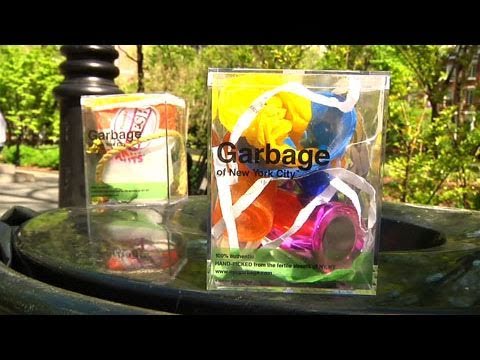
So it turns out that people really are willing to pay $50 or $100 for pieces of NYC garbage with trendy packaging – am I the only one who’s not surprised?

NYC Garbage creator Justin Gignac talks about how he used to sell the garbage for only $10. At that price point, most people saw it as a funny gift or a gag. When he increased the price to $25 or $50 people began to see it as “Art.”

Since the dawn of culture people have debated what is and what isn’t art. Have we come to the point where the defining factor for art is its price? Sad days indeed.

As a Finance student I firmly believe in the power of free markets. In general the value of anything can be well described by the price someone is willing to pay for it. But with Art (be it music, film, paintings, or pieces of garbage) my gut reaction is that it shouldn’t be just about the money.

For me, exceptional art is always made with integrity.  It is made solely for the purpose of expressing an idea or emotion and is not designed in order to bring monetary profit. Strong sales should be the result of good art, not the goal.

So is NYC Garbage made with integrity? I hate to say it but I believe that it is. Justin Gignac is making some easy money selling boxes filled with trash but I think his “art” shines an interesting and ironic light upon the folly of modern consumerism.

What do you think?  Would you buy NYC Garbage art?

Spam prevention powered by Akismet