Categories
Uncategorized

Response #2 – Institutional Logic

I found Mariana’s Post on logic to be very interesting. It comments on the difference between financial logic and institutional logic. It links an article that defines financial logic as maximizing profits, and institutional logic as a balance between profits and public interest.

I disagree with this model. It reminds me of the debate of Friedman and Freeman regarding stakeholder theory. The author of the article argues that great companies take the wellbeing of the consumer into account rather than just profits. However, I believe that when a company seeks to maximize profits, it is generally taking the public interest into account. This can be explained by the high interest on social responsibility of consumers. In order to maximize profits, companies must adjust their behaviours to be parallel with the goals of the consumer. For example, by seeking to maximize profits, a firm is often already being socially responsible since social responsibility is a high priority to the consumer.

Mariana’s Post: https://blogs.ubc.ca/mdelosrios/2011/11/24/financial-logic-vs-institutional-logic/
Original Article: http://hbr.org/2011/11/how-great-companies-think-differently/ar/1

Categories
Uncategorized

Black Friday!


This is an interesting article about black Friday. It explains the increasing competition in Canada in an attempt to reduce the lost revenue due to the competitive prices in the USA. Black Friday has very little meaning in Canada, but that is quickly changing.

The article attributes the magnitude of Canadians shopping across the border to the strong Canadian dollar and the rising demand for deals in economic uncertainty. This is influencing Canadian retailers to adopt the famous day of shopping. It talks about the issue of decreasing margins that is exchanged for the increase in sales.

I find this interesting since the Canadian companies are not necessarily increasing profits, but to reduce losses to the USA. Their choice to increase volume by decreasing their margins was simply strategic. It is somewhat contradictory, because by changing their habits drastically, they are simply trying to keep the status quo.

Link: http://www.theglobeandmail.com/report-on-business/economy/black-friday-sweeps-north/article2248092/

Categories
Uncategorized

Loss of Real Income in Canada


Here’s an article regarding decreasing wages. It states that the average Canadian real income, adjusted for inflations, is dropping.

One part that interested (angered) me is where the NDP criticized the government of indifference toward the matter. I really don’t see how the NDP could do any better. One way they plan to do this is by raising minimum wage to an artificial high, violating one of the most elementary concepts of economics. Raising the minimum wage again will just raise the unemployment rate, since the demand of employees from businesses will decrease due to the higher price per unit of labour. The NDP seems to have a very simplistic approach to things, and they obviously lack the necessary skills to run a country.

Link: http://www.cbc.ca/news/business/story/2011/11/24/statscan-wages.html

Categories
Uncategorized

Rocking the European Boat Will Capsize Us All

Due to Europe’s close ties with America, it is no surprise that the crisis across the Atlantic is affecting how our companies do business. American makers of  drugs, clothes, solar panels, and computers have reportedly felt the effects and uncertainties that the crisis could worsen are scaring consumers and investors just as the holidays roll around. Europe’s struggling growth is already slowing the profits of certain U.S. companies and could eventually affect the entire economy.

Presently, the U.S. economy is especially vulnerable as it not too strong itself-it currently faces weak hiring, stagnant pay, a wide trade deficit, possible tax increases, high energy costs, and potentially steep spending cuts in government. Wells Fargo estimates that the U.S. economy will have grown 0.4% point lower than it’s estimated 2.1% due to Europe’s stagnation.

Already, the European market is affecting U.S companies and consumers in multiple ways:

1. Rocky stock market make consumers more conscious of their spending
2. Lower sales, prices, and profits
3. Banks are cutting lending
4. Uncertainty causes reluctancy to spend and invest

American companies should put up safety precautions for foreign investment and trades because, as we all know due to globalization, if the European market goes down, they’re dragging the world along with it.

Link: http://abcnews.go.com/US/wireStory/us-companies-feeling-impact-european-crisis-14943671#.TsA7BOtc8Xw

Categories
Uncategorized

Aboriginal and Corporate Desires Conflict

In B.C., an uneven landscape confronts the eye when looking to meet obligations to consult with aboriginal communities over resource development. Certain first nations are in prolonged battles to keep their land away from corporate expansion while others are striking agreements for joint decision-making in land-use planning. Although there are no treaties with first nations over much of the land in B.C., a key issue for resource development is accommodating aboriginal interest on the land base; “it is the number one concern facing mining exploration in the development sector in the province”, states Gavin Dirom.

Unfortunately, it is difficult to create a template for accommodating and consulting first nations’ interests as they vary between themselves. Treaties would be the most effective way for addressing recognition yet they also take a large amount of time, although dealing on a case-by-case basis is expensive, and can take a toll on individual first nations as they do not have the same financial resources as the government.

The government and first nations must meet in the middle, discuss and consult, and not necessarily agree on every aspect, but to have a fair ruling in order to unlock economic potential yet create a sustainable, environmentally-friendly development.

Link: http://www.vancouversun.com/business/Certainty+still+question+land+rights+resource+development/5699136/story.html

Categories
Uncategorized

Entrepreneurship


Here’s a relatively new company that is very entrepreneurial. Their company, TidyTrailers.com, is a junk removal business. Like 1-800-GOT-JUNK, they exist to remove unwanted household items. However, this company is particularly innovative since they reinvented the process by passing the physical labour onto the consumer.

After high school, I ran a small business for a few years, Yellow Truck Junk Removal Ltd.  At the time of incorporation (2008), my competitors consisted of a few large corporations such as Scudamore’s 1-800-GOT-JUNK, as well as some other smaller, single-truck businesses like mine. The reason I was able to make profits for a few years was because i charged roughly half the price per volume of material. However, the old method of pricing by volume had a disadvantage since the disposal of the customers’ materials was charged by weight.

TidyTrailers.com had a different approach. They allowed the client to do the loading themselves in exchange for a discount. They would drop off a trailer and pick it up at a later date, charging the customer according to the gross weight rather than cubic feet. Even though their prices still couldn’t compete with the small companies such as mine (which were full-service), their marketing strategy was successful in that the customer thought they were receiving the lowest price since they had to do the work themselves.

Links: http://www.tidytrailers.com/

https://www.youtube.com/watch?v=qO8PBmORdtU

Categories
Uncategorized

Response #1 – Caffeine limit


In response to Adelle’s post, I don’t believe it is the government’s job to limit the amount of caffeine in a drink. Recently, the Canadian government has been attempting to restrict the amount of the stimulant allowed in each available beverage. Similarly, some drinks have been made illegal in some parts of the United States.

The banning of these drinks in certain states is particularly interesting. Some states banned the sale of an “energy drink” that contained alcohol: Four Loko. The ban was put into place due to some alcohol related deaths of youth. They attributed the deaths to caffeine being consumed concurrently with alcohol, a depressant.  However, I do not believe this is the case. I believe that it is the popularity of the beverage among young and underage drinkers to be the cause of the deaths. Young people are less aware of their limits. By making drink that happens to appeal to those who are unfamiliar to drinking, they are unjustly blamed for deaths that would occur with the next most popular youth drink, such as wine-coolers.

In fact, banning “coolers” in Canada was once considered for its preference amongst teenagers due to its sweetness. However, it’s up to education about the substance, whether caffeine or alcohol, that safety is achieved, not the banning of drinks that taste a certain way.

Adelle’s Post: https://blogs.ubc.ca/adelletepper1/2011/10/06/canada-restricting-caffeine-in-energy-drinks/

Other links: http://www.nytimes.com/2010/10/27/us/27drink.html?th&emc=th


Categories
Uncategorized

External Blog: Bootstrapping

Here’s a link to a blog entry that I found particularly useful. It uses the term, bootstrapping, to describe a practical way to begin a small business. It involves cutting costs to a minimum during the early stages of business in order to make up for a lack of capital. I find this particularly useful for entrepreneurs, since I was once in a position where I started a company without the experience and credibility to acquire a loan. It blurred the distinction between the LLC and personal life since revenue and costs of the business were so interconnected with that of of the person during startup. In the article, it suggests simple cost-saving techniques that blur the distinction, such as finding free publicity and working from home. These techniques are extremely useful in the creation of a small business.

Many prominent business people have a “go big or go home” attitude. This article stands out since there are many small business owners who lack the ability to acquire significant capital.

 Link: http://www.canadabusiness.ca/eng/blog/entry/7255/

Categories
Uncategorized

Netflix Followup

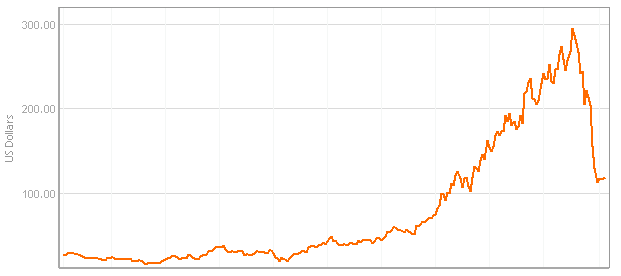
Here’s an interesting article that follows up on the Netflix situation discussed in class. It follows up on the huge losses brought forth by recent price increases. Upon checking Netflix’s long term stock performance, it shows that it’s valued at roughly the same point as September of last year. However, this is a colossal drop from its peak in July. Here are Netflix’s stocks in the last five years.

According to the article, the CEO claims the loss of customers should level off “as the price effect washes through.”  Sure, but what about the company’s future? Netflix’s previous successes were made possible through technological advancements – what used to take several days to download now takes minutes. But, this means that other channels of distribution, legal or not, are becoming more and more convenient as well. For Netflix to flourish, their prices must be low enough to justify the “inconvenience” of downloading through alternate routes such as BitTorrent and Usenet. Personally I believe Netflix’s prospects are dim unless they rethink their business model. Their advancements heavily rely on copyright issues, which is slow and is unlikely to keep pace with how convenient the free means of distribution are becoming.

Link: http://www.theglobeandmail.com/globe-investor/netflix-stock-crushed-as-subscribers-flee/article2212024/

Categories
Uncategorized

Ethics: Anti-Competitive or Clever?

Does anyone remember this controversy? In 2009 computer chip manufacturer Intel Corporation was fined a record setting $1.45B USD. They were found guilty by the European Union for anti-competitive tactics, a decision which is being appealed.

What exactly constitutes “anti-competitive” practices? Some of tactics under question include predatory pricing, paying assemblers to exclusively make products using Intel chips, and using crafty computer code to harm the performance of competitor’s chips.

As the article puts it, some may view the tactics malicious and anti-competitive, while others view them as clever and creative. The laws surrounding the issue are designed to prevent any single firm from attaining a monopoly. But are these strategies unethical? For example, when a company temporarily sells a product at a loss to drive competition out of business can attain a monopoly to later sell the product at an inflated price. Many countries have laws against this, even relatively capitalist nations like the USA. As someone who strongly values a laissez-faire economy, I cannot personally conclude whether unethical decisions were made by Intel. Instead, the controversy left me with a paradox:

It is through Intel’s relentless competitiveness that they are labeled as anti-competitive.  

Link: http://www.dailytech.com/FTC+Intel+Reach+Settlement+Intel+Banned+From+Anticompetitive+Practices/article19265.htm

Spam prevention powered by Akismet