Categories
Off The Wire

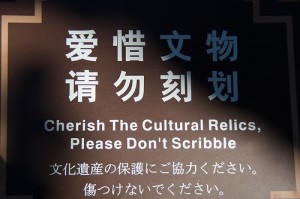
People still have to write, even if it’s just scribbling

scribble

I often apologize to people about my messy writing.  In fact, long ago, I determined that it could basically write in code if I just, well, wrote.  It seems like good penmanship (penwomanship?), is going the way of the dodo, according to a recent Associated Press article, “Cursive writing may be a fading skill, but so what?”  My own handwriting may well beg the question as to whether or not the education system ever taught writing past the third grade, but is this a skill that children need to prove their good character in the future?  Does handwriting only matter when we are without electricity or a decent charge in our laptop or our cellphone (or other texting device)?

Categories
Off The Wire

A better pencil

There is a interesting short interview over on Salon with Dennis Baron, author of A Better Pencil. In his book, Baron looks back across history at how every advancement in communications has been met with a level of fear and suspicion, particularly from those who are strongly invested in the medium that is being displaced by the new one.  At the heart of this reaction, according to Barron, are issues of power and control:

” The more people use technology, the more people communicate, the more people in power become concerned with how to control that use. There are two forces pushing against each other. Whether it’s government or religious organizations or schools controlling what children do online or parents controlling what their kids are doing with communication technologies or groups online self-organizing and deciding how to control what does and does not get expressed — it’s similar to what happened when printing presses became a major means of communication or when radio and TV became major communication players. How do you license, how do you control what gets said on the air?”

Read the whole interview at Salon.

Categories
Off The Wire

“Fitting words for an epitath…” — an encyclopedic smackdown!

Boing Boing alerts us to this debate between Jimmy Wales (Wikipedia’s founder and chairman of the Wikimedia Foundation) and Dale Hoiberg (senior vice president and editor in chief of Encyclopaedia Britannica). There seems to be some legitimate animus bubbling below the surface… which adds some spice to a fairly clear summary of the respective positions, and I’d say both articulate their points quite well. Thinking of Wikipedia as something of a synecdoche for open environments and loosely-structured practices, it’s a fun mental exercise to apply these arguments to a broader academic context. Play to win exciting prizes!

Earlier: Jimmy Wales to Beijing: Wikipedia won’t censor

(Cross-posted to Abject Learning)

Categories
Off The Wire

Attack of the career-killing blogs…

I somehow made it to this point in my life without knowing what memeorandum was — my first glance turned up this new article on the career implications of academic blogging:

On the one hand, some resistance to the proliferation of blogs is understandable. The value of academic culture is that it stands apart from the ephemeral marketplace. Universities are by their very nature culturally conservative and slow to change. The odd situation would actually have been if universities had automatically embraced blogging. Holbo suggests that from one perspective, blogging is an affront to the traditional idea of the university. “You want to graft this onto the last living medieval guild system?” he imagines a senior scholar protesting.
But in another sense, academic blogging represents the fruition, not a betrayal, of the university’s ideals. One might argue that blogging is in fact the very embodiment of what the political philosopher Michael Oakshott once called “The Conversation of Mankind”—an endless, thoroughly democratic dialogue about the best ideas and artifacts of our culture. Drezner’s blog, for example, is hardly of the “This is what I did today …” variety. Rather, he usually writes about globalization and political economy—the very subjects on which he publishes in prestigious, peer-reviewed presses and journals. If his prose style in the blog is more engaging than that of the typical academic’s, the thinking behind it is no less rigorous or intelligent.
To take only one other example, John Hawks, an assistant anthropology professor at the University of Wisconsin at Madison, posts three to five essays a week on subjects like evolutionary theory. He writes about science with the breadth of the late Stephen Jay Gould and doesn’t see a big difference between most of his online and offline output. “Much of what I write online is scholarly. When I review an issue in human evolution, it is a genuine review. If I criticize something, I back it up,” he says. Indeed, his essays are festooned with citations.
So, might blogging be subversive precisely because it makes real the very vision of intellectual life that the university has never managed to achieve?

Also features a good overview of peer review issues, of both weblogs and scholarly work.
Categories
Off The Wire

Digital text conundrum

From a posting made yesterday by Tim Bray:

Here’s a puzzle: what’s the oldest electronic text? Let’s qualify that a bit, stipulating that the text should be substantial in size and essentially unchanged since first committed to bits. I suggest that when this artifact is identified, a paper version should be produced, to ensure that we don’t lose an important piece of our heritage. 

If you have nominations for this designation, post them in the comments field below.

Categories
Off The Wire

Nitpicking Wikipedia’s Vulnerabilities

Most of you have likely heard about wikipedia by now (and perhaps even cited it in your research)! Over on Slashdot there is an interesting question about wikipedia that has a number of links to questionable practices in other forums for scholarship like peer-reviewed journals, conference papers, etc., followed by a group of techno-geeks offering their impressions of the value and worth of wikipedia. We’ll be taking a closer look at phenomena like wikipedia in Module 4, so some of the points and controversies here might be of interest to the group.
Be warned, Slashdot is not always the most polite of communities (though they are extremely resourceful!).

Categories
Off The Wire

Turning the Pages – Online Gallery at the British Library

The British Library has a wonderful collection of books from their collection scanned in and available for online page turning (not scrolling). Take a look as they’ve developed a very nice interface designed to replicate codex experiences. Well, without the musty smell, that is!
http://www.bl.uk/onlinegallery/ttp/ttpbooks.html

Categories
Off The Wire

Quality Hypermedia

George Landow: Evaluating quality in hypermedia
I found this by scanning the del.icio.us/tag/hypertext feed which I’ve subscribed to using bloglines.
“What is quality in hypertext? How, in other words, do we judge a hypertext collection of documents (or web) to be successful or unsuccessful, to be good or bad as hypertext? How can we judge if a particular hypertext achieves elegance or just mediocrity? Those questions lead to another: what in particular is good about hypertext?”

Categories
Off The Wire

Newsreader – textual remix on the fly

newsr.gif

News Reader is software for reading and playing the network news environment. News Reader initially offers the current “top stories” from Yahoo! News — which are always drawn from mainstream sources. Playing these stories brings forth texts generated from alternative press stories, portions of which are (through interaction) introduced into the starting texts, gradually altering them. News Reader is an artwork designed for daily use, providing an at times humorous, at times disturbing experience of our news and the chains of language that run through it.

I found the interface took a bit of getting used to, but it was fun — and the project points to some interesting new directions on how text environments can be turned inside out online.
Via Grand Text Auto.

Categories
Off The Wire

Glide: an interactive exploration of visual language

Twined like the double spiral of the DNA molecule, the close coupling of language and consciousness is revealed in myths of language origin.

Spam prevention powered by Akismet