Categories
Uncategorized

Writing Machines@ Flickr

3806291100_9ff2317db3There is a wonderful collection of images over on Flickr collected by a group called “Writing Machines.”  It is easy to forget just how many different styles of typewriters existed before things went electronic and now digital.  You can explore the group’s pool of images here.

Categories
Uncategorized

Smell of books

Hi all,

The Papyrus to Cyberspace broadcast raises a host of issues relating to our long-term relationship with books and the anxiety provoked by the idea of leaving behind books as objects to be flipped through, fondled and, well, smelled.  We may be able to carry a thousand books on a Kindle or read pages of our favourite newspaper on small little screens, but do we get the full aesthetic experience of musty old paper or wet newsprint?  To respond to the sterile nature of electronic books, the fine folks at smellofbooks.com have developed some products to help us deal with loss of B.O. (book odour).  Check out their aerosol e-book enhancer on their website!

cans

Categories
Uncategorized

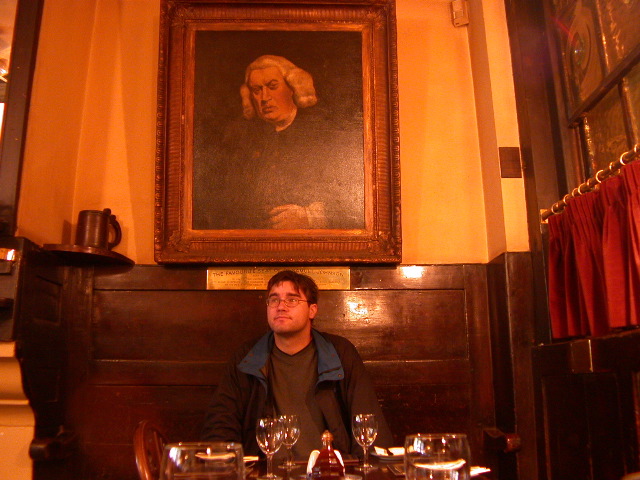
Johnson’s Dictionary

32

photo: Jeff Miller

The book that influenced all others

Henry Hitchings, author of the 2005 book Dr Johnson’s Dictionary: The Extraordinary Story of the Book that Defined the World, describes how Johnson’s working method was innovative.

“He started not by coming up with a list of words like previous compilers had, but by reading 2,000 books. When he saw words that were interesting, he marked notes on them in the margin. So usage became his primary criterion and he had at least one quotation for each word.”

Samuel Johnson also brought elegance to his definitions. Whereas [earlier lexicographer Nathan] Bailey described a wheel as “a round device too well known to need description”, and a spider as “an insect well known”, Johnson defined a wheel as “a circular body that turns round upon an axis”, and a spider as “the animal that spins webs for flies”.

Johnson defined a trance as “a temporary absence of the soul”, and a rant as “high sounding language unsupported by dignity of thought”.

– Brian

Categories
Uncategorized

In praise of technological determinism…

Well, maybe this post won’t quite work as the devastating defense of the dread spectre of technological determinism that I hope to write one day. But having heard the line “technology isn’t important” in discussions amongst educational technologists so many times I certainly find myself nodding in agreement with Martin Weller here… As has been said before, read the whole thing, but in the interim a few choice morsels:

…technology often doesn’t succeed because we ignore all the stuff around it – the administrative context it operates within, the time people have to use it, how it makes people feel about their jobs, etc. I know all this stuff, but what ‘the technology isn’t important’ people often really mean is ‘I want to ignore technology’. And that is surely the wrong way to go.

…from my perspective the technology isn’t important argument is used as a justification to disregard anything technologically driven and hopefully carry on as we’ve always done. In this context suggesting that technology isn’t important is irresponsible. I’m sure plenty of journalists argued that technology wasn’t important, it’s quality reporting that counts. That didn’t stop technology completely transforming their industry. And I’m sure post-Gutenberg we heard arguments that ‘printing isn’t important, it’s what’s in the Bible that counts’. And when Brunel was busy laying railway lines I’m sure horse-drawn carriage owners insisted that ‘the railway isn’t significant, it’s staying in nice inns that we should focus on’.

It’s true enough that we can get too excited by the bells and whistles of the latest techie doo-dads, but I think Martin’s post suggests we can do better when promoting the human dimension of our practice.

— Brian
Categories
Uncategorized

Hypertext: Edge-notched cards

The New York Times ran an interesting articleon June 17th, about Paul Otlet, a Belgian library who some claim may have invented one of the first models of a hypertextual system as well as theorized a networked system that bears some resemblance to what we now see as the world wide web. As we delve into some the history of hypertext in Module 4, it is interesting to consider Otlet’s work, which dates from the late 19th century.
You may need to have a “free” account with the NYT to view the article:
http://www.nytimes.com/2008/06/17/science/17mund.html?pagewanted=1&8dpc&_r=1

Categories
Uncategorized

The Machine is Us/ing Us-Wesch Video

I use this video with Teachers and Teacher Librarians when I am trying to stress the importance of information literacies and our need to understand them. Hope no one has posted it earlier.

Michael Wesch is Assistant Professor of Cultural Anthropology at Kansas State University.

[youtube]https://www.youtube.com/watch?v=6gmP4nk0EOE[/youtube]
Deb

Categories
Uncategorized

returning to orality – talking avatars

I thought this was kind of interesting and fun to play with. Sitepal suggests that the speech capability of the avatar keeps customers more engaged and at your site longer. I’ve been using recordings of sample problems posted onto a moodle site and getting similar feedback from students.
Tris

Categories
Uncategorized

Typography is what language looks like

While ETEC 540 is not a course about typography per se, it has indirectly renewed my interest in the art of arranging type. I’ve just started reading Ellen Lupton’s book Thinking With Type.
thinkingwtype.jpg
On literally the first page she introduces the idea, “typography is what language looks like”. To gain a visual sense of what this means and an idea of the concepts covered in the book have a look at the following video from the Vancouver Film School:

Categories
Uncategorized

Hyperland – take two

I’m embedded the Google Video link to Douglas Adam’s Hyperland, and the one in the link below does not see active anymore. It is pretty common for links to migrate over the course of time, so it is often a good idea to do searches at the original hosting site (in this case Google Video), when a link goes dead. Let’s see how long this one lasts!

[googlevideo]http://video.google.com/videoplay?docid=7190175107515525470[/googlevideo]
Jeff

Categories
Uncategorized

Yet more electronic anachronism

Perhaps inspired by the now-legendary medieval helpdesk video, a riff on 15th Century email:

This is snagged off the Textologies newswire, and the comments added by Print is Dead blogger Jeff Gomez don’t pull any punches on the significance of the jokes:

In the “15th Century Email” video, the guy understands the technology enough to use it (when he makes a mistake, he knows to use the DELETE key to correct his mistake), but instead of just correcting the one mistake he then erases the entire letter and starts from scratch, the way you would crumble up a piece of paper and start all over again. And when eBook programs try to keep the experience of “turning” virtual pages, it shows they’re reacting the same as the man in the video; they understand (and want to exploit) the idea of electronic reading and digitization, but the fact that they retain the idea of turning “pages” means they’re missing out on the bigger experience. Once eBooks and digital reading can get beyond this thinking, the book will then be truly redefined, and the idea of reading will be finally revolutionized. Until then, like “15th Century Email,” we’re just using new technology in an ancient way.

Spam prevention powered by Akismet