Also, I learnt something interesting today…

My supervisor told me, if people here (well, the topic was on government officials) tell you they will get things to you by tomorrow, they most likely won’t. If people tell you they will get it done but don’t really give a specific time, then it’ll probably get done!

Categories
economics thinking quotes

My stomach is making strange noises….so I decided to stay in tonight. Plus I woke up at 5 am this morning, unable to fall back asleep…

I was just re-reading an essay

Elie Wiesel made a similar point to the Global Forum in Moscow last winter when he said that the designers and perpetrators of the Holocaust were the heirs of Kant and Goethe. In most respects the Germans were the best educated people on Earth, but their education did not serve as an adequate barrier to barbarity. What was wrong with their education? In Wiesel’s words: “It emphasized theories instead of values, concepts rather than human beings, abstraction rather than consciousness, answers instead of questions, ideology and efficiency rather than conscience.

Now if only we can make those conventional economists understand this quote….

Categories
agriculture

The politics and economics behind urban agriculture (specifically land tenure and zoning issues) are so complicated that it’s getting me really excited. Well, it actually makes my job a bit harder, but then if it was an easy issue to be solved, it would have been solved already.

One day, when I learn a little bit more, I will write a post about these complicated dynamics between individuals, organizations, and the physical environment.

First Day at Work

I arrived in the morning and immediately got to work after lunch.

Met lots of people relevant to my projects to just introduce myself. Participated in a meeting where they were negotiating/asking for funding. Interesting people dynamics. Definitely different than what I’ve experienced before.

Now I’m super jet lagged and sleepy.

Dar is very different than Kampala. I can’t wait to find out more.

Arrived!

I just arrived this morning in Dar at 9:30 am.

Vancouver –> Amsterdam: 9 hours

Amsterdam: 6 hours wait

Amsterdam –> Nairobi: 8 hours

Nairobi –> Dar: 1 hours

I’ve had enough of being in a plane for a while….like 2 weeks.

Amsterdam airport:

  • Meditation room: a place for people of all religions to have quiet spiritual time – super cool!
  • Relaxing place with really nice sofas and chairs – way better than those crappy ones in many airports that I’ve been to!
  • Washrooms with toilet seat sanitizer
  • Washroom sinks with no mirrors – to prevent people from staring at themselves for too long and holding up the queue! The mirrors were on another side of the wall.
  • Ridiculously expensive bottled water….:(
  • Then I found a water fountain!
  • 6 hour lay-overs really aren’t that bad when you have a computer
  • Note to self: always bring your electric plug converter with you in the hand carry luggage!

And talking to people on the plane is super interesting. Didn’t really get what I wished for (inside joke – sorry), but everyone was so friendly and fun to listen to.

New Chapter

I’m going back to Tanzania!

This time, I’ll be in Dar es Salaam (the largest city, not the capital). Working as a project officer for urban agriculture needs assessment for two NGOs (one based in Vancouver and the other one in Dar).

I’m so unbelievably excited about this job, it’s hard to describe. Maybe I should just say that I danced around the UBC office I was working in when I got the phone call. Thankfully, my co-workers knew me enough to not call the police.

I guess, although this is only going to be a 6 month contract, it’s going to be a new chapter in my life. I intend on documenting this chapter a little better than I have in the past. Or so I’ve told everyone I know. Yeah…..I know I know! Stop looking at me like that. I might have said similar things in the past…but I’m serious this time! :P

No promises, because I’ll probably break them. You probably know by now I’m not great when rules are made. But I really would try to write even a little bit once in a while.

I would really appreciate any questions or comments!!!

As one of my friends said the other day, even getting a blank piece of paper in the mail is awesome! Just the fact that you took the time to send that piece of paper, right? So comments are much appreciated.

I’ll be arriving in Dar in about 2 days. See you then!

Categories
writing

When I entered and when I am leaving

I recently came across a certain document that made me red in the face and nostalgic: my letter of intent when I applied to the Global Resource Systems program, my bachelors of science at UBC.

Red in the face because of all the big words and cheesy cliches I managed to stuff into this 500 word letter. Nostalgic because I recently had the honour of being student speaker at my graduation convocation, and I had to craft a very similar speech. For your amusement and enjoyment, I’m going to post both of these writings/speech. Also as a reminder for myself 5 years down the road.

Global Resource Systems letter of intent

(Please keep in mind that I was 19 years old when I wrote this letter. I’m being very brave even posting this online!)

Dear Selection Committee,

My name is Tiffany Tong and I am currently a Science One student. I am passionate about and devoted to contributing to the betterment of the world. I envision a global village that is truly peaceful, where not only is there peace between countries, but also peace within every beating heart. To achieve my goals, I believe we need to maintain a delicate balance amongst humans, animals, and the environment. Hence, we need to embrace true sustainability in every part of our lives. The Global Resource System program, with its emphasis on global citizenship, interdisciplinary learning, and sustainability, provides an excellent environment for me to learn the tools and skills to reach the starting path of my dreams.

I intend to specialize in urban planning for developing countries, especially the fastest growing economy in the world-China. I chose urban planning because it has a direct impact on the lives of the majority of the world population – city dwellers – and will be an essential foundation of rapid development. It is my firm belief that current cities are inflexible and segregating its inhabitants from the natural environment. Accordingly, I wish to learn how to plan and implement flexible cities which integrate all the elements of the local ecosystems, local culture, and the newest environmentally-friendly science and engineering technologies available.

My proudest achievements in extracurricular activities include co-founding and leading the Roots & Shoots club at my high school. We promoted harmony among all animals, humans, and the environment through organizing various projects such as the 30 Hour Famine, beach and highway clean ups, and animal adoption awareness. Also, I started the Aquatic Conservation Team in conjunction with the Vancouver Aquarium to raise awareness on storm drain pollution.

Recently, I initiated the Dollar Project, which is in the process of becoming an AMS club, with the goal to encourage every student and staff at UBC to donate a dollar per year to various charities. With 47,000 community members, our collective power and potential to invoke change is enormous.

Internationally, I was honoured to be the only Canadian panellist for the Japan Return Program, which organized a month long Japanese Summit that invited youth from all over the world in 2005 to gather and discuss issues under the theme “Love, Earth and Peace.” Discussions were held at various places, including EXPO 2005 in Aichi, Japan, and with Mr. Ishihara, the governor of Tokyo. From these experiences, I have learnt greatly about the world, the problems it is facing, and a global perspective into possible solutions. And most importantly, they have motivated me into devoting my life to help make a difference in the world.

I am confident that I will be an asset to the Global Resource System program, for I plan to acquire knowledge to fill my head and compassion to fill my heart. Please contact me if you would like any further information.

Thank you for your time and consideration.

Sincerely,

Tiffany Tong

My speech as student speaker at the Faculty of Land and Food Systems graduation convocation May 31st 2010:

(and a million hugs to my amazing friends who helped me edit this)

Thank you President Toope.

Good morning fellow graduates, honoured guests, and wonderful professors and staff.

It is a great honour for me to be standing here today.

But I hope you wouldn’t think of me as a representative of my fellow colleagues. How can one person represent such a diverse and interesting group of people?

When I first stumbled into this faculty in my second year, I thought it was a really strange place. We have farmers, economists, activists, nutritionists, laboratory scientists, community builders – as well as people like me who really don’t know if we could ever find a label – all in one place.

And you know what? Gradually, I’ve discovered that surprisingly, we all get along well. Marvellously well.

Now, my faculty is the place where I feel most at home. Half of me wishes that I could always smell Agora, or sit in the orchard garden, or visit the UBC Farm whenever I like. It’s amazing to see how well all of us – all so different from each other – can work together. And how three simple words, as cliché as they may be, connect us all: land, food, and community.

If I have to distil what I’ve learnt at UBC into a single fact, it would be the fact that we are all so interconnected in this world that we can’t afford to think in small categories. We can’t afford to think as I did when I first entered this faculty. And we definitely can’t afford to work alone.

This is why I’m so proud to be a graduate from this faculty and this university, both putting so much emphasis on collaboration between disciplines.

But I want to suggest that theories are not enough. After having the chance to receive a world-class education at UBC, we are now entrusted with the responsibility to shape this world with our actions. Not just words, but actions. We have been privileged with opportunity. Now, with graduation upon us, it is our time to act for those less privileged.

How should we do that? I really don’t have a concrete answer. (if anyone does, please call me ;) But let me share one of my favourite quotes from David Orr’s “What is Education for?”:

“The plain fact is that the planet does not need more “successful” people. But it does desperately need more peacemakers, healers, restorers, storytellers, and lovers of every shape and form. It needs people who live well in their places. It needs people of moral courage willing to join the fight to make the world habitable and humane.”

Let us begin this journey today, on this traditional Musqueam territory devoted to learning, by giving a gift, together as the grad class of 2010, to the University of British Columbia.

  • $10,000 to the AMS Bursary Programme
  • $10,000 to the UBC Alumni Association, for student directed programming on University Square
  • $5,000 to the UBC Learning Exchange

These are all worthy causes, but I hope we don’t stop here. Let us all join in the adventure towards making this world more habitable and more humane.

Finally, a heartfelt thank you to all who have helped us reach this extremely important moment in our life.

Once again, congratulations on graduating!!
Categories
Uncategorized

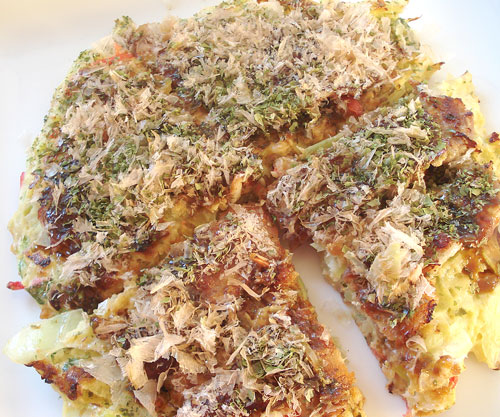
Food experiment: Okonomiyaki (a.k.a. Japanese pizza)

I don’t even remember why I wanted to make this in the first place. But who needs a reason to make something so yummy?!

Okonomiyaki (お好み焼き) actually means “grill/cook (yaki) what you like (okonomi).” So basically you can put any kind of toppings/ingredients into the basic batter and cook it in the same way.

Actually in Japan, when you eat this in a special restaurant, they have a hot plate in front of you for you to cook it yourself. You order what you would like to be in your okonomiyaki, the waiter gives you the batter with all the ingredients, then you mix it and cook it yourself! It’s super fun. I remember the first time I tried it in Japan we had no idea what to do so the waiter had to help us :P Of course, the best part is that the okonomiyaki stays piping hot on the hot plate while you eat it.

But you really don’t need all that fancy equipment. This is a super simple recipe to make at home. And since I had none of the special Japanese ingredients (e.g. pickled ginger, shredded seaweed, bonito (fish flakes), okonomiyaki sauce etc), I just made everything at home.

There’s different styles of okonomiyaki in Japan, the two most famous ones are the Osaka and Hiroshima versions. I’ve actually never tried the Hiroshima ones (which is made differently and includes stir fried noodles). This one I’m making is more similar to the Osaka style.

Traditionally, you put a lot of stuff on top of the okonomiyaki when it’s done. It really should look like this:

(here’s the super real version of how to make it with super complicated steps: http://www.justhungry.com/okonomiyaki-osaka-style)

But this time, I just made a simplified one (with lots of photos): http://visualrecipes.com/recipe-details/recipe_id/120/Okonomiyaki-aka-Japanese-Pizza/

Also, since I didn’t want to buy the sauce that is used to put on top of it (you can’t eat okonomiyaki without the sauce!!), I found this recipe: http://okonomiyakirecipes.nthmost.com/quick-okonomi-sauce-recipe/

(actually I didn’t even have ketchup, so I just used canned tomato sauce. Hey! stop looking at me like that….ketchup is really just tomato sauce + vinegar + sugar!) I have a feeling you can buy okonomiyaki sauce at most Asian supermarkets.

basically:

1. Mix 1 beaten egg + 3/4 cup water

2. Add 1 cup flour, mix well

3. Add 1/4 to 1/8 finely chopped cabbage (how much depends on what you like. I love it with more cabbage, plus it will shrink). Once you mix it up, if it seems a bit dry, add a bit more water. Don’t over do it!

4. Cut up the rest of what ever topping ingredients you chose (vegetables, meat, mushrooms, corn, cheese etc)

5. Cook toppings on a pan for a bit (how long depends on what you cook); don’t put the cheese in here…

6. There’s two ways to do this: 1) tip all the toppings back into the batter bowl and mix or 2) put batter directly on top of batter

7. Add some oil to the pan and heat. Add batter + toppings.

8. cook both sides two times: but batter in –> wait until a little bit brown –> flip –> wait until a little bit brown –> flip –> wait until a nice golden brown –> flip –> spread the sauce on the top, lots of it –> cook bottom until a nice golden brown and make sure the middle is cooked.

Done! Dekiagari (done in Japanese)!

Since I’m not a meat eater, I just used whatever leftover vegetables I had in the fridge. Adding in cheese is also really tasty although you have to add quite a lot.

Small tips:

1. don’t try to make a big one to save time. they’re really hard to flip and when it’s too thick, the middle doesn’t taste too good.

2. use some oil ( I usually try to use as little as possible). But for this dish, you want the outer crust to be quite crispy. Heat up the oil first before you put the batter in!

3. put a little bit of baking powder in. Maybe it was my biased thinking, but I swear it was fluffier and tastier when I put it in the second time I made it. And do not press the thing down with your spatula.

4. don’t be afraid to substitute! I used wheat flour because I didn’t have anything else. I used tomato sauce instead of ketchup. Plus I had none of the other toppings (not even mayo – funny story, I spent 10 minutes at the super market trying to find a mayo that didn’t have many scary sounding ingredients/preservatives. I couldn’t. And I was too lazy to make mayo from scratch (egg yolk and olive oil). Mayo does make this taste reaaaally good)

Profiting from poverty? The question of “development professionals”

I recently read this post http://chrisblattman.com/2010/05/12/poverty-professionals-and-poverty/ (reading the full original paper is highly recommended…it’s only 6 pages long!)

I’ve had the same question in my head for a long time, especially when I was ‘out in the field’ in Uganda and Tanzania. Seeing the UN and other aid agency workers driving around in expensive 4 wheel drives compared to the people who could barely afford bus fare that they were trying to ‘help.’ There is no wonder that resentment abounds.

But how can we reconcile these differences? Should development workers have to live in the same way as those people they are trying to help? Is it impossible to make good policies without first understanding how people who are you making policies for live?

For something closer to home, should all politicians and policy makers experience “normal” life a bit more? How can we design a good public transport system when the majority of the designers actually don’t take public transport (or bike) on a daily basis?

One thing that really stayed in my mind when I watched the movie “Gandhi” is that Gandhi was determined to live a ‘normal’ life. He spun his own cloth, planted his own food, and washed his own clothes. The other leaders probably thought it was a waste of time. But he insisted. I think he had good reasons.

Food experiment: Risgrøt

Risgrøt (risengrynsgrøt (with raisins) or riskrem (with cream/whipped cream)) is Norwegian rice pudding. Probably my favourite from the Norwegian foods I’ve tried (a close second would be brown cheese).

Ris=rice and grøt I guess is the pudding (:P). Grøt is pronounced similar to “grert”.

It’s a traditional Christmas dish with lots of variations. You can make it with sour cream or mix in whipped cream to make a cold dessert etc. I only learnt to make it the most basic way, with milk, rice and salt. The best part is sprinkling sugar, cinnamon (Kanel if you’re trying to find it in a Norwegian supermarket..), and “an eye of butter” in the middle. You can also add raisins.

Recipes here: http://www.recipezaar.com/recipe/Risgrot-Hot-Rice-Pudding-155893 this one uses only milk and rice, which makes it super rich and decadent.

and this one http://www.cybershingle.com/recipes/pp/rice/risgrot.htm uses water to start the rice off. I tried it recently and it was nice also. So if you don’t to use so much milk, use this recipe!

Spam prevention powered by Akismet