Categories
Uncategorized

Bing’s search engine ventures into China

bing-logo-white5

http://www.canadianbusiness.com/technology/companies/article.jsp?content=20100426_10011_10011

Since’s Google’s feud with the Chinese government to provide uncensored results, the company’s  operations have been reduced greatly due to China’s “Great Firewall”.  Just recently, China Unicom,  the country’s second largest wireless carrier, dropped Google search as the default search engine for their handsets and instead allowed for the manufacturers to choose from a list of alternatives.

With China’s booming internet base of over 350 million and with Google being slowly taken out, Bing has taken the initiative to take a portion of the market share that Google had in China – approximately 36%. Motorola has already agreed to include Bing as an alternative search engine for smartphones that operate with the Android operating system in China.

china_internet_1013853c

But Bing has a long way to go – currently, it only possesses 5% of the Chinese Search market. In addition, analysts say that Bing will have a difficult time capitalizing on Google’s market share as competition from Baidu, China’s homegrown leading search engine, will be extremely high.  Many people tend to use things they are familiar with, and if Chinese internet users can’t use Google, its very likely they will switch to Baidu instead of Bing.

Microsoft has already spent $100 million in rebranding Bing, and despite the overwhelming obstacles, the management team remains optimistic about their investment. How will Bing react to the competition and censorship issues that Google once faced, and ultimately, will Microsoft benefit from Google’s actions in China?

Categories
Uncategorized

Managing Bias in Meetings

https://www.mckinseyquarterly.com/Taking_the_bias_out_of_meetings_2561

I came across this interesting article from McKinsey Quarterly on tips for having effective business meetings. It shared several key points that will help mitigate the impact of  biases and lead to sounder business decisions.

1. Ensure the right people are involved.

Make sure a meeting involves diversity – people from different cultures, with different personalities, with different interests and with different expertise. It is also important to have people in meetings who are willing to provide feedback and criticism.

2. Assign Homework

Ensure information gathered is objective, reliable, and accurate. If a meeting involves making a decision, have people separated in to research of the pros AND cons of the decision.

3. Create the Right Atmosphere

Within the meeting, allow everyone to have chance to share their opinion, even if its individual experiences or ideas that create possible biases. Create a climate where people recognize that its okay to disagree, and can use humor to diffuse the tension time by time.

4. Manage the Debate

Before discussion occurs, let everyone write where they stand on the particular issue/decision and the supporting information to justify that stance. When discussion begins, start off by asking people of the objective analysis, the pros and cons of the situation PRIOR to people sharing their personal judgement/stance. The first method prevents Group think, while the second ensures all the details surrounding the situation is given, rather than having people only give facts that support their case.

5. Follow Up

Commit yourself to the decision. Create Milestones or pre-agreed criteria and conduct periodic reviews on the decision and on the meetings as whole to suggest any future improvements.

Hope this is helpful to those who are heavily involved in group, club, or conference or projects!

Categories
Uncategorized

Facebook’s Advertising Policy

http://www.nytimes.com/2010/03/04/technology/04facebook.html?fta=y

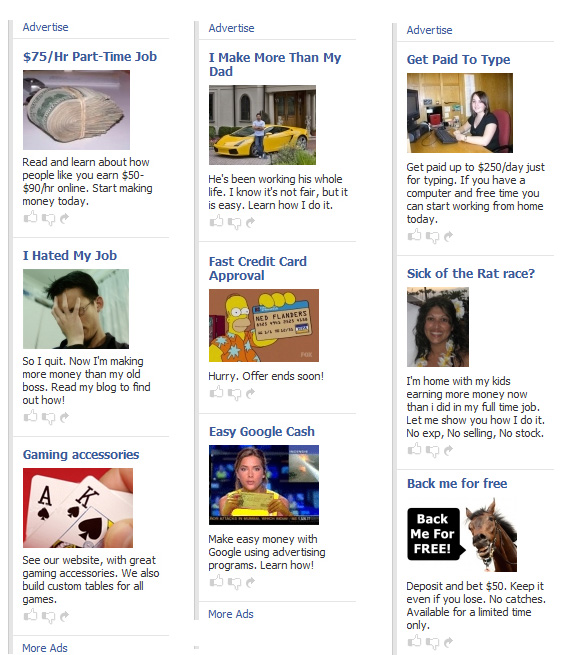
You’ve seen it all before – Facebook advertisements from “Lose 30 pounds in 2 weeks!”, to “Lower your debt by more than 50%, to “Congratulations, You’ve won a new Ipad!”

In the midst of these random and odd advertisements (some would argue are spam), commonly seen brand names and legitimate advertisements can still be found on Facebook. Yet despite that, the overall quality of the promotional messages perceived by users of Facebook are low, with some even saying its downright creepy.

The primary reason Facebook has these mixtures of ads is because its policy implements self-service ads. Self-Service ads allows anyone or company to create an ad and post it up in matter of minutes. Although Facebook has a terms of service for advertisements, they do not review the ads individually. The only feedback system for the ads is through a  “like” or “Close this ad” button from Facebook users, from which ads closed will show up less for results.

Self-service ads can also be customized – creators of ads can choose certain criteria for who the ads reach – demographics, location of residence, gender, and even for specific information shown on people’s profile page (interests, wall posts, etc). Because of this, many Facebook users are also concerned about the information that is being shared with third party advertisers.

On a positive note though, Dan Rose, vice president for business development at Facebook says, “the ads on the site are becoming more professional and straightforward as the company updates its policies and enforces them.”

This begs the question as Facebook continues to update its advertising policy – should Facebook take more control over the advertisements and implement standard reviews so inappropriate ads are prevented, or should they make stricter terms and conditions and hold the advertisers with more responsibility for their ads?

Categories
Uncategorized

Youtube’s revenue approaching $1 Billion

http://mashable.com/2010/03/05/youtube-revenue-2010/

Many of us can attest to being YouTube users. From checking sports highlights, to watching music videos, or to  just get a good laugh, we spend several hours a week surfing for videos on this site.

But we are not alone. Every day, hundreds of millions of viewers across the world contribute to over 1 billion views on YouTube – a proportion that is unmatched by any other online video site. With over 13.8 billion videos, YouTube currently leads the way with 40% of the online video market share.

In 2006, Google had paid $1.68 billion to purchase YouTube. Many during this time argued it was an overpriced bid. But in recent years, YouTube has been experiencing enormous growth, generating $727 million in revenue for 2009 and a projected $945 million for 2010. With the staggering increase of both site viewers and videos viewed, YouTube’s investment for Google is finally reaching a return.

But a questions remains. How does YouTube make money anyway? Given YouTube’s millions of viewers, it is a hotbed for companies to post their advertisements and marketing campaigns. YouTube offers to these companies various means to display their brand:

1. Website  link attachments  to videos being watched

2. Video Advertisements prior to an actual video

youtube ads at end

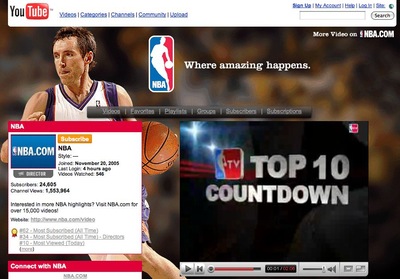
3. Partner Program: Companies can create their own official channel and provide their own content (ex. NBA, CBS, FritoLay,etc)

4. Poster Advertisements attachments to videos being watched

Video ads are the most recently introduced, and many viewers of the YouTube community are already beginning to complain that these ads are quite disruptive (sometimes, you have to watch a 30 second ad to watch to a 15 second video…)

What will YouTube’s advertising program look like in the near future? They have been increasing advertising material on their site every year – will it have eventually have a negative impact to their viewer base and overall market share? How will Youtube’s growing video and viewer base unfold in the next several years and will their revenue continue to increase at the astonishing rate that it has?

Categories
Uncategorized

My Carbon Footprint!

Carbon Footprint

Just did the Carbon Footprint calculator from go BEYOND’s website – here are the breakdown of my results:

Daily Commute: 0.015 tonnes CO2 per year

Food: 2.295 tonnes CO2 per year

Long Distance Travel: 0.033 CO2 per year

Shelter: 0.442 CO2 per year

Apparently I’ll already doing a pretty job being green… perhaps its attributable to the fact that I live really close to where I study and in addition have no social life to produce CO2 emissions….. =o

Categories
Uncategorized

Amazon Earnings Soar Despite Sluggish Economy

http://www.theglobeandmail.com/globe-investor/amazon-earnings-soar/article1448032/

During a time when traditional retailers are slashing inventories to offset pullback on customer demands, Amazon, the world’s 4th largest online retailer reported an astounding 40% earnings increase for the full year of 2009. The biggest gain came during Amazon’s fourth quarter,  as net income rose much higher than expected by 71%.

Despite the current recession, Amazon’s speedily growth illustrates the competitive advantage that online retailers have when customers are strapped for cash. By offering merchandise cheaper and more efficiently, they are able to reduce lag time in the supply chain and on the other hand, attract more customers with its lower prices. Amazon’s ability to maximize these advantages explains them leading the way in online retail growth.

Furthermore, Amazon’s introduction of the new “Kindle” eBook reader has helped significantly to increase sales revenue. By providing convenience of both reading and purchasing books from over a wide range of selection, Amazon has paved the way for an era where paperback books will become obsolete. But Amazon is far from stopping. With competitor Apple’s iPad being released, Amazon has responded by purchasing an touch-screen colour company known as TouchCo, in hopes of preparing for an upgrade for the next kindle.

Amazon recently also purchased an online shoe and apparel store called Zappos that was responsible in contributing over $200 million to their overall sales revenue. It seems both businesses and consumers are focusing and relying more and more on the online sector for entertainment, fashion, and retail goods. With the online retail market already growing at a steady 5 to 10% annually, what will the face of the new market, or the demands of the consumer, look like in the near future

Categories
Uncategorized

Windows 7 Phone Series

http://money.cnn.com/2010/02/15/technology/microsoft_mobile_software/index.htm

Microsoft has just released its new operating system for mobile phones in hopes of reclaiming their position against competitors such as the Apple, Google, and Blackberry. From several years ago, Microsoft has seen its mobile market share drop from 25% to 10%, and Microsoft CEO Steve Ballmer hopes that this new release can be a major push for them to get back into the mobile market.

Microsoft says this phone is unlike any other in the market, and their advantage lies in providing live, instant access to related content from the web, applications, and services into a single view to simplify tasks. There are 6 hubs “built on specific themes reflecting activities that matter most to people”:

People: This includes relevant social content such as Facebook and Windows Live Messenger

Pictures: The Windows 7 phone allows for complete integration with the Web and PC

Games: This hub, includes for the first time ever,  the Xbox Live 360 experience on a phone

Music: The phone provides synchronization with window’s Zune music player

Marketplace: This hub allows for the windows phone to access various online, or downloaded applications and games

Office: Provides Microsoft Office programs such as Word, OneNote, and SharePoint and allows for users to stay productive even on the go.

In addition to these technical advantages, Microsoft also allows for customization in the phone depending on their manufacturers. For instance, some phones may be equipped with keyboards while others may not. This means customers will get greater choice on purchasing a phone that is just right for them. In addition, Microsoft also has strong support from its manufacturers, as it is likely that mobile companies such as Qualcomm, Samsung, LG, HTC, HP, Dell, Sony Ericsson, Toshiba, and Garmin-Asus will be producing the Windows 7 Phone.  Carrier companies are also showing strong support for the introduction for this phone, as the phone will be made available in networks including T-Mobile, Sprint, and Verizon, Telefonica, Vodafone, SFR, Telestra and Telecom.

Specifically in the smartphone market, Blackberry currently leads with 41.6%, iPhone with 25.3%, and Microsoft with 18%.

How much of an impact with this new release make on microsoft’s position in the smartphone market?

How will competitors like Blackberry and iPhone respond?

Categories
Uncategorized

Product Variety to Product Overload

http://money.cnn.com/2010/02/15/news/companies/walmart_dropping_brands/index.htm

With Walmart leading the way, many big retailers have also responded to the recession by dropping many brand-name products from their line-up in hopes of both simplifying the shopping experience and removing dead weight in the stores aisles. Unless a product is one of the top sellers in its category, it will be removed and replaced with a cheaper store brand. This is primarily focused on the need that customers now are buying less and looking for more bargains.

Such changes, with the example of  Walmart, include a 44% decrease in the shelf space for toliet paper and a 39% decrease in mouthwash. In the next upcoming months, retailers will continue to trim multiple brands from categories such as household wipes, bar soap, salad dressing and bleach unless they get negotiate deals for better pricing.

This new move by retailers underscores two important points concerning both supply chain and consumer marketing. Firstly, while retailers would love to have product variety in their stores, they realize that such variety takes a toll on the overall efficiency of turning over inventory. As the article put it nicely, “In good economic times, product variety is a must for retailers. But in down times, when shoppers aren’t buying much, variety can be a burden.”

Secondly, this change also fits with the current consumer demand. In this recession, customers are less discriminating in the brands they purchase and focus more on the prices by buying generic brands. With this mindset, retailers understand there is no longer a need overwhelm the shelves with product variety.

Categories
Uncategorized

Fast Fashion: Zara

After reading the article on Zara’s innovative supply chain process, one can see the multitude of benefits that arise whenever a company establishes an open communication channel between members of different functions and hierarchies. From analyzing the unsold items customers tried on at every store and passing the information to country managers, to having a culture of immediacy and teamwork between commercials and designers at headquarters, Zara has allowed important information to flow – fast and accurately – throughout the various supply points in their production process. In addition to this, their policies of having members of the commercial organization join the sales staff during discount periods and having equal sized desks with the absewnce of formal titles help foster team cohesion, organizational commitment, and an atmosphere of camaraderie.  With these strengths, Zara places itself as one of the leading businesses in the fast fashion industry.

Despite this, there are several questions I have in regards to Zara’s supply chain model.

1. How do you balance between the artistic freedom of the designers and the need to respond to consumer trends from the commercials?

2. By what standards does a prototype pass the test for mass production? Are there more sustainable ways to test this?

Categories
Uncategorized

The Economics of Sweatshops

http://www.nytimes.com/1997/06/22/weekinreview/in-principle-a-case-for-more-sweatshops.html

The title of this article is “In principle, a Case for More ‘Sweatshops’

Like the title suggests, the author pools together different leading economists’ opinions on how sweatshops can be a beneficial way for developing countries to modernize despite the torturous hours and low pay in the worker’s conditions.

By arguing that working at a sweatshop is not always the worst alternative for adults and children alike in certain countries, economists say that that such a job is not as unfair as many would believe.  In developing countries such as Cambodia, Indonesia and Malawi, where low wages and poor working conditions are often the norm, a sweatshop job can provide opportunities and escape to many unemployed and needy people from worser alternatives such as starvation and death while offering the indigenous norm in wages and working conditions (even if its much poorer than our country’s standards). This argument would explain why there are so many sweatshop workers employed today – they weighed the cost and benefits of working in a sweatshop and the benefits outweighed the costs.

The article then moves to analyze the positive effects of sweatshops on a economy as whole. Using examples such as Hong Kong, Taiwan, Korea, and Singapore, it mentions how it was through sweatshops and the manufacturing of things such as toys, shoes, apparel that each of these regions were able to increase their national income from 10% of American income to 40% within a single generation.

Lastly, the article rebuts those who criticize sweatshops for stealing jobs and wages from Americans and advocate for the end of sweatshop factories. Economists argue that having corporations close their factories in developing countries would only make matters worse and only hurt those who they were trying to protect in the first place. As a sweatshop factory closes down, the workers become unemployed and are left to face the alternatives they had tried to avoid.  Mr.Krug, an economic advisor, sums it up by saying ” My concern is not that there are too many sweatshops but that there are too few.” Echoing many others, Krug believes it is these very jobs, which in past acted as stepping stones for countries such as Singapore and Korea, that can bring many developing countries today out of backbreaking rural poverty.

After applying the cost-benefit principle, this lady here sews because it is better than any alternative

Spam prevention powered by Akismet