First and foremost, the CME group website is my all time go-to website. I use it excessively (perhaps too much), and it always provides the most up to date prices of the crops, with a lag of 10 minutes. I often use it to record price charts to figure out the current price pattern and fluctuation cycles. It also provides different charts, varying from minutely to monthly, which can also be used for analyzing data to predict future prices.
Wheat:
http://www.cmegroup.com/trading/agricultural/grain-and-oilseed/wheat.html
Corn:
http://www.cmegroup.com/trading/agricultural/grain-and-oilseed/corn.html
Soybean:
http://www.cmegroup.com/trading/agricultural/grain-and-oilseed/soybean.html
The United States Department of Agriculture (USDA) website also provides rather useful information and data. One of the articles I came across from USDA twitter was “U.S Drought 2012: Farm and Food Impacts”(http://ers.usda.gov/newsroom/us-drought-2012-farm-and-food-impacts.aspx). It’s a particularly interesting article that goes into detail on how the drought has affected food prices and consumers, farms, crops, and livestock. Statistical data and bar charts are also provided. I’ve attached examples below.

Source: 2011, ARM, US Drought Monitor (Aug 14, 2012 drought status).
This diagram shows the drought severity distribution for major crops, and the numbers are in value term.
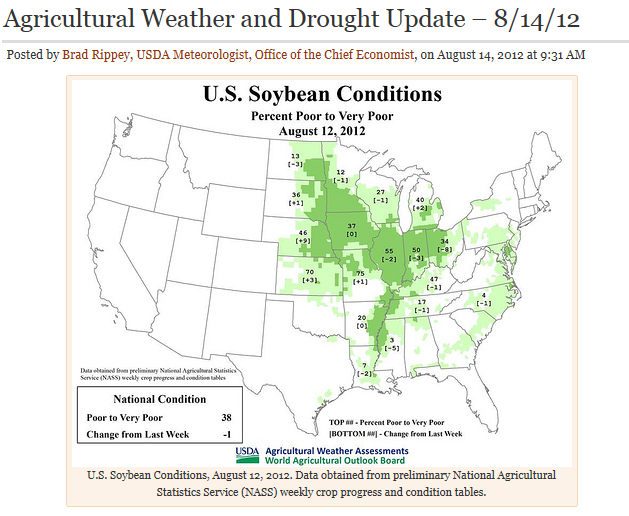
(Source:http://blogs.usda.gov/2012/08/14/agricultural-weather-and-drought-update-81412/ )
The diagram above indicates the damage that the drought had on soybean in certain parts of the U.S. This year’s drought is affecting over 1/3 of the county.
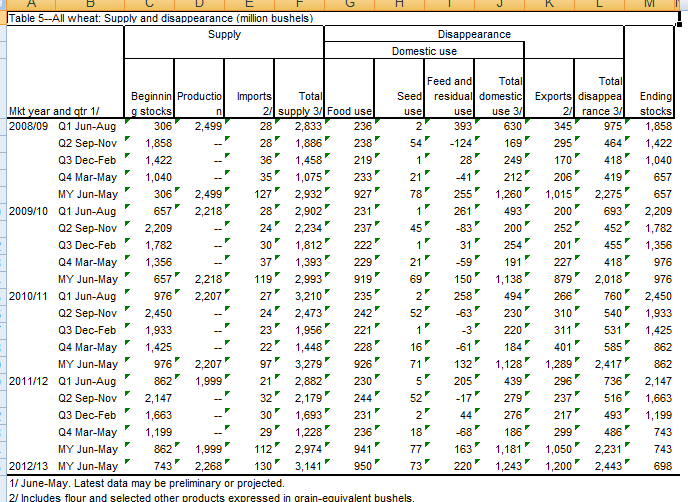
Wheat Yearbook Tables provide tables and statistical information for US Acreage, production, yield and farm price, world production, supply and disappearance, and USsupply and disappearance. As well as government and private stocks, and domestic and international prices. Above is a screen cap for wheat supply and disappearance in the US. It is updated on Sept 21st, 2012. (http://ers.usda.gov/data-products/wheat-data.aspx)
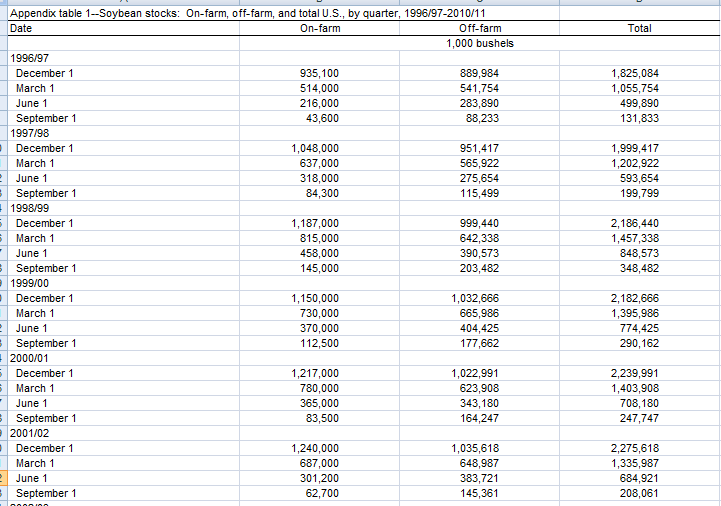
The website also provides detailed stocks information, which can be used to analyze supply quantities, which affects the commodity’s price pattern greatly. Provided above is a screenshot of the table. For more information, please visit the USDA Oil Crops Yearbook page (http://ers.usda.gov/data-products/oil-crops-yearbook.aspx).
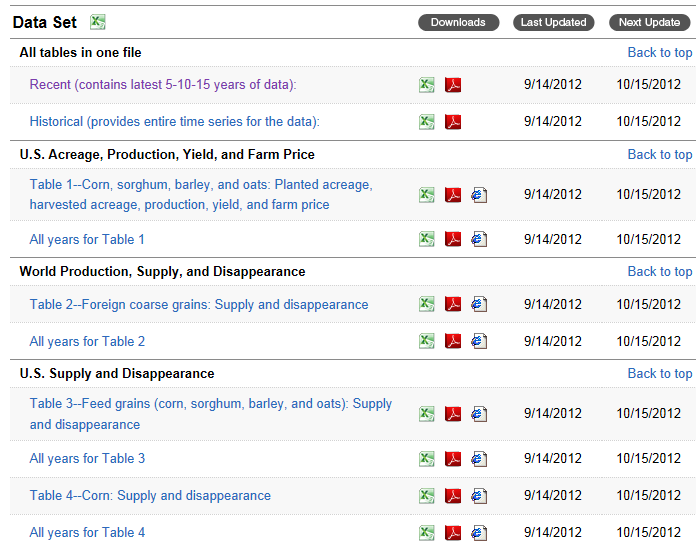
Similar to soybean and wheat, USDA has a yearbook table for corn.(http://ers.usda.gov/data-products/feed-grains-database/feed-grains-yearbook-tables.aspx)
I realize that it can be quite difficult and time consuming for beginners to evaluate and go through all these information. Nevertheless, these statistical numbers can come in handy for careful analytic works.