Categories
TRADING GAME Uncategorized

WEEK 3 (Part 3): Cool Source of Information

Below are the websites I’ve been using extensively for the past 2 weeks:

Also, U.S. Wheat Associates – The World’s Most Reliable Choice (http://www.uswheat.org/newsEvents/wheatLetter) is quite resourceful. They have wheat letters released two to three times a month. The latest one was released on September 27th, 2012. In the letter, they discussed issues such as how crop shifts in China may affect world wheat market, market meddling, and how Australian drought adds anxiety to wheat market. It also discussed how south Asia team learns more about managing supply chain challenges at NCI, and wheat industry news, etc. Charts were included in the wheat letters to further demonstrate what’s being explained.
Below is the link to September 27th’s wheat letter:
http://www.uswheat.org/newsEvents/wheatLetter/doc/4CCAAA621965468C85257A86006D2FDA?OpenDocument
Along with the letter, US Wheat Associates also provided the USD Harvest Report (crops’ quality information): http://www.uswheat.org/reports/harvest/archive

In addition, I found the references to be a good section for discovering new links and good information. Many articles’ reference links often led me to interesting websites that are relevant to the topics that I was searching for.

Categories
TRADING GAME Uncategorized

WEEK 2 (Part 1): The Went Right/Wrong

Monday (Sept 17th)

POSITION SUBMIT DATE SUBMIT TIME TYPE CONTRACT QUANTITY EXECUTED
LONG Sept 15th 1:00 am Market C2Z 1 Yes

What went right? I went SHORT on corn last Friday, and offset to LONG on Monday. Part of the corns was ready for harvesting, which led to the decrease in price over the weekend last week. The corn conditions were improving as harvest processed. USDA estimated that 24% of the corns were in good or excellent condition, though that’s still 27% lower compared to last year. Furthermore, the drought depleted the crop supplies; I wasn’t certain how low the price of corn would decrease to until increasing again. It seemed that the decrease caused by harvesting was temporary, whereas the impact of the drought was more drastic; thus the price of corn was going to increase again rapidly. Fortunately, my prediction was correct. On Sunday night, December 2012 Corn has decreased by 7.2 and by Monday morning, it lowered further, down to – 31.2 compared to the previous day. This drop in corn future was followed by a quick rebound in price on Monday afternoon; price increased to +2.4 and fluctuated to +0.4 afterwards. I successfully managed to offset before corn price went up again.

Corn (C2Z) Price In: $787.75
Corn (C2Z) Price Out: $756.0
Total Gain/Loss: + $1336.50


Wednesday (Sept 19th)

POSITION SUBMIT DATE SUBMIT TIME TYPE CONTRACT QUANTITY EXECUTED
LONG Sept 19th 10:00am Market S3F 1 Yes
SHORT Sept 19th 11:21pm Market S3F 1 Yes

What went wrong? Since the biggest annual drop in price on Monday, soybean price has been fluctuating rapidly. This is resulted from the impact of drought, slower harvest progress, but better than expected yield, as well as the occasional showers. I didn’t bid on Tuesday, because I couldn’t quite pinpoint which direction the price will shift to. On Wednesday morning, news reported that soybean price was rebounding. Therefore, I took initiative and went LONG on January 2013’s soybean (S3F) with the price of $1654.4 (+14.4) at 10am.The next hour, soybean price increased expeditiously to around $1665 (+23.2). Attributable to the recent fluctuation in soybean price, I was convinced that rapid increase in price would only be followed by a sudden drop. To prevent getting stuck in the LONG position while the price is low, I decided to offset at 11:21pm. I was in the market for less than 2 hours. However, soybean price amplified even further (+27.0) and reached its peak just before the market was closed. Though I was correct about the drop in price after a rapid increase, as soybean future did hastily drop from +27.0 to -2.0 in the afternoon, I was too urgent at offsetting S3F. I should’ve waited longer to see where the price was going, and could’ve earned more profit.

Soybean (S3F) Price In: $1663.00
Soybean (S3F) Price Out: $1672.00
Total Gain/Loss: + $449.00

Friday (Sept 21st)

POSITION SUBMIT DATE SUBMIT TIME TYPE CONTRACT QUANTITY EXECUTED
LONG Sept 21th 9:41am Market W2Z 1 Yes
LONG Sept 21th 9:51am Market W3H 1 Yes
LONG Sept 21th 12:26pm Market W2Z 1 Yes

In a way, nothing went as planned in terms of trading on Friday.

On Friday morning, news reported that Russia is considering taking actions on the reduced stocks, and planned on export control. Meanwhile, wheat importing countries, Japan and Morocco, are increasing their import for wheat (*see “the road ahead”). I predicted that with an increase in demand and decrease in supply, wheat price will increase, and bought a share of December 2012 wheat and March 2013 wheat each. At that time, the price for December wheat was $892.2 (+12.6), and the March wheat price was $904.4 (+13.0). As anticipated, price of wheat increased from $892.2 (+12.6) to $896.4 (+17.0) from 9:40am to 11:00am, and peaked at $897.6 (+18.2) at 11:30am. After, prices started to fluctuate between $892.4 (+13.0) and $895.4 (+16.0). At 1:30pm, I decided to go short and offset the 2 shares of December wheat, and leave the March wheat in the market over the weekend because I believed that wheat price is going to increase even after the weekend.

Unfortunately, that didn’t happen. None of the transactions got processed until the end of the day. My price in for both shares of December wheat (W2Z) was $897.25, which is the same as Friday’s closing price for W2Z. As well, March wheat (W3H)’s price in was $908.00, which is also the same as W3H’s closing price. The 2 transactions I sent in for going short never went through and were deferred.

I currently have 2 stocks of December wheat and 1 stocks of March wheat in Long position, and I am going to offset at least 2 of them on Monday.

If the transactions were processed at the time that I sent in the bids, my price in for December’s wheat would have been $892.2. If that was the case, I should’ve offset them when the priced rose to $897.0, rather than keeping them in for too long. This is because even when pattern shows increasing in price, price fluctuates frequently, and it’s highly unlikely for price to increase throughout a long period.

***

In general, I find myself relying on the CME data too much. The statistics is undoubtedly very useful in terms of keeping track of prices, and offsetting before I lose too much profit. Nevertheless, paying too close attention to the numbers means less time to analyze other factors. While I do find up-to-date news very useful in terms of deciding price patterns, different information gives different signals and I often find myself confused when prices fluctuate too much.


Reference

http://www.brecorder.com/markets/commodities/asia/80406-cbot-soybeans-to-rebound-to-1682-.html


Categories
TRADING GAME Uncategorized

WEEK 2 (Part 2): The Road Ahead

The price of wheat, corn and soybean are expected to increase for the next while as a result of the worst drought in the U.S. Midwest since 1956. This drought is affecting not only the land and crops in the United States, but other nations around the world as well. For instance, supplies are tightening in Russia, the world’s 4th largest exporter, and crops are threatened in Australia, the world’s second largest exporter. That said, however, other factors such as climate change, and crops’ yielding level, could also fluctuate and change the crop prices.

Wheat

Wheat price is anticipated to increase next week due to an increase in the world demand and decrease in supply. Russia, as one of the world’s biggest wheat exporters, is possibly controlling their export due to the lack of stocks. If the domestic price continues increasing, Russia is likely to curb grain export to protect domestic consumers. At the same time, world’s largest corn importer,Japan, plans to import 1.21 million tons of wheat for animal feed. This number is 58% higher than their estimation in March, indicating that the supply of corn is tightening, which leads to an increase in demand for wheat. Also,Moroccoestimates a 17% import on soft wheat from October to December. Adverse weather depletedMorocco’s soft wheat harvest to 2.74 million tons, while their domestic demand was 7.1 million last year. Morocco is looking at an additional 4.3 million tons of soft wheat import.

By increasing the demand from the importing countries, and decreasing in supply from the major exporters, it led to an increase in wheat price.

Soybean

Soybean futures had its biggest percentage drop in a year, and reached its annual low price on Monday, September 17th. CBOT November soybeans fell 70 cents per bushel. This was resulted from better-than-expected harvest yields in theMidwestfarm belt. Due to the drastic drop in price, major fluctuations can be observed in soybean price, before it stabilized again. Hence, soybean future could be hard to predict for the next week.

Corn

Like soybean, the price for corn is likely to fluctuate a bit. The U.S. Department of Agriculture claims that half of the nation’s corn crops are in poor or very poor conditions. However, corn future has been decreasing at the beginning of last week since part of the corn harvest was completed. As of this weekend, about 60% of the corns were finished for harvesting, and the corn seeds were doing better than expected.  Occasional showers were also boosting crops. Nevertheless, the drought has still caused the corn supplies to be constrained. Farmers in theUShave cut feed corn consumptions by 8% to 4.4 billion bushels. Corn users, such asJapan, have been substituting wheat for corn; this could also mean the depressing in price for corn.

In the case of corn, different factors point to different directions. Corn price could either go down or up next week, though it is not likely that it is going to have major increase or decrease in price.


Reference:

http://www.businessweek.com/ap/2012-09-20/rainfall-easing-drought-in-certain-corn-states

http://www.dailytimes.com.pk/default.asp?page=2012%5C09%5C22%5Cstory_22-9-2012_pg5_10

http://www.ft.com/cms/s/0/e04706c0-fca4-11e1-9dd2-00144feabdc0.html#axzz27EbDjNPd

http://online.wsj.com/article/SB10000872396390443995604578002130070385440.html?mod=googlenews_wsj

http://in.reuters.com/article/2012/09/17/markets-grains-idINL3E8KH41Z20120917

http://www.reuters.com/article/2012/09/20/wheat-morocco-idUSL5E8KKOK020120920

http://www.reuters.com/article/2012/09/21/japan-wheat-feed-idUSL4E8KL2DC20120921


Categories
TRADING GAME Uncategorized

WEEK 2 (Part 3): Cool Source of Information

First and foremost, the CME group website is my all time go-to website. I use it excessively (perhaps too much), and it always provides the most up to date prices of the crops, with a lag of 10 minutes. I often use it to record price charts to figure out the current price pattern and fluctuation cycles. It also provides different charts, varying from minutely to monthly, which can also be used for analyzing data to predict future prices.

Wheat:
http://www.cmegroup.com/trading/agricultural/grain-and-oilseed/wheat.html
Corn:
http://www.cmegroup.com/trading/agricultural/grain-and-oilseed/corn.html
Soybean:
http://www.cmegroup.com/trading/agricultural/grain-and-oilseed/soybean.html


The United States Department of Agriculture (USDA) website also provides rather useful information and data. One of the articles I came across from USDA twitter was “U.S Drought 2012: Farm and Food Impacts”(http://ers.usda.gov/newsroom/us-drought-2012-farm-and-food-impacts.aspx). It’s a particularly interesting article that goes into detail on how the drought has affected food prices and consumers, farms, crops, and livestock. Statistical data and bar charts are also provided. I’ve attached examples below.

Source: 2011, ARM, US Drought Monitor (Aug 14, 2012 drought status).
This diagram shows the drought severity distribution for major crops, and the numbers are in value term.


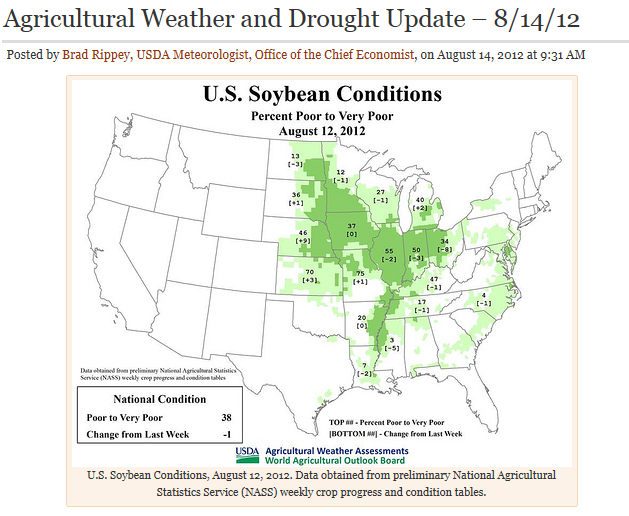
(Source:http://blogs.usda.gov/2012/08/14/agricultural-weather-and-drought-update-81412/ )
The diagram above indicates the damage that the drought had on soybean in certain parts of the U.S. This year’s drought is affecting over 1/3 of the county.


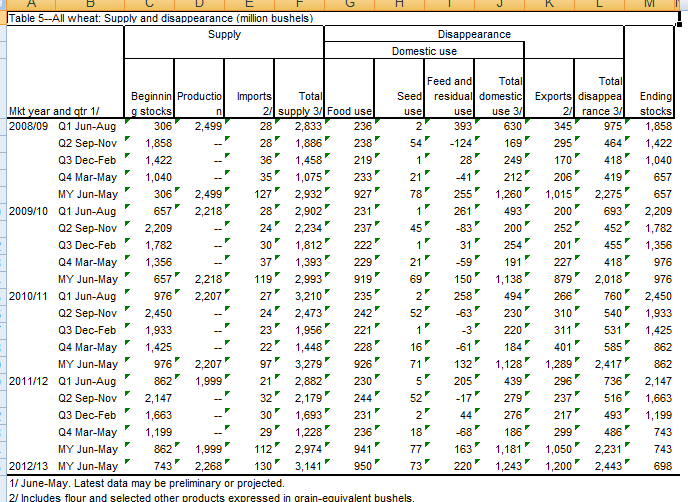
Wheat Yearbook Tables provide tables and statistical information for US Acreage, production, yield and farm price, world production, supply and disappearance, and USsupply and disappearance. As well as government and private stocks, and domestic and international prices. Above is a screen cap for wheat supply and disappearance in the US. It is updated on Sept 21st, 2012. (http://ers.usda.gov/data-products/wheat-data.aspx)


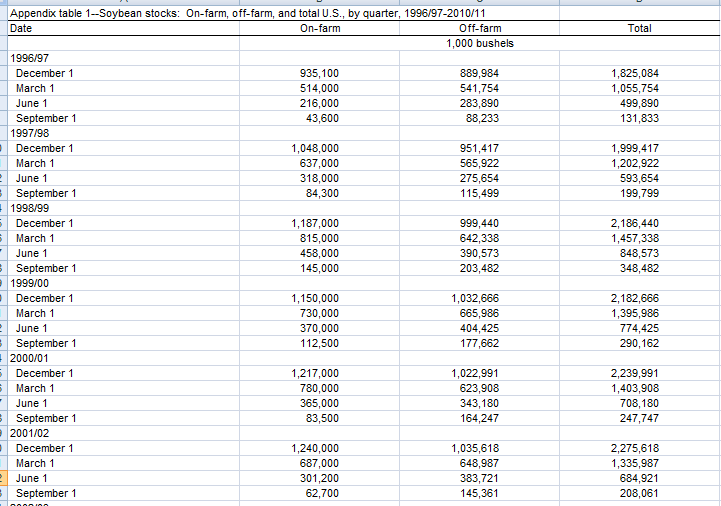
The website also provides detailed stocks information, which can be used to analyze supply quantities, which affects the commodity’s price pattern greatly. Provided above is a screenshot of the table. For more information, please visit the USDA Oil Crops Yearbook page (http://ers.usda.gov/data-products/oil-crops-yearbook.aspx).


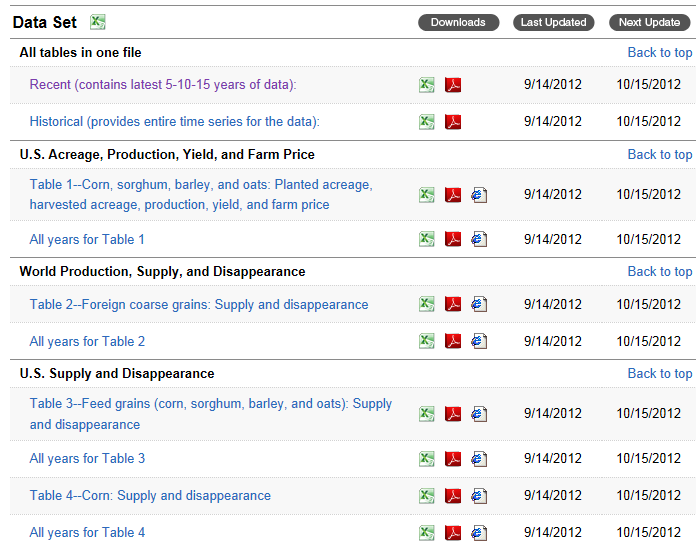
Similar to soybean and wheat, USDA has a yearbook table for corn.(http://ers.usda.gov/data-products/feed-grains-database/feed-grains-yearbook-tables.aspx)


I realize that it can be quite difficult and time consuming for beginners to evaluate and go through all these information. Nevertheless, these statistical numbers can come in handy for careful analytic works.


Spam prevention powered by Akismet