Categories
TRADING GAME Uncategorized

WEEK 9 (Part 3): Cool Source of Information

Website 1: http://www.topnews.in/business-news/commodity-update

One of the websites that I recently started visiting more frequently is TopNews.in. This website is very organized and strictly divided into different segments. For instance, Under Analyst View, they divided the sector into TopNews UAE, Top News, New Zealand, Company News, Singapore, Asia Edition, United States and Spain. It’s mostly organized by region, as well as by the level of importance. For the FRE 501 trading game, United   States would be the most relevant one. While the downside about this website is similar to that of Trading Floor – not everything are future commodity trading related, however, they do have a sector specifically dedicated to Commodity Updates (see link above). I find their news rather differentiated from the other commodity news that I usually get from Google News. Some of the articles they provided are written from a diverse perspective, and allows readers to view things from a different aspect. Furthermore, several of the articles provided on the website contain commodity trading tips and personal opinions from experts, hence it is not entirely news oriented. Personally I really liked this website for this, because it’s always harder to research for “opinions” than “news that has already happened”. Even though these experts aren’t responsible for our gains and losses from trading, and most of the time their opinions are biased to some extent, I still find reading professional’s opinions and tips more enjoyable and valuable than simply reading news report. This is also why I recommend this website to my fellow classmates this week: it contains a combination of news and personal tips from experts; readers get the best of both worlds!

Website 2: http://www.barchart.com/

I’ve also started using Barchart since Wednesday (Nov.7th)’s tutorial on technical analysis. While Trading Chart is still the go-to website for me when it comes to basic analytical charts, Barcharts provides better trading charts with more options. For instance, I find it much easier to analyze the trading charts with the price patterns colored (area), but Trading Chart doesn’t have that option, whereas Barcharts does. Therefore, to analyze the price patterns in more depth, Barchart is a more optimal website to get daily trading charts than Trading Chart.


Categories
TRADING GAME Uncategorized

WEEK 8 (Part 1): The Went Right/Wrong

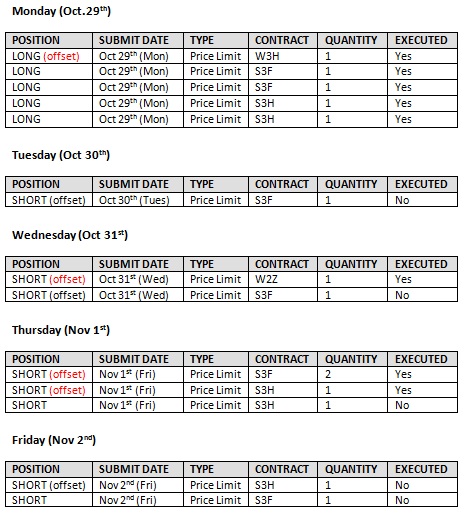
WHAT WENT RIGHT? As mentioned in last week’s blog, I anticipated that all 3 commodities future prices to increase this week. On Monday (Oct.29th) morning, I set up 1 price limit order for December wheat, as well as 4 different price limit contracts for January and March 2013 soybeans, because of the rumor on China increasing import demand for soybean, which could potentially increase the future prices dramatically. Fortunately, all the contracts were triggered sometimes during the day. I also managed to offset my short wheat contract from last week. Though there was some increase in price, futures prices for soybean didn’t show any signs of substantial increase until Tuesday (Oct 30th). Both wheat and soybean prices spiked on Wednesday (Oct 31st); I wasn’t sure how long they were going to increase for, and since I did have a large number of LONG contracts on hand, I tried to offset 1 soybean contract, and 1 wheat contract. The wheat contract was offset when wheat prices nearly reached its daily peaking price, and I earned $1061.50. The January 2012 soybean (S3F) contract failed to offset, because the price limit I set was never reached, which turned out to be a good thing as the soybean future prices further spiked on Thursday, which was totally unforeseen. According to Reuters Africa, China, world’s biggest soybean importer, was still the key cause to the boosting of soybean prices this week. Reuters Africa explained that October’s economic data from China revived and that there were signs of them increasing the imports for soybean. In addition, China’s annual harvest has decreased in a few key planting provinces. In addition, there was concern regarding South American’s soy crops being less than estimated, due to delayed planting caused by wet weather.

After seeing the price spiked yet again on Thursday (Nov 1st) morning, I knew I wanted to offset all 4 soybean contracts, since the chance of them continuing to increase for an extra day was very slim. I sent in 4 price limit orders on Thursday (Nov 1st) morning, and hoped that all of them would be offset successfully. While 3 of them did offset, one of the March 2013 soybean contract didn’t. From the 3 LONG soybean contracts that did offset, I managed to earn $1399.00 + $1674.00 + $1325.00 = $4398.00. I made an attempt to offset the LONG soybean contract again on Friday (Nov 2nd) morning, along with another January 2013 Soybean contract going SHORT. Unfortunately, neither of the orders went through, and as of Friday, I have a potential loss of $162.50 on the March 2013 Soybean contract.

WHAT WENT WRONG? I really should’ve set a lower price limit for the LONG March 2013 Soybean contract (S3H), so that it could offset on Thursday (Nov 1st). Also, instead of trying to get into the market on Friday (Nov 2nd)morning (and failed), I should have sent in a few soybean contracts going SHORT before the market closed on Thursday (Nov 1st); since it was obvious that soybean future prices could start dropping at any minute, after dramatically increasing for 3 days straight.

WHAT NOW? With the soybean future prices utterly decreasing, I still have a March 2013 Soybean contract in the market going LONG. From looking at the natural disasters that’s occurring all over the world, and the deleterious weather farmers face when planting, I anticipate that soybean future prices to increase in the long run. Hence, I’m going to be optimistic and keep the LONG S3H contract in the market until the soybean prices bounce up again.

End of Week 8 Balance: $46198.07


Reference

http://af.reuters.com/article/commoditiesNews/idAFL3E8M14XM20121101

http://futures.tradingcharts.com/intraday/ZSX2?anticache=1351825200


Categories
TRADING GAME Uncategorized

WEEK 8 (Part 2): The Road Ahead

Meteorologists and agronomists in the U.S.warn that the threat of the drought has not yet passed. Also, dry weather in the western U.S. is starting to severely damage the crops’ winter planting and production. Important agricultural states, such as Nebraska and Kansas have the lowest level of moisture in years. Climate experts estimate that certain areas need additionally 5 to 6 feet of snow to over 15 inches of precipitations over the next months in order for crops to revert to their normal conditions. In general, I anticipate commodity future prices to increase in the coming future, as a result of the recent disastrous weather that’s damaging the crops, along with the natural disasters that’s occurring around the world.

On the other hand, USDA was scheduled to release updated crop estimations on November 9th (Friday), which is likely to affect the commodity futures prices.

Wheat

While heavy rains hit the eastern U.S. last week when Hurricane Sandy roared, the west region remained waterless. Dry weather still remains to be a problem in the U.S. Plains winter wheat belt. Joel Widenor, a meteorologist for Commodity Weather Group, claimed that a continued lack of rain in the Plains area is likely to cause a third of the wheat crops entering winter poorly established. These areas will be vulnerable to the cold air that’s approaching. Normally, the new winter wheat crop should already be established with steady roots for the cold winter, but the wheat has only started emerging this year. Currently 15% of the U.S.winter wheat crops are rated to be very poor, 45% fair, and only 40% are ranked good to excellent. Hence, I expect wheat commodity prices to increase as winter approaches.

Looking from the technical aspect though, it appears that recent wheat futures prices have been fluctuating quite rapidly. Personally, I’m quite unlikely to be buying or selling any wheat contracts next week, as I find recent wheat market patterns quite difficult to predict, especially since I prefer offsetting all of the contracts before the end of the week if feasible. However, I might consider going LONG on one of the wheat contract that expires in 2013, and leave it in the market for a few weeks, to wait for the future prices to increase.

Corn

Analysts are suspecting some producers could switch corn acres to soybeans, as there’s concern about delayed corn planting in South America. If this happens, South America could lose to about 20% of corn production for 2012/2013 due to excessive precipitations, and flooding. Furthermore, Brazil’s trade ministry said that the country has exported a record of 3.66 million metric tons in October. The drought in the U.S. has increased the global demand for corn, and Brazil is expected to export a total of 17 million metric tons of soybean. Brazil is also exporting increasing amount of ethanol, as it is the main feedstock for ethanol in North America. However, as its stocks decreases, exporting business is gradually shifting back to the U.S., which causes the corn price to increase. On the other hand, Hurricane Sandy has improved the weather condition in the eastern Midwest region of the U.S., which is expected to aid the harvest of the final U.S. corns and soybeans. To conclude, planting concerns in the South America, and shifting of exporting market could both increase corn future prices, while improved weather condition is likely to decrease corn prices.

While news is once again pulling corn future prices both ways, from the analytical chart above, I think corn prices are highly likely to increase at the beginning of next week, unless breaking news happens over the weekend.  Otherwise, I am going to go LONG in a few corn contracts at the beginning of week 9.

Soybean

Soybean futures prices were pressured, and dropped by over 30 cents on Friday. It was largely due to recent private firms’ optimistic estimations on theU.S.’ 2012 soybean and corn harvest, which were above USDA’s estimation. USDA’s October estimation for the U.S. soybean crop was 2.860 billion bushels, while INTL FCStone estimated the soybean crop to be at 2.959 billion bushels on Thursday, and Informa Economics estimated the soybean crop to be 2.925 billion bushels on Friday. USDA also mentioned that the US soybean harvest was 87% complete already. In addition, the dry weather in the western U.S. is affecting soybean planting, as well as other crops.

On the contrary, the growing concern regarding South America’s planting delay hasn’t been diminished, and it could cause producers to switch from corn acres to soybeans, which means there could be an increase in soybean production in 2012/2013. If it does occur, it could potentially decrease soybean futures prices. Also, improved weather in the eastern Midwest part of the U.S. should assist the harvesting of the final U.S. corn and soybeans for the ten days.

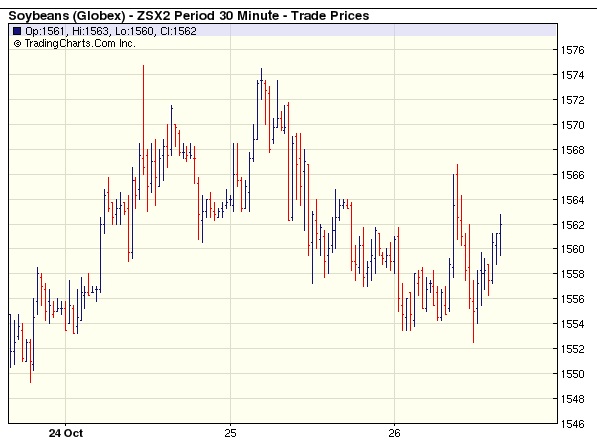
Soybean price dropped by more than 30 cents after CBOT closed on Friday (Nov 2nd). As shown above, the hastily fall in soybean commodity price allowed soybean prices to return to the price level they were at before they spiked three days ago (as shown above). If no breaking news occurs over the weekend, I foresee soybean future prices to drop to a stop early next week, perhaps stabilizes for a day or so, and rebound up latter during the week. Also, I doubt next week’s price fluctuations in soybean are going to be as thrilling as they were this week, especially since recent news are pulling the commodity prices both ways.

Reference

http://af.reuters.com/article/commoditiesNews/idAFL3E8M261J20121102

http://www.brecorder.com/markets/commodities/america/88605-cbot-corn-down-on-technical-selling-.html

http://www.brecorder.com/agriculture-a-allied/183/1253793/

http://futures.tradingcharts.com/intraday/ZSX2?anticache=1351922666

http://mobile.reuters.com/article/idUSBRE8A112T20121102?irpc=932

http://www.reuters.com/article/2012/11/01/us-brazil-commodities-exports-idUSBRE8A01DO20121101


Categories
TRADING GAME Uncategorized

WEEK 8 (Part 3): Cool Source of Information

Website: http://www.tradingfloor.com/

Trading Floor is a very professional and formal website consists of a wide range of information from popular financial blogs, to trading mentor videos. It is an online community, targeting people who trade futures, stocks, FX options, CFDs, and Trade Forex. Trading Floor is connected with some of the experienced traders from different fields, such as equity strategists, macroeconomics pros, and most certainly, commodity trading strategists. These featured experts give advises and personal opinions for readers by commenting on the website on a regular basis. Similar to Twitter, this website allows people to follow these experts to receive updates from them. Here is the link to the list of trading experts that Trading Floor features: http://www.tradingfloor.com/traders

As mentioned earlier, Trading Floor is designed for not only future commodities traders, but also traders from other markets as well. For this reason, certain information provided on the website is not relevant to FRE501’s trading game. However, since they have everything divided into different sections, we can simply go to the agriculture section under topics, and it provides updated information on soybeans and corns. For example, one of the recent updates on agricultural commodity was by Ole Hansen, Head of Commodity Strategy at Saxo Bank; he discussed the recent grain ratio updates, with corresponding graphs. He mentioned that both soybean/corn ratio and corn/wheat ratio are very stable, except that wheat tends to do slightly better due to weather problems in exporting countries, and soybeans are likely to underperform due to the recent news on South American crop. Both of which corresponded to what has happened with the commodity markets in the past week. Therefore, even though not all the information provided is necessarily directly aimed at future commodity traders, crops are crops, what happens to the world crop production, and demands and supplies of importers and exporters of these commodities should affect all the markets equally.  Thus, I find Trading Floor useful despite the additional information it contains on other markets.

(Source: http://www.tradingfloor.com/topics/soya-beans)


Categories
TRADING GAME Uncategorized

WEEK 7 (Part 1): The Went Right/Wrong

WEEK 6 RECAP

I finally managed to take advantage of the wheat prices fluctuation, and offset both contracts with a slight gain after keeping them in the market for 3 weeks. The short contract (W2Z) was offset first at the beginning of the week, while the price was low, and I set a price limit on the long contract (W3H), which was triggered after wheat price rebounded.

End of Week 6 Balance: $40668.59

***

WEEK 7

HOW I MEANT TO PLAY THE GAME… Both corn and wheat futures prices spiked for two days straight at the end of week 6; I was certain that commodity future prices would drop for the first half of the week, and rebound during the latter half. Given my prediction for the next few days, my initial plan was to go SHORT on several wheat and corn contracts early on Monday (Oct 22nd) morning, and offset them before the market closes on Tuesday (Oct.23rd). Perhaps, wait for a day, to re-enter the market with a few LONG contracts for both commodities, given that corn and wheat would rebound after the drop from Monday, and Tuesday. I would then offset all of my long contracts before the market closes on Friday, and keep no contracts in the market over the weekend.

WHAT REALLY HAPPENED? Tradesim didn’t allow my week to go as planned. I set up a few price limit orders for 3 SHORT wheat contracts, and 1 SHORT corn contract on Monday morning. Based on the price record from CME, it was clear that both wheat and corn future prices went above the price limits that I’ve set on Monday. However, Tradesim failed to trigger my price limit orders, and none of the contracts were executed. I became frustrated after I saw the prices for both commodities started to show signs of dropping on Monday night, and resent my orders with market orders. While they did get processed the next day, Tradesim lagged, and my orders weren’t processed until right before the market closed on Tuesday. By then, the prices have already hit their limit down, and started to rebound. As a result, even though corn and wheat commodity prices were dropping for the entire Tuesday, my total gain was negative due to my low “price in” prices. I essentially went SHORT after the future prices were finished descending. Knowing that I wasn’t going to make any gains with both commodities’ price patterns going upward; I sent in another 4 price limit orders, and set the prices just below my “price-ins”, to allow the contracts to automatically offset themselves once the commodity prices decrease again.

HOW THE WEEK ENDED… After Ukraine had confirmed a ban on exports of wheat on Wednesday, both corn and wheat future prices spiked. I was potentially losing a total of $2962.00, and 3 of the contracts were receiving margin calls. None of the price limit orders were triggered, because the prices went the opposite direction. Fortunately, spiked prices were responded by a drop on Thursday; corn price dropped low enough that the price limit order managed to offset the contract, and I earned $174.00. My potential loss for the 3 SHORT wheat contracts has also decreased to $1312.00, and the margin calls were cancelled. Commodity futures prices continued to drop on Friday, and the price limit for 2 of the SHORT wheat contracts were triggered. I managed to earn $61.50 for each contract, which total up to be 2*$61.50 = $123.00. As of Friday, my potential loss for W3H SHORT contract is $200.00.

End of Week 6 Balance: $40765.34


It appears that Tradesim has been having difficulty processing my orders at the time that I intended them to, and I always ended up entering the market after the predicted prices have completed fluctuating.  As a result, the prices usually have already started to move in the opposite direction by the time my contracts are in. I wonder if it would be better to just do the opposite of where I think the prices are going to go, and take the lagging period into consideration when making trading decisions.


Categories
TRADING GAME Uncategorized

WEEK 7 (Part 2): The Road Ahead

Wheat

Export demand for wheat is expected to increase in the coming weeks for the U.S.suppliers; since wheat supplies are running low in the competitor exporting countries, such as Russia. As well, the recent ban on wheat export in Ukraine is also causing export demand to increase in the U.S. Interestingly, due to a disease ravaged harvest, which caused most wheat to fail to meet the quality requirement for bread, Britain is going to be a net wheat importer for the first time in ten years. Furthermore, the recent dry weather is hurting crop production in Australia and the U.S. plains. The dry weather and lack of moisture in the U.S. plains could possibly cause difficulty for winter wheat planting, and this is going to renew concerns about drought stress on the crops. An increase in exporting wheat demand, along with a possibly decrease in wheat product are likely to increase the wheat future prices in CBOT.

In addition, even though wheat future prices have been declining for the past two months, technical traders are going LONG on December wheat contracts, as they expect December wheat future prices to go up.

Corn

In the U.S., corn future prices have remained high due to reduced harvest yield. As well, farmers have been increasing their corn storage as harvest period approaches to an end. On the other hand, chief analyst for Northstar Commodity Investment Co., Mark Schultz, claims that oversea demands, ethanol production, and domestic feed demands for corn are all shrinking. People are no longer interested in corn, because meat and fuel productions are not making any profits. In the mean while, corn traders are waiting for the USDA to report the latest U.S. crop size, and it is possible for corn futures to continue moving in a sideway pattern. The recent hype on Hurricane Sandy could also have an effect on corn future prices. South County farmers who still had standing corn in their fields cut all of them in anticipation of Hurricane Sandy last week. Both high winds, and heavy rains could severally damage corn crops.

Recent news on corn showed signs of corn future prices going in different directions. Therefore, I think it is possible that corn price will continue to show a sideway pattern, and have fluctuations from day to day.  As for the corn future price pattern for the next few days, I expect corn futures to spike early next week, rebounding from last week’s dramatic fall.

Soybean

Due to five consecutive years of decline in soybean growth and continuous growth in domestic demand, China’s soybean imports have increased to 57.5 million tonnes in 2012, and reached record high. According to the latest report from USDA, it is possible that China’s demand for soybean is going to reach 61 million tonnes in 2013. Also, major soybean producers after the U.S., Brazil and Argentina have started planting crops for next spring; traders can expect soybean future prices to be pressured from increasing in production, but increasing in demand from China is likely to pull the commodity price in the opposite direction.

Looking at the upcoming future, soybean future prices have been declining for two days straight (as shown above) last week. I highly anticipate the prices to rebound early next week. Since November, soybean contract is approaching its expiry date, and rapid fluctuations in S2X future prices can be expected until it expires. Hence, I plan to go LONG in January soybean contracts; since commodity future prices for contracts in the further future are more likely to follow the price pattern than the ones near its expiry dates.


Reference:

http://www.agriculture.com/markets/analysis/corn/grains-drift-lower-friday_9-ar27123

http://www.albertafarmexpress.ca/news/cbot-wheat-corn-end-lower-soy-higher/1001799830/

http://www.businessweek.com/news/2012-10-26/wheat-climbs-on-demand-for-u-dot-s-dot-supplies-corn-soy-gain

http://news.providencejournal.com/breaking-news/2012/10/so-county-farmers-cut-corn-bracing-for-high-winds-and-rain.html

http://www.nzweek.com/business/chinas-soybean-imports-to-reach-record-high-18402/

http://online.wsj.com/article/DN-CO-20121026-009942.html

http://online.wsj.com/article/DN-CO-20121026-009477.html


Categories
TRADING GAME Uncategorized

WEEK 7 (Part 3): Cool Source of Information

Website: http://www.agriculture.com/

The Agriculture website was recommended to me by my fellow classmate, Cindy Bae a few weeks ago, and I have been using it since. Aside from the latest news update on agricultural commodities, Agriculture also provides up-to-date weather forecasts along with maps, weekly moisture index, and palmer drought index. As well as soil moisture, precipitation maps, weather, and market report, etc. (http://www.agriculture.com/weather). It is a very useful website for both the farmers and the traders.

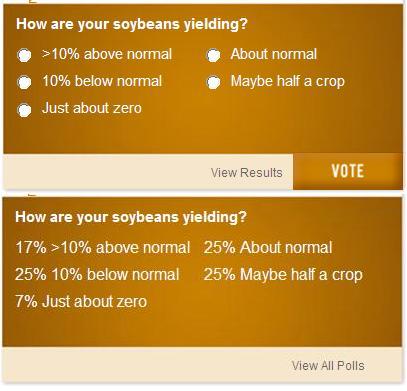
It’s also worth mentioning that Agriculture has created some fun polls (http://www.agriculture.com/polls) that usually shows up on the side bars for web browsers to vote, and view results. See examples attached

These results should never be used as official evidence to predict the futures market price patterns. Since there is no way of testing the accuracy of the results of these polls, and they are probably highly biased. They are used for fun purposes only.

Twitter

Reuters Top News @Reuters
CME Group @CMEGroup
Dept. of Agriculture @USDA

I started following Reuters Top News, CME Group, and Department of Agriculture on twitter about two weeks ago. They update their twitter account as frequent as they update their official websites. I find it easier to keep up with the recent market trend after I followed them. Also, they almost always provided website links along with the corresponding news that they posted. This saves me time from going to their sites individually and look for the specific news.


Categories
TRADING GAME Uncategorized

WEEK 5 (Part 1): The Went Right/Wrong

WHEAT

They are Stuck!

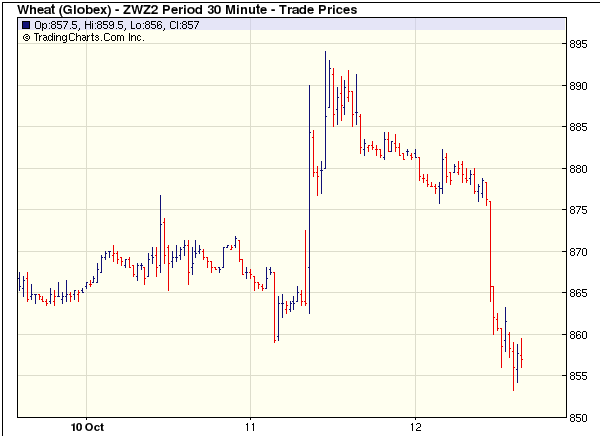
It’s been over a week since I placed the spread order on wheat. Spread order is used to reduce the loss, and risk. However, as shown on the chart above, that wasn’t the case. Since the end of last week, I have been losing in both long and short wheat contracts. This occurred because up until Wednesday (Oct.10th), the market price has been higher than W2Z, the SHORT contract, and lower than the LONG contract, W3H (see graph below).
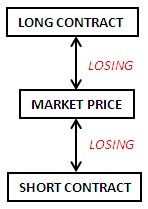
My plan was to offset 2 contracts individually, unless the wheat future prices fluctuated drastic enough that the gain from one contract was large enough to cover the loss for the other.

Although it wasn’t nearly high enough to cover the loss from the SHORT contract, wheat futures price increased to above W3H (LONG)’s “price in” on Thursday (Oct. 11th). This was a result of USDA’s estimation on the reduction in both the U.S. and world wheat stocks. Since I didn’t think wheat future prices were going to fluctuate as much as soybean futures, I decided to offset the long contract while it’s making gains. However, there wasn’t enough W3H available for me to offset. According to Thursday’s closing price, the market price is still higher than W3H’s “price in”.

Due to the lowered export demand for wheat in the U.S., along with the expected storm coming on the weekend, the U.S. government forecasted for greater world supplies for wheat than initially expected.  Unexpectedly, wheat future prices dropped severely on Friday. As listed above, W2Z’s price out was $856.75, I could’ve ended the contract if I placed a price limit on W2Z earlier during the day. However, since I failed to offset my long wheat contract yesterday, offsetting W2Z means increasing the risk of losing more from W3H, especially since the market’s closed for trade over the weekend. I ended my 5th trading week by leaving both wheat contracts in the market for another weekend.

SOYBEAN

Missing Opportunity for Potential Gain… AGAIN!?

POSITION SUBMIT   DATE TYPE   CONTRACT QUANTITY EXECUTED
SHORT Oct 9th (Mon) Market Spread S2X 1 Yes
LONG Oct 11th(Thurs) Price Limit S2X 1 Yes

Potential Gain/Loss

SOYBEAN Monday Tuesday Wednesday Thursday
Price In 1554.00 1554.00 1554.00 1554.00
Today’s Price 1551.00 1550.00 1523.25
Price Out 1548.00
Gain/Loss $150 $200 $1537.50 $299

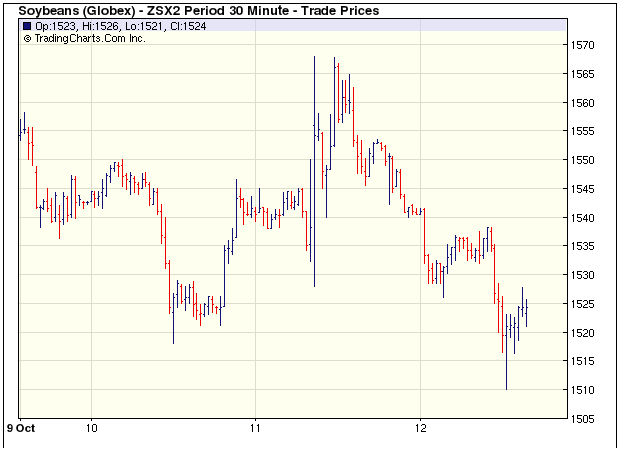
As mentioned last week, I predicted soybean futures to stay relatively constant until the release of USDA’s report on Thursday (Oct. 11th). While the price did stay quite stable on Monday, and Tuesday, soybean futures dropped to monthly low, and price at closing was $1523.25 on Wednesday. While I had second thoughts about offsetting on Wednesday, I insisted on going with my initial prediction, and stayed in the market. However, soybean price started to rebound on Wednesday night, and continued to increase on Thursday.

Soybean future prices soared, because USDA reported that while soybean production has increased by 9% from September, it’s still 8% lower from last year. USDA forecasted that soybean domestic supplies would be tight next year, which caused the price to spike on Thursday.  Another possible reason to soybean’s hasty price spike could be due to the weather. According to Brian Early, an Indiana agronomist, with more rain, soybeans receives less daylight, and as a result, it becomes more difficult to get the moisture out of the soybeans.  However, USDA disagreed, claiming that the recent rainfall has lessened the severity of their soybean situation from the drought. On the other hand, when analyzed with technical analysis, it’s reasonable for soybean price to rebound after a drastic drop in price.

After soybean future prices increased by almost 40 cents per bushel, I set a price limit that is slightly lower than my S2X’s “price in”. My strategy was that if the price reached that price, I’ll offset the contract without much gain, but the loss would be zero. If the price continued to spike without dropping even slightly, I’ll leave the contract in the market, until soybean price drops again. Fortunately, the price fluctuated at some point during the day, and the system automatically offset the contract at $1548.00. I gained a total $299.00

However, soybean future price, once again, dropped drastically on Friday. Soybean futures price drop was a result of slowing demand for the U.S. supplies; the U.S. is the world’s biggest grower and exporter of soybeans. I clearly should have been more patience with the soybean price pattern.

If I offset the soybean before the market closed on Wednesday, or waited until Friday to offset, I could’ve had a gain of approximately $1500.00 or more. I should’ve had more faith in the price fluctuation cycles that I’ve observed for the past month, and expected price to rebound after such drastic drop in price on Wednesday; as opposed to solely depend on the USDA reports to effect the commodity price. Therefore, I lose by not gaining the potential $1537.50-$299.00 = $1238.50 that I could’ve earned by offsetting earlier.

After missing huge potential gains for 2 weeks straight, I realized that timing is really important when it comes to trading. It’s absolutely useless and pointless to predict the correct price pattern if I’m unable to predict the time or moment that price starts to fluctuate and flip the price pattern.


Reference

http://af.reuters.com/article/commoditiesNews/idAFC3E8J302C20121011

http://www.agriculture.com/markets/analysis/wheat/wheat-falls-on-dem-concerns_11-ar26879

http://www.bloomberg.com/news/2012-10-12/corn-soybeans-decline-on-slowing-demand-for-u-s-supplies.html

http://futures.tradingcharts.com/intraday/ZS/B2

http://www.hoosieragtoday.com/index.php/2012/10/11/soybean-harvest-may-slow-as-rain-begins/

http://www.sacbee.com/2012/10/12/4906863/news-summary-wheat-falls-on-weekend.html

http://thegazette.com/2012/10/11/corn-soybean-prices-soar-on-usda-production-yield-report/
 

Categories
TRADING GAME Uncategorized

WEEK 5 (Part 2): The Road Ahead

Since commodity future prices for wheat, corn and soybean all took a steep and hasty downhill dive on Friday. I foresee prices for all 3 commodities to rebound early next week.

Wheat

In general, wheat futures price stayed relatively stable until the release of the USDA report on Thursday. While USDA did report a lower than expected domestic and world wheat supplies, risen corn prices led wheat price to increase as well. Corn and wheat future prices often move together as they are substitutes, and both are used in animal feed. Wheat future price dropped tremendously on Friday, due to an increase in global wheat supplies from lowered export demand for the United States, and the predicted weather change a day earlier. I expect wheat prices to jump up next week, because wheat future fell below analysts’ expectations; it only makes sense for it to make a quick rebound before stabilizing at a relatively low price again.

Looking slightly ahead into the future, I foresee an increase in wheat futures price, because the USEDA report also forecasted a reduction in the world wheat supplies for 2012/13 by 6.2 million tons due to decreased production in the United Kingdom, Russia and Australia. All three countries are major wheat producers and exporters.

By looking at the analytical chart above, and ignoring all other factors, I see a clear upward trend in the wheat price pattern after Friday (Oct.12th)’s dramatic drop in wheat price. Therefore, despite the 2 wheat contracts (1 LONG, 1 SHORT) that I already have in the market, I am likely to place another LONG contract on wheat next week.

Corn

Corn price spiked last Thursday (Oct.11th), after USDA reported that corn harvest is the lowest since 2006. It continued to reflect the severe impact from this year’s drought. Nevertheless, like wheat, corn price was also pressured due to reduced export demand on Friday (Oct.12th). USDA reported that instead of exporting 300,000 to 425,000 tons like analysts expected, the net corn export sales were only 14,200 tons in the week through October 4th. Furthermore, 69% of the corns are already harvested this year, which is 28% ahead of what would be harvested in a typical year.

While reduction in exporting sales caused the corn futures to decrease, I still predict corn price to increase. For the global supplies of corn is still tight, and corn users such as livestock farmers, the ethanol industry, and other corn importing countries, are continuously demanding for the crops.

Soybean

U.S. government report reported an improvement on global soybean supplies, which greatly eased soybean future prices. Also, South America’s beneficial planting weather pushed down soybean price even further. Precipitations are seen in northern Brazil, and significant rainfalls are noted in the eastern Mato Grsso region. Both Brazil and Argentina, the world’s second and third largest soybean producers, are estimated to produce 81 million tons and 55 million tons of soybeans this year. Moreover, according to USDA’s weekly export sales report on Friday, soybean exports have reached lowest in two months; investment funds reported that 10,000 soybean contracts were sold as traders respond to the USDA report. World soybean supplies have increased as a result of that. President of grain trader Hammersmith Marketing Ltd., Wayne Bacon, reasoned that soybean futures will remain high until the U.S. is no longer the only supplier of soybean. He anticipates the prices to decrease after harvesting is done in South America. Based on the information gathered, I predict soybean prices to slide down, and stay relatively low in the near future. As for the next few days, I think soybean price is going to rebound next week, especially after dropping so drastically last week.

Compared to wheat and corn, price pattern for soybean appears to have more fluctuation, as indicated in the chart above. The price chart above shows the soybean future price change for the November, 2012 contract, which is expiring in less than 2 months. Prices tend to fluctuate more as contract approaches the expiry day. I anticipate S2X futures price to fluctuate more intensely as November approaches, although the same can’t be said for other soybean contracts.


Reference

http://www.agriculture.com/markets/analysis/wheat/wheat-falls-on-dem-concerns_11-ar26879

http://www.albertafarmexpress.ca/news/u-s-wheat-corn-dive-on-poor-exports-profit-taking/1001763217/

http://www.businessweek.com/news/2012-10-12/corn-trims-weekly-advance-on-speculation-rally-may-cut-demand

http://futures.tradingcharts.com/intraday/ZS/B2

http://futures.tradingcharts.com/intraday/ZWZ2?anticache=1350095089

http://www.portageonline.com/index.php?option=com_content&task=view&id=29160&Itemid=35

http://www.winnipegfreepress.com/business/us-slightly-lowers-corn-harvest-projection-as-droughts-impact-becomes-clearer-amid-harvest-173703471.html


Categories
TRADING GAME Uncategorized

WEEK 5 (Part 3): Cool Source of Information

BLOG: http://nogger-noggersblog.blogspot.ca/

I randomly came across Nogger’s Blog the other day, and was surprised by the insightful information and thoughts presented by the blogger. The owner of the blog has worked as a shipper, merchant, trader & broker, in the agriculture field for over 30 years. He updates his blogs on a regular basis, with updated news, data, and information, as well as personal thoughts and opinions. If one is not currently up to date with the recent commodity futures market, reading his blog would help the individual to go back into the loop instantly. Although, readers still have to be aware of the potential biasness presented in the blogs. As Nogger disclaimed himself, all comments on the website are sole opinion of the blogger, and they are not considered as professional advises. He is not responsible for the accuracy of the information and data.

WEBSITE: http://agrimoney.com/

Agrimoney is one of the websites that’s been frequently used since the beginning of this trading game. I chose to suggest Reuters (http://in.reuters.com/) over Agrimoney two weeks ago, because I found myself visiting Reuters on a daily basis, but it was not the case for Agrimoney. Nevertheless, it is still a resourceful website that provides the latest news for commodities, as well as their future prices. The one feature I like the most about Agrimoney is that they have an “Opinion & Features” section (http://www.agrimoney.com/4/opinion/), which contains experts’ and officials’ thoughts on the recent commodity price pattern change. I find it more useful than news, as news only gives me information on what has already happened, and most of which were statements, which are none-arguable. It’s not as useful as opinions when it comes to forecasting the upcoming price change in futures market.

Spam prevention powered by Akismet