Categories
Comm296

An Alternative and Memorable Marketing Campaign – But is it effective?

https://www.youtube.com/watch?feature=player_embedded&v=1B442Uvi8yM

I present to you Olla Condoms’ facebook marketing campaign headed by the Brazilian agency – AGE Isobar.

The agency targeted specific male facebook users and created fake facebook profiles for their hypothetical unborn children by adding “Jr” to their names. These profiles then sent friend requests to their respect “fathers” further solidifying the encouragement for condom use. This idea is not only innovative, but also at a low-cost (though labour-intensive).

However, is it actually effective? When evaluating this question. Two main issues arise.

One, the effectiveness is hard to measure. We do not know how many guys who have received this invite were actually put into action. Ultimately, we don’t know if this will actually convince these guys to choose Olla condoms over other brands. In addition, the campaign emphasizes more on the importance of general condom use rather than focusing on differentiating Olla as a brand. Hence it is hard to choose appropriate metrics to measure the effectiveness of this campaign.

Second, the response has a high likelihood of backfiring as what can be humorous to one can be can be annoying to another. One negative response as by one commentator expresses:

That’s not advertising. Its spammish behaviour. No brand shall friend request me, without a life time hatred called upon them. Stick to the ads – douchebags..

It is evident that while personalized advertisement can be memorable, over-personalized advertisement can become annoying, spam-like, and semi-creepy.

This case study can be applied to other marketing campaigns that attempt to break the mold with innovation – though creativity is a good thing, it must also ensure effectiveness – successfully positioning the brand and putting the viewer into action.

Source: AdWeek

Categories
Comm296

Poo Poo Paper & Modern Toilet – Filling Up Unoccupied Postions in Consumer Minds.

Brace yourselves, brands are going to places where they’ve never gone before.

This is a response to Alvin Koo’s Blog Entry: “Holy Crap vs. Mom’s Healthy Secret.

In his post, Alvin pinpointed the branding advantage Holy Crap had over Mom’s Healthy Secrets even though the two products share simliar functions. This advantage is a result of Holy Crap‘s unconventional brand name and atypical cereal packaging. This is an important, yet sometimes overlooked, point raised by Alvin – to be memorable, you really need to stand out.

To put in marketing terms, when your product is unique and unconventionally associated with, it effectively fills up an unoccupied position in consumer minds.

No one would have guessed that ‘crap’ and ‘cereal’ could be paired together to successfully form a brand that’s not only acceptable, but beloved.

While discussing this use of unconventional association with ‘crap,’ Poo Poo Paper comes to mind.

Who would have thought that recycled paper made from elephant feces would receive massive popularity and favourable reception by consumers considering you are essentially purchasing poop? I certainly wouldn’t have. And yet, the brand is able to remain vividly in consumer minds thanks to the exact reason Alvin pointed out – filling up unoccupied postions in consumer minds through association with unconventional terms.

However, perhaps there is no other brand that takes this to the extreme more so than Modern Toilet, a toilet-themed restaurant based in Taiwan that gained massive popularity since opening.
Modern Toilet‘s marketing has done the impossible task of associating food successfully with toilets in consumer minds. Other than being immediately memorable, this fosters a massive word of mouth tendency, which attracts curious visitors who would share their unique dining experience through online photos and social media. This in effect, allows Modern Toilet to reap profitable rewards and gain positive recognition.

These examples show a vital indication that the product’s intrinsic properties only takes a secondary importance to brand presentation when it comes to being able to be remembered, accepted, and beloved.

Brace yourselves, brands are going to places where they’ve never gone before. Perhaps this gives hope to some entrepreneur out there currently working on a new line of Poo Poo Perfume.

Categories
Comm296

A Consumer’s Perspective on McCafe and its International Expansion

This is a response to Heena Ahuja’s Blog Entry:“Renovating McDonalds’ Brand Image”

In Heena’s post, she discussed how McCafe, McDonald’s subsidiary, contributes to McDonald’s brand image through diversifying McDonald’s service and offerings.

In this post, I wish the dissect why this approach for McCafe is successful with regards to my personal experiences with the brand as a consumer not only in Canada, but also on an international level.

As clearly demonstrated by the video below, McCafe’s value proposition is personalization that focuses on delightful personal treats. This is a disctint departure from McDonald’s main line of fast-served burgers and fries, or as Heena described, a shift from “[McDonald’s] brand image in order to better adapt to its customers changing needs.”

It is evident that McCafe aims to establish itself as a brand that is personal, pleasurable, and casual – a direct opposition to the often stress-filled 21st century working life-style. This especially resonated with John Betts, McDonald’s Canada CEO, who believes “people tend to linger a little bit more in restaurants today…[and] take a break from the busy lifestyle.”

As a consumer, I can particularly relate to this very tendency Betts refers to. In fact, I believe this is the exact reason why I was drawn to McCafe. Last summer, while travelling in Guangzhou, China, I decided to treat myself and visited McCafe for the first time after a long day of trekking outdoors under the unbearably scorching sun. For a cup of ice-coffee and 3 lamingtons, I was willing to spent a total of $30 RMB, which is equivalent of spending $30 Canadian dollars in Canada in buyer power terms.

As a usually frugal consumer, it was surprising to me how I was so willing to spent so much money for so little physical food. To put more precisely, I was surprised by how much I was willing to pay for an experience. I have to admit, the experience of sitting on McCafe’s leather furniture, enjoying the airconditioned and modernly decorated interior, and listening to smooth jazz was more memorable than the actual taste of the lamingtons. I felt relaxed and truely had “My Me Time,” as described by the promotional video, under the comfortable and warm setting.

This anectode precisely shows how successfully McCafe can deliver its value proposition. I am certain that I was not the only consumer who was able to experience McCafe in the way it portrays itself to be as McDonald’s July Same-Store Sales Rise 5.1% on Gains in China. Globally, McCafe’s brand establishment is so consistent in that the next time I visit a McCafe, regardless in Vancouver or in Guangzhou, I shall expect the same experience.

Categories
Comm296 Marketing

“LOL?.. With a Tint of Creepiness.” – Can Facebook’s One-on-one Marketing Go Too Far?

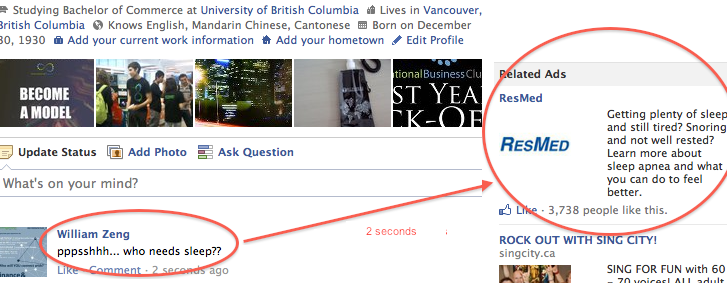
Yesterday, while web-surfing on Facebook, I received a personalized ad 2 seconds after my profile status update. Though the ad was not directly related, it was a highly intelligent selection out of a million other possibilities. This content-personalization technology is creating extraordinary opportunity for small businesses.

Facebook is an immensely powerful marketing tool with both highly capable push and pull functions. More specifically, it achieves every marketer’s dream – automatic market segmentation and targeting. This is an extremely efficient way for small businesses to reach its target markets because of:

Low Cost – Since all the market information is readily available, small business does not incur costs for market research to determine target market.

Effectiveness – Brand position will be effectively delivered because ads are only shown to people with higher likelihood of taking interest. In effect, brands more effectively develop relationships with potential customers since the ads presented are relevant to their needs.

Levelled Playing Field – The intelligent ad-filtering process decreases threat of competition with the playing field of Facebook being levelled – brands, big or small, will have to go through the same system only to be seen by the people who would be interested.

Connectivity – There is an tremendous sense of immediacy in ads displaying seconds after user online activity. This is crucial for retention because it encourages impulse interest. I admit. I clicked on the ad because I was immediately intrigued by what was presented to me. In addition, Facebook’s ‘like’ function promotes a strong network effect in which one can be instantly influenced by peers’ ‘likes.’

However, from the perspective of the receivers who cannot espace this frenzy, an issue of security arises. Will web-users always be fond of the carefully-personalized ads? Or will some be concerned about external bodies utilizing private information to achieve unjustified goals?

Speaking for myself, although I thought the ad showing up seconds after my update was pretty cool, I couldn’t help but to feel a bit watched…

Spam prevention powered by Akismet