
Create a complex digital story, educational in nature, using one of a range social media.
Your story must:
• Be educational
• Be a story–not a digital lesson or lecture
• Be viewable either as an embedded file or a link on the Story page of your e-portfolio
In addition to the embed/link of the story itself, describe the following on the Story page:
• Why was this the right tool for you to use to tell your story, particularly from a pedagogical perspective?
• How did you purposefully select this for your storytelling tool?
• How does this story work within a course that you teach (or would like to teach) using sound pedagogical arguments?
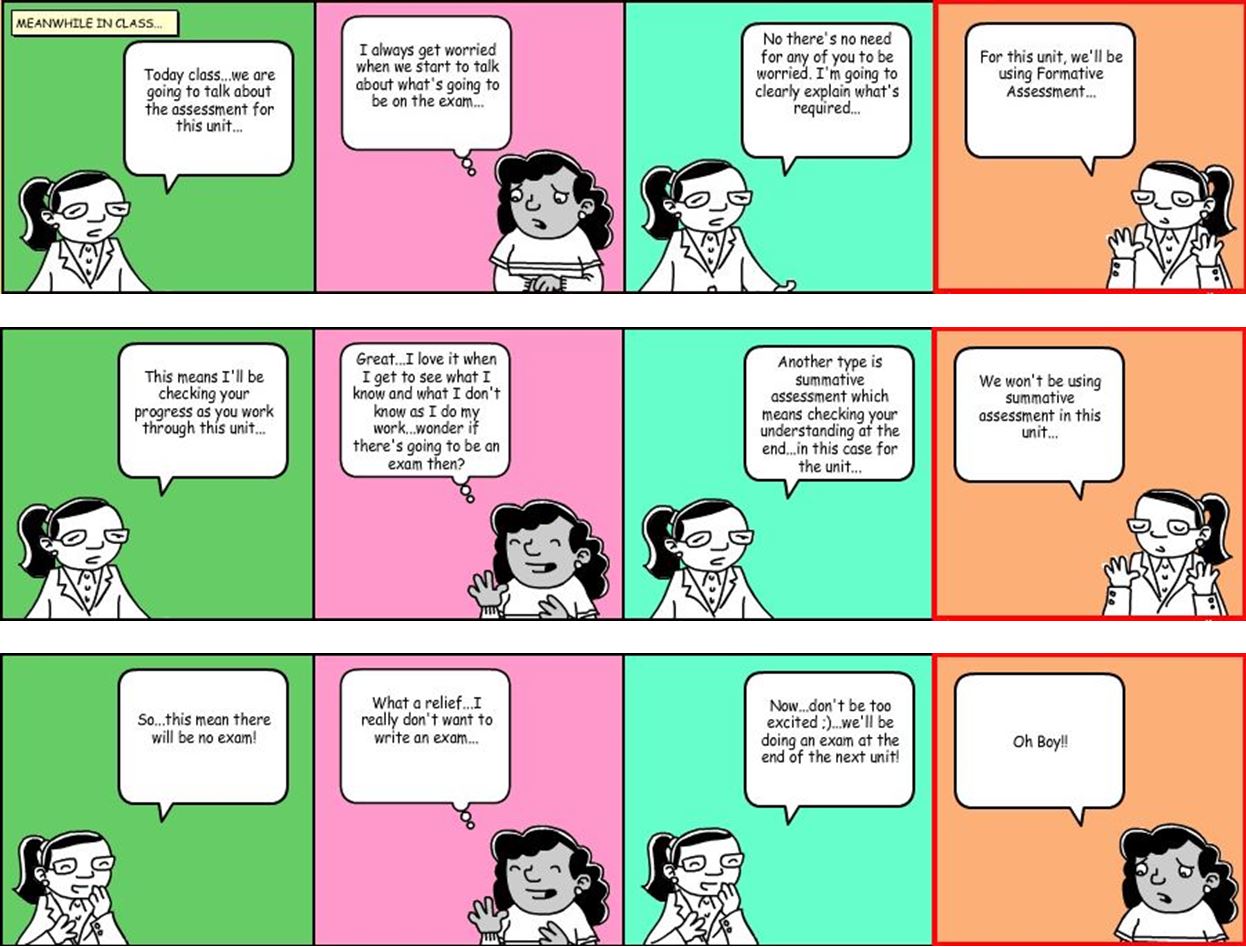
I created an education theory ‘tongue-in-cheek’ comic strip, see graphic above, using Make Beliefs Comix (MBC), an online website where users are able to create their own comic strips. This tool was recommended in a another ETEC for digital storytelling so I decided to use this for a new experience an to evaluate the tool. Interestingly, users are able to quickly and easily create shareable comics. The MBC website provides many templates and information specifically geared towards educators, including templates and tools that allow users to create and customize their comics. In addition, teachers can provide templates as scaffolds and have students work on their completion. Created comics can then be printed, emailed, or shared on various social media.
One of the reasons I chose Make Beliefs Comix to tell my story is I believe it exemplifies the four attributes of an e-learning environment as described by Anderson: Learner-Centered, Knowledge-Centered, Assessment-Centered , and Community-Centered (Anderson, 2008).
- Learner-Centered: MBC allows users to create their work in an online setting. Learners are free to choose from any number of available templates, can create their own characters and props, and may layout their comic in a way the feel appropriate. The highly customizable nature of this online tool provides users with an opportunity to “share their understandings, their culture, and the unique aspects of themselves” (Anderson, 2008 p. 36).
- Knowledge-Centered: MBC provides users with a way of understanding and discussing knowledge. MBC provides users the affordance to share their knowledge by “providing a near limitless means for them to grow their knowledge and find their own way around the knowledge of the discipline, benefiting from its expression” (Anderson, 2008 p. 37).
- Assessment-Centered: With MBC, teachers are able to provide formative assessment by commenting on the students’ work as they progress. Students are able to improve the quality of their work by first reflecting on the feedback received, and then editing their work prior to final submission. MBC also provides an informal social network where students can post and reflect upon the ideas of their peers; learning to both provide and receive constructive feedback, which serves to maintain student interest and commitment (Anderson, 2008).
- Community-Centered: Using social media, teachers can set up groups, feeds, etc. as part of a public community or as members of a private school-based community. Students and teachers are able to read and comment on the posted comics. In this way, students are able to share with their peers as both learners and experts; “supporting and challenging each other, leading to effective and relevant knowledge construction.” This “shared sense of belonging, trust, expectation of learning, and commitment to participate” (Anderson, 2008 p. 39), creates a sense of community in the learning environment.
Another reason I chose to use MBC is that MBC embodies aspects of constructivism, allowing users to actively construct knowledge through social interaction (Watson, 2001). With MBC, users are able to demonstrate and reflect on their prior knowledge in a social media forum. This online collaboration encourages users to learn tolerance for and gain an understanding of different viewpoints while constructing their new knowledge together in an engaging way (Watson, 2001).
Production of my comic was fairly straight forward due to the site’s ease of use. First, MBC provides many templates and how to videos on their site which allow for users to quickly and easily create a new comic. Second, comic layouts, backgrounds, characters, and props are also customizable using straight forward tools. Finally, once completed, due to the digital format, sharing comics would be relatively easy. Through my use of MBC, I can see that it would be a great tool to utilize with students in a classroom; both from education theory standpoint but also because creating comics is so fun!
My only issue was the limitation on the number of panels per comic. I had to create multiple comics and then put them together using a graphics software. I think for the creation of smaller comic strips, this tool is ideal.
References:
Anderson, T. (2008). Theory and Practice of Online Learning. Edmonton, Alberta: AU Press, Athabasca University.
Watson, J. (2001). Social Constructivism in the Classroom. Support for Learning, 140-147.