My parents, after having lived in the midwest for 30+ years, uprooted and headed east in 2011. Now in Middletown, CT, my mom is the president of the community college while my dad is taking on a new role of house-husband after retiring from a long career as a professor. The midwest is notoriously freezing cold, terribly windy, and full of tornadoes, so moving to Connecticut seemed like a reprieve from those harsh winters and stormy summers.
How wrong they were. Within three months of moving into their new home, they went through two hurricanes and a tropical storm, one of which turned into an ice storm that took out the power for a week. It was a swift introduction to life in a coastal state in the midst of rapid climate change.
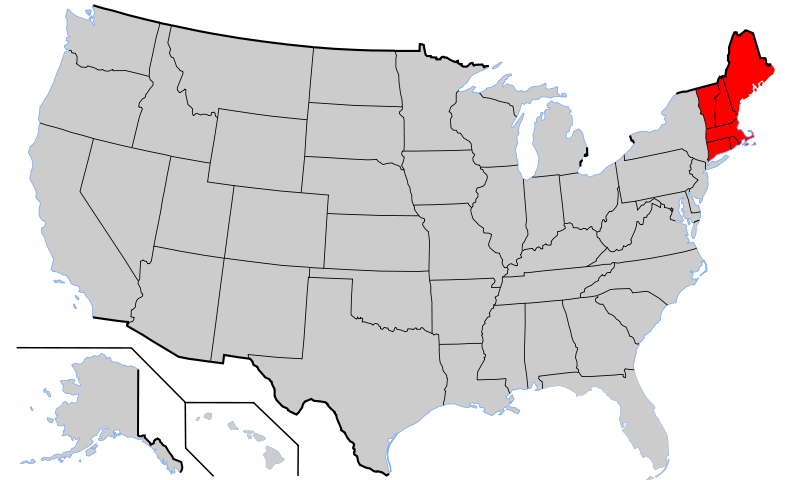
Connecticut, which is part of the region of New England, sits on the Long Island Sound, and is known for its wealthy coastline. Celebrity homes neighbor the water in some of the richest towns in America. But sea level rise, increased storms and more severe weather -all correlated with climate change- threaten the state and region. The New England states are relatively small- the whole of New England fits comfortably inside any one of the western states- so state level climate action would do little to affect the region’s total carbon emissions. Acknowledging this fact, the New England States along with a few of the Mid-Atlantic States (New York, New Jersey, Maryland, and Delaware) created the Regional Greenhouse Gas Initiative (RGGI, pronounced “Reggie”) in 2008.
RGGI is the first mandatory cap and trade system in the USA. The cap, set at 91 million tons of CO2 for 2014, applies only to fossil fuel power plants. Each year the cap is set to decline by 2.5% to further reduce emissions, keeping in step with the New England Governors’ Climate Change Action Plan. Emission permits are auctioned every three months, and the revenues are then invested into clean energy, energy efficiency, and consumer benefit projects (rggi.org, 2014)
The initial impacts of the RGGI are just beginning to be seen, as 2009 was the first year emission allowances were auctioned. An analysis done by the creatively named Analysis Group found that the RGGI can be attributed with $1.6 billion in added economic value, including 16,000 jobs and $1.1 billion saved on energy bills (Hibbard et al., 2011).
Greenhouse Gas (GHG) emissions in the region fell by 6% in 2013, though how much of that decline can be attributed to RGGI is disputed (Volcovici, 2014). Simultaneous to the start of RGGI was the Great Recession, which decreased household spending, including on energy consumption. In addition, the price of natural gas has dropped dramatically due to the rise of hydraulic fracturing, which has caused some power plants to substitute to natural gas, independent of the carbon cap. Natural gas emits much less CO2, and so has had the overall effect of reducing the carbon emissions of the region.
To illustrate the impact of natural gas, just look at the cap set by RGGI in 2013 which was 165 million tons of CO2. At the end of the year, only 91 million tons had even been emitted, which depressed the price of the allowance and virtually eliminated the need for tradeable allowances (allowances have been auctioned within the range of $2-4/ton). In response to this, RGGI has now set the 2014 cap at 91 million tons, hoping to increase the trades of emission allowances.
In regards to the cost effectiveness of RGGI, we’ve discussed in class how costs are only minimized when the marginal cost of abatement is equal across all firms and/or individuals. Obviously, because RGGI is targeted only at power plants (25MW+), this assumption is not fulfilled. However because of the complexity of administering a cap and trade system, I think that RGGI is probably the most realistic version of cost effectiveness, in that it creates a system which could be expanded in the future to cover more parties. Cost effectiveness has to be concerned not only with total costs of abatement but also with total administrative and transaction costs as well. In a pioneering program like RGGI, it seems fair to target a subsection of the carbon economy to figure out how best to operate.
One of the decisions that RGGI made was to auction off emission permits, the idea being to overcome the windfall profits that were seen in Europe when permits were allocated for free. Because the states auction the permits, they collect revenue, which is then used to deal with the distributional effects of the cap and trade program.
When I went home for winter break, I was surprised that my parents had switched every single light bulb in the house, including in “my room” a.k.a. the cat’s living space. I couldn’t believe that they had done the work- it would be a huge undertaking to figure out every light bulb needed and spend the time replacing them and then responsibly disposing of the old ones. And it turned out I was right- they didn’t do it. The Connecticut Clean Energy Fund had sent a truck around the neighborhood and for a nominal fee they did an energy audit of our home and changed out all the lightbulbs, put weather guarding on the windows, and recommend the best times to run the washing machine (thanks to their advice my dad now starts the laundry at 4am to save money on the energy bill, which takes a certain…. dedication I suppose.)

Overall the CT Clean Energy Fund has provided energy efficiency services to one million households and 7,700 businesses. This has saved 4.3 million tons of CO2 emissions within the state.
I would be remiss to not mention clean energy innovation, specifically because my bestie, Megan, just helped to launch the new Center for Clean Energy Innovation (CCEI) in Washington D.C. The CCEI is dedicated to encouraging innovation in clean energy technology by large scale investments in research and development at the State, National and International levels. Climate change, they offer, is an “innovation challenge,” which can’t be solved by carbon pricing alone. Using funds from RGGI auctions to invest in clean energy technology, in addition to efficiency and traditional renewable energy sources, could spur the New England economy forward, and make them a leader in innovative solutions to energy access.
There are also further questions to ask of RGGI: What will happen if energy usage increases as economic growth and employment continue to improve? How can we deal with the environmental impacts that fracking presents? Can RGGI be expanded to include other sectors of the carbon economy?
Despite the storms, my parents have grown to love their new CT home. They’ve removed any trees that threaten their power lines and they’ve bought a generator just in case. Global climate change threatens the coastal communities of the state and region, but through initiatives like RGGI and other programs at the state level, Connecticut could become a leader in climate change mitigation and adaptation.
References:
Hibbard, Paul, Susan Tierney, Andrea Okie, and Pavel Darling. The Economic Impacts of the Regional Greenhouse Gas Initiative on Ten Northeast and Mid-Atlantic States: Review of the Use of RGGI Auction Proceeds from the First Three-Year Compliance Period. Analysis Group; Economic, Financial and Strategy Consultants, 15 Nov. 2011. Web. 6 Mar. 2014. <http://www.analysisgroup.com/uploadedFiles/Publishing/Articles/Economic_Impact_RGGI_Report.pdf>.
“Regional Greenhouse Gas Initiative.” Www.rggi.org. N.p., n.d. Web. 6 Mar. 2014. <http://www.rggi.org/>.
Volcovici, Valerie. “U.S. Northeast Carbon Market Emissions.” Reuters. N.p., 5 Feb. 2014. Web. 6 Mar. 2014. <http://uk.reuters.com/article/2014/02/05/usa-energy-carbon-idUKL2N0LA1YB20140205>.