I read an article recently for class about email marketing trends across laptop and mobile devices and stumbled upon an interesting fact that I’d like to explore a little further, regarding emails opened on mobile devices:
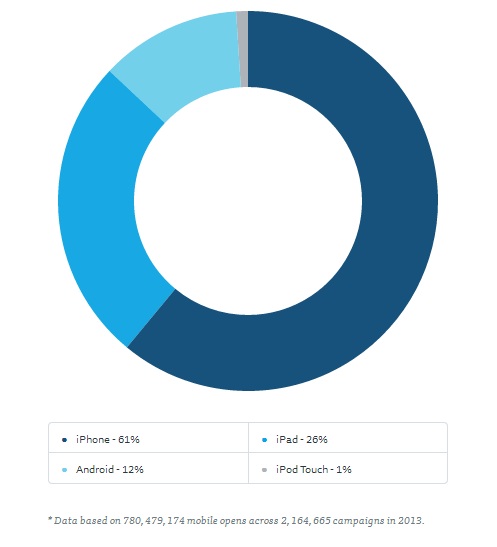
“The iPhone is the most common mobile device that subscribers use to open their email for the first time. Between iPad, iPhone and iPod Touch, nearly 90% of all mobile opens happened on an Apple device.”
The exact numbers were: iPhone (61%), iPad (26%), Android (12%), and iPod touch(1%) as seen in this break down:
https://www.campaignmonitor.com/guides/email-marketing-trends/
Does this data imply that Android users are less engaged on their phones than people who use iPhones?
And if so, why? After all, Android phones are just as, if not more, powerful devices than iPhones are in terms of hardware.
Regardless of reason, the disparity between the two is surprising to say the least – especially since Android phones dominate iPhones in terms of market share. Is there a paradox here?
There are clearly more Android users but people using iOS seem to use their phone more to check email. Although measuring e-mail engagement is not enough to make a conclusion about whether or not users of different OS are more or less engaged, there might be something to this idea. Interesting… I wonder if this is a trend for other things too – using apps, online shopping, etc.
After doing some light research, it turns out that opening email isn’t the only category that iPhone beats Android in for engagement. According to this study done by IBM, iPhone users tend to shop more, spend more, and use and keep their apps as well – the data appears to point to the idea that Android users are less engaged and that engagement overall is an issue across all Android devices and their users. I can’t say exactly why this happens since I don’t know for sure, but my hypothesis is that there a few factors at play:
- iOS has generally has a more inviting user interface (UI) and a smoother user experience (UX) with a very low learning curve
- Plenty of Android devices (this is a huge term since there are an enormous number of variations and brands) run on different versions of the same operating system, making apps inconsistent and buggy across many devices
- iOS users generally tend to have more money to spend (and as discussed earlier, are more willing to spend)
- iOS apps are more responsive