If we are to look into the champagne market and the marketing strategy for different champagne producers, we will likely see that most if not all champagne advertising are geared towards men which is of working age. However, Armand de Brignac has become a successful champagne brand by targeting a younger crowd such as party lovers in their early 20s. While brands such as Bollinger and Dom Perignon have appeared in movies like James Bond, Armand de Brignac has chosen to appear in Jay-Z’s “Show me What You Got” music video, associating itself to the hiphop culture which is rare for a champagne brand. In addition, the packaging of the bottle is also differentiated as they do not package it like other ‘normal’ brands but instead uses the colour of gold which symbolizes wealth and the Aces of Spades which symbolizes its status as one of the best champagnes in the market. It is interesting to now see whether other top champagne brands will also target the younger market, which they could possibly view as making their products less prestige, ruining their marketing image.
profile?annotation_id=annotation_980821&feature=iv&user=tippexperience
(Please click on the link as its a unique youtube URL which has a different formal to other clips, therefore the direct link does not work)
Having recently learnt about advertising and PR (public relations) I came across an interesting Youtube clip which is upload by Tipp-Ex. Tipp-Ex is a Germany brand of correcting fluid and correcting tape. On the clip Tipp-Ex does not seem to illustrate how their product is unique or beneficial. However, they did very much give us a memorable ad in which we can interact with the clip and fill in any word (i.e. feed, kill, marry, eat + other abusive terms) into the blank which has been created by the Tipp-Ex correction tape. Arguably the clip could also be a PR move (or both advertising and PR) because their is an interaction between the viewer and the media which gives it the publicity. Another argument for it as a PR move is that Tipp-Ex cannot control what message the viewer gets and whether they register the product into their minds. Personally I enjoyed playing around with the clip to the point that I had to double check the brand to write the blog!
Play around guys and have fun!
The Prestige Demand Curve
Having read over Stefano’s blog regarding certain phenomenon in which the demand for a product can be illustrated in a upward fashion, it really got me thinking about my economic class and many products that is associated with being prestige or luxurious. Although in his blog Stefano refers to the luxurious products as being a Giffen good, it is actually a Veblen good (a Giffen good is usually a staple product – i.e. rice, milk – that increases in demand as prices for other goods increases as people will need them for survival), nevertheless his idea is legit and presents an interesting question. As a marketing student, I wonder how can we market such brands to make it a luxury product in which the demand is pretty much inelastic. Is is just simply limiting its demand and make it a ‘rare’ item? Or is it just providing the product with excellence in every aspect (product, operational, etc.)? For example, a brand like Rolls Royce provides arguable the best luxury cabin but it also comes with an hand made engine and offers world-class repair services worldwide.
Secondly, I also wonder whether a single product can be both a normal good and a Veblen good. Looking at roses, many people will associate roses to being a normal product, however, during festive seasons such as Valentines, if we are to bring in rare roses and set it at a high price I am sure that it can turn into a Vablen good as well!
Livestrong Extended!
I think we all remember a time a couple years back when we all wanted one of those little yellow Nike “Livestrong” wristbands. Some people may what it to support the cause of Lance Armstrong, so may want to be trendy, but we all more or less wanted at least one of this little yellow rubber thing! What really impresses me about Nike’s marketing of the “Livestrong” product line is how much the product line has really expanded from only wristband (although its success can be argued as the hype surrounding it tends to be relatively short-term). Doing a google search for “Livestrong” we not only see pictures of the original wristband product, but we can see new products such as casual shoes, running shoes, basketball shoes, sunglasses (in association with Oakley), and other clothing product which features the signature yellow of Lance Armstrong and the “Livestrong” logo. To me this is a really good example of product development as Nike is expanding within its current market with new products (although shoes are net new products, putting them under the “Livestrong” brand should classify it as one) and continues to show who top companies like Nike and Adidas can maintain its positioning in its industry for such long periods of time.
Culture and Perception
Having read through the findings by Eyetrack III on http://marketingjournal.blogspot.com/2006/05/how-our-eyes-move-and-see.html I find it very most interesting how we scan certain parts of the page before other and also how this knowledge can be a valuable piece of information for marketers. For example, according to the one of the finding, if we are to promote a sales event, the SALES heading should be on upper left hand corner of the page to capture the most attention.
Nevertheless, I wonder if the research by Eyetrack is culturally biased as Westerners read from left to right and from top to bottom, while this is not true for all cultures (i.e. Japanese, Chinese, and Arabic). For example, if we are to make the same sales promotion in China would we have to move the SALES heading to the top right hand corner to capture maximum attention? Please tell me what you guys think 🙂
p.s. I copied the diagrams from the actual link to illustrate the where our eyes will scan and give priority to first on a page according to Eyetrack III
In his blog – https://blogs.ubc.ca/willdorr/2010/10/27/subliminal-marketing/ – Will raised up a really good question regarding ethics in marketing. Although the chapter on ethics is not covered in this course, it is often something we ponder about when we make a decision or when we see how something which may be morally grey can affect us like in the youtube link Will posted.
Taking a shot at answer this ethical question myself, my first respond will have to be that it is unethical to persuade a consumer to make his/her decision unconsciously because this provides a method for a company to eliminate the consumer’s process of finding information and comparing the best products which he/she would like to purchase. But on the other hand, we can also say that other means of advertising is also unethical because many company put out misleading information or promote many promises they or their product fail to keep. Having look at it this way, can we say that the use of subliminal advertising – if employed by all company in a market – be fair game to all involved? Or would this be unfair to all consumer as they would be all the products they take in unconsciously? I guess we will need more research to answer this question truthfully…
When Hedo Turkoglu was traded from the Toronto Raptors to the Phoenix Suns, I am sure almost all Canadian basketball fans are glad to see a lazy and out-of-shape baller leave their team for a usable player (Leandro Barbosa). However, being a Phoenix fan, I am not glad to see this trade on the receiving end. As the NBA preseason starts and finishes, my concerns about Hedo have become legit as he is inactive, unproductive, and seems to be “carefree” during games. However, the Suns organization, Hedo’s teammates, and Hedo himself have been saying all the right things about Hedo such as that he is a team player and a versatile addition to the team. Only time can tell whether this trade will be a bust, but looking at current results and performances, this may be a sign of post purchase (trade) dissonance!
Powerful Segmentation
Back when I was a kid, I often wonder through the stack of magazines in my father’s office, often picking up several magazines to look through. One of the magazine was called ELITE which is published exclusively for members of the Royal Bangkok Sports Club, which is a club with a membership of 9000, consisting of current and former prime ministers, military officials, influential businessmen, or basically, the Thai aristocrats. Looking through magazines, I often would look at advertising as they strike the young version of myself as colour and interesting. I understand why many marketers would want to advertise their product/service through magazines with a great reader base as they will get a lot of publicity, what I am confused about is why would they want to advertise in ELITE where the reading base is very small. However, it is only until now – having learned about STP – that I understand that advertising in ELITE, marketers (including BMW, Ferrari, and Lexus) are segmenting the market demographically (with income being the variable) to potentially entering a market segment with the biggest potential spending power in Thailand. By basically advertising in the right spot, they can eliminate the need to filter unwanted segments straight away. Now THAT is powerful!!!
The Decision
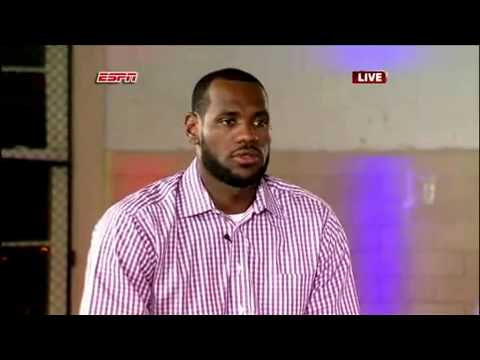
Like many prominent athletes of this era (Kobe Byrant, Tiger Woods, Roger Federer) LeBron James has his own “brand” image as the King of Basketball. However, his highly publicized campaign during the NBA free agency has strongly damaged his reputation as a likable athlete that an average individual would like to associate his/herself with because of his arrogant and self-centered announcement via ESPN name the Decision. Why would anyone sane do something so egocentric as to announce on national television that they are leaving behind all home town fans and “his” city in such a classless fashion? May be “the King” will need better branding and follow the more humble approaches of those humble stars like Kevin Durant or Steve Nash.
The Power of Data-Mining
In today’s competitive market, firms are always trying to expand their product/service line into new market in hopes of capturing new costumers. For example, we can see that McDonalds have attempted to expand into the premium coffee market through the introduction of McCafe in some of its locations or – as we all see in class – Ritz has introduced its “toasted chips” in invade the bigger and faster expanding chips market. Data-mining plays an important role in the introduction of new products because the trends and relationship between products that can be extracted by firms can significantly determine how a new product/service would do when introduced to a market. For example, McDonalds must have been confident that a decent portion of their customers would like to grab a cup of coffee after a meal there before introducing the McCafe.
The power of data-mining is evidential when we look at Budweiser, whose primary product is beer. My friend observed that another product line that has been introduced by Budweiser is BBQ sauce, which has been packaged as a ‘6 pack’ like a pack of beer. With a 100 guesses, how many people would have expected a beer producer to introduce a BBQ sauce product? However, if we really think about it, many beer drinker will drink during a BBQ with friends or with some snacks, therefore, the idea possibly isn’t that far-fetched after all… and here ladies and gentlemen: this is the power of data-mining!