Categories
Uncategorized

Language, Memory, and Storytelling

As a newcomer from a foreign country where English is not well spoken, I encounter hundreds of unfamiliar words in university. The word “reconciliation” used to be one of them. “Reconciliation with Indigenous people” was a common way to hear it, combined with another unfamiliar word “Indigenous”. I had the vague understanding of this phrase as “respecting the aboriginal people and making the relationship better”, until I finally looked up the meaning of the word “reconciliation”. When I first saw the definition saying “the restoration of friendly relations” or “the action of making one view or belief compatible with another” and the Japanese translation saying “仲直り, 和解” (both by Google), I remember I somehow felt uncomfortable hearing that. Even though I have poor understanding for conflict between Indigenous people and settlers, it feels really strange for non-Indigenous people who colonized the land and extracted all the resources and culture, saying getting along with Indigenous people, using the English word, “reconciliation”.

“Truth and Reconciliation Commission”, which was held in South Africa, was the first time I heard the word “reconciliation” other than the context of talking about Indigenous people in Canada. In our ASTU class, we were assigned J. M. Coetzee’s novel “Disgrace”, which indirectly portrays the “Truth and Reconciliation Commission” through David Lurie’s encounter with women, his daughter’s life in Salem, and his own trial for sexual harassment towards his student, Melanie.

One of the things that stood out to me during the class was David’s theory of communication. As a professor in the “communication” development, David questions the capacity of communication as a means of translating one’s feelings. This suggests that language is not necessarily the best way to communicate. Personally speaking, I often find it hard to express myself through English, not just because I am not good at it, but because I am not sure which word to choose to express my thoughts accurately and properly. Sometimes, there is a perfect word in Japanese which I would love to use, while no dictionary provides an alternative word in English, and vise versa. The same thing could be said for “truth”, which is another important term in the novel “Disgrace”, besides “reconciliation”. We have been talking in class throughout the year about “master narratives and counter narratives”, “agency of storytelling” and “streams of thoughts”, and we now know the ambiguity and unreliability of stories about our memory – there is no such a single “true” story for anything.

The novel “The Reluctant Fundamentalist” by Mohsin Hamid, which we read in the first term, also leaves the ambiguity towards truth and reconciliation. While 9.11 is conveyed as a tragic story of terrorism by the evil foreigners in the master narrative, this book challenges this by depicting the story of a Pakistani Changez, and questions our epistemology about the relation between Americans and Muslims. At the end of the novel, the author remains the climax unclear and stimulates readers to imagine rather Changez and the unknown American man had reconciled or killed each other. In this context, it might be questioning the possibility of storytelling by showing the ambiguity of stories and language for the reconciliation between America and Pakistan.

The use of metaphor is another way to keep the ambiguity. In “The Reluctant Fundamentalist”, the relation between Changez and America is depicted through his girlfriend Erica and his workplace Underwood Samson. In “Disgrace”, the animals in Salem, which Lucy and Bev Shaw (who works in an animal disposal center) cared and loved, seems to play an important role in David’s life, and seemingly depicts the process of “Truth and Reconciliation Commission”. In “Country of My Skull”, Antjie Krog refers to the “Female Storyteller”, explaining that “these stories undermine boundaries; men turn into women and vice versa, animals become people, women fall in love with animals, people eat each other, dreams and hallucinations are played out” (52). This resonates with Lucy’s attachment towards animals and nature, and the way she viewed “reconciliation”. Lucy mentions about Petrus, who is the father of the boy who raped her, as “offering an alliance” (Coetzee, 203), which she painfully but sincerely accepts by marrying him. This might represent the Afrikaans who accepted change in racial positionality and their mistake. The quote of “undermin(ing) boundaries” might be the binary boundaries in our society, such as “men and women”, “truth and lie”, “personal and public”, “enemies and allies” and “black and white”. This novel seems to break down these boundaries, which itself is the process of reconciliation, and what Lucy is trying to do.

In my personal view, dogs seem to represent some source of security, as dogs are used as watchdogs often. One of the sources of security for White people like Lucy and David during the apartheid era must have been the privileges of being White. Thus, the dogs in this book can be understood as the representation of people’s privileges during apartheid. By Lucy getting raped by the Black people, she loses her dogs and experience physical (being raped) and mental (both being raped and losing her dogs) pain. The end of apartheid in South Africa must have been painful for White people in terms of losing their power, and at the same time, in terms of officially being the target of hatred both publicly and privately. However, Lucy recognized her privileges and the need of abandoning and reconciling with the people in her village. Thus, she took care of animals by collaborating with Black people in the region.

This theory fails to explain the changing relationship between David and dogs. Especially, how he avoided the animals won’t resonate with the idea of dogs being the privileges of White people, since David would be supposed to be attached with dogs (privileges) from the first place. Maybe, loving and taking care the dogs might be the metaphor of recognizing and accepting the privileges that they have. While David didn’t specifically mention about apartheid in the book, he seems to avoid recognizing his privileges at first. However, he gradually recognizes his positionality through Lucy’s lifestyle and his “reconciliation” with Melanie, but abandons them by disposing the dogs which he loves. At last, he says he wants to keep a dog for another week, but eventually gives up.

Indeed, both truth and reconciliation are vague and the reliability is questionable. However, I believe storytelling can include the possibility and ambiguity of our memory at the same time, which will hopefully lead to understanding our privileges, inequity, and others’ positionality. The theme “memory” in this class seemed to be too personal at the beginning of the year. However, our memory is what creates the society, and we can’t just draw lines between public and private facts. Our memory might not be reliable, but it doesn’t make it untrue. It rather suggests us what we actually know about ourselves.
Categories
Uncategorized

The Owner of Our Thoughts

It has been already 5 months since I came to UBC in September, when I was still so confused and panicking everyday for the new university environment in a new country. I still clearly remember myself, not knowing what I am doing here, anxiously staring at other classmates to learn how to act in a North American classroom, which made me even more scared realizing that I have nothing that makes me fit in this classroom. After 5 months, I still have much to improve, while things have become much better by meeting awesome people, learning how to deal with things around me, and getting use to the environment, which all together has keep on changing my perception every day.

Of course, this ASTU class is no exception of what has changed me. This term, we started to look at psychological theories about memory and mind, which made me think about the concept of what we remember or think and what we don’t. We looked at William James, who argues that our mind is like a stream of consciousness that constantly changes by your experiences, which makes everyone’s thoughts different, while we also focused on Sigmund Freud, who argued that we unconsciously repress the desire of pleasure by “reality”, and instead we repeat and project the desire which we have oppressed in the past. Indeed, these are not all of the ideas which they generated, and some have been criticized in by others then and now, while I believe these ideas about memory and thought are in the bases of what we believe about us today too.

When I first encountered these two different types of ideas, I felt stronger connection with James’ theory, especially that it says our perception constantly changes through our own experiences. In our sociology class, we have been discussing how our knowledge are produced by culture, being influenced by the social spaces which we live in. As I mentioned earlier, I literally realize how my perception has been changing every day through completely new experiences which I would have never experienced if I hadn’t come here. This also reminds me my first blog post, comparing my restless brain in the new environment to the sluggish “muddy stream of memories and thoughts”, which fortunately have become much smoother now. Yes, the stream has changed through learning, talking and adapting in this new environment, whereas, the stream itself hasn’t been completely overthrown, and indeed I still struggle converting my conservative ideas and habits which I have constructed in my 19 years in Japan.

While James’ theory easily fit to my experience, I couldn’t immediately agree to Freud’s explanation that we repeat unconscious desire from the past. Though we could say that he also argued the continuity of memory as James do, the difference of whether everything is new or from the past seemed incompatible. Well, but after all, unconscious things are unconscious, and we can’t really capture it. I might be acting out what I repressed in my past, which I will never know since it is unconscious. Moreover, the process of culturally constructing our knowledge and thoughts is unconscious most of the time – then, how much are we actually aware of what we think?

This was one of the questions for the novel “Mrs. Dalloway” by Virginia Woolf, which depicts a day in London after the World War Ⅰ, focusing on PTSD (shell-shock) from the war and how different people experienced the post-war era. Woolf uses “free indirect speech”, which jumps around multiple character’s consciousness continuously, which enables readers to jump between different people’s experiences. While this narrative style shows the character’s stream of thoughts, I wonder whether these characters are aware of what they are thinking as clear as it is written in text, or rather it is a narrative by an observer that can read their minds clearer than themselves. When I compare this with the documentary film “Stories We Tell” (I have written this in my first blog post as well), which we discussed about in class previously, both seems to incorporate the different people’s different experience towards the same event, which can be also explained by William James’ theory. However, I feel that the biggest difference between these two pieces is whether a person is trying to convey the story that they want to or not. In “Stories We Tell”, what each person who were interviewed said were what they chose to say, not what they just thought. As we choose what to say when we talk, I feel we choose what to believe that we think as well. If we conducted an interview to the characters of “Mrs. Dalloway” about what they thought that day, I feel the story would have become a completely different one.

After all, I feel like no one owned the story that day. Even though the title is “Mrs. Dalloway”, and it was the day which she held her party, Septimus killed himself, Rezia lost her husband, and Peter came back to London for the first time in a while, no one doesn’t actually own the story, because no one knows even what they are thinking – we constantly change by a force of experience, as William James says, and we don’t know what past makes us do or think in our conscious, as Sigmund Freud says.

This is the same thing in our lives too. We never have access to what others’ think in reality as we do when we read “Mrs. Dalloway”, while we even don’t know all of the things that we think ourselves. Then, I wonder why there is any force from outside to make us fit in a certain shape, tell us what to do as if they know what the best is, as if they own the story. Or, is there actually no forces, but our society which is constructed by our thoughts constrains our beliefs, that we don’t even understand? When I think this, I eventually just come to the thought that I never know where my thought comes from. This blog itself is a stream of consciousness which presumably relates from the unconscious part of me, making me constantly feel something is not right, but I don’t know what it is. I guess I have to keep on thinking the question of what I do own and where my memories come from for the coming years in UBC, and in my life.

Categories
Uncategorized

What a Story Implies

It is undeniable that 9.11 had a devastating impact – not only on America, but on the whole world. Yet the shock was immense and catastrophic stories of the victims has been conveyed extensively, most of the stories of the influence on people in the Middle East or Islamic people has been remained unheard.

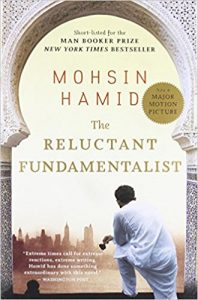
In the ASTU class, we read the book “The Reluctant Fundamentalist”, written by Mohsin Hamid. The book describes how a Pakistani man, Changez went through the post 9.11 era in America, where he talks to an unspeaking American stranger in a café in Pakistan. Before the 9.11, Changez had hope and expectations toward America to study and work there, while the 9.11 changed people’s perception toward him and also he roved between his two identities as a New Yorker and Pakistani, and eventually he goes back to his own country.

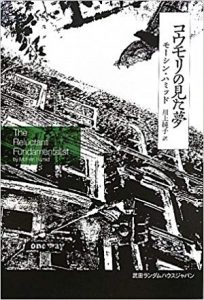
When I was searching about the book online, merely for linking the page, I accidently came across one book. It took a while until I realized that it is a Japanese translation of “The Reluctant Fundamentalist” – since the Japanese title was, as I directly translate it, “The Dream the Bat Dreamed”. Yes, the Japanese translation sometimes completely changes the title when translating books or movies. This one must be one of them – but somehow I couldn’t just ignore it and just go on, and rather reminded me about the scene where the bat came out in the book. Right after the scene that Changez saw the news about 9.11 in Manila and focused back to the unspoken American in the café, he mentions about the American man flinching to the bats. After Changez says that the bats are “circling rather low”, he says “Let us, like the bats, exercise our other senses, since our eyes are of diminishing utility” (pp.75-76). When I first read it, it sounded as if he was only talking about the situation of the café, being dark with the sun setting. Whereas, I felt as if Hamid purposefully intended to convey a meaning at this end of the important chapter of a turning point. What does it mean by the bat being “blind”?

 
One way to interpret the bat is that bats are Changez and the unspeaking American man, as Changez says. Right before mentioning being bats, he says “enough of these speculations!” to the man. Also, the identity of the unspeaking American man who is not revealed… which can be thought that these situations having no clue about each other would be “blind”. Maybe Hamid used this metaphor for the two people being suspicious and trying to find the intention of each other though the conversation (listening) or other senses. Another way would be considering the bat as Changez himself during the post 9.11 era, trying to be accepted by America or his lover Erica while being concerned of his own country which is in crisis by America due to the starting of the “War of Terror”. As we learned in POLI class, America labeled other countries rather if they are its ally or enemy, and attacked nonconventional enemies which generated a host of new problems. Changez was one of the victims as well, being discriminated by his physical appearance and feeling the emotion against America by the national affection toward Pakistan. Thus, he might be the bat, flying between the two identities of a “product of American university” and “Pakistani”. And as I believe, from the Japanese title “The Dream the Bat Dreamed”, Changez had a dream, being successful in America with sill keeping his Pakistani identity, but the blindness of the world didn’t allow him to do so, and eventually lead to him acting against America in Pakistan.

As most of the master narrative for 9.11 is a perspective from Americans, and the counter narrative becomes the suffering from racism or stereotypes of Islamic people, I feel that Hamid still doesn’t make the Pakistanis’ story clear, but made it hidden behind the clear story of Changez. As he fosters the acknowledgement of the counter narrative of 9.11, he also includes the intention of highlighting the ambiguity and indiscernibility of the hidden story.

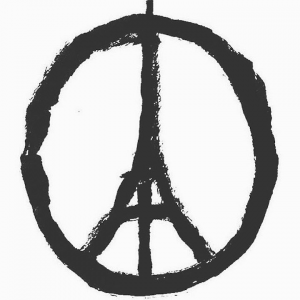
In class, there was a question asking the difference between what is commemorated or not. Events such as 9.11, the two world wars, or other tragedies often get remembered by the collective through medias and memorial services. However, the death of each person, or which seems to be irrelevant to one culture gets to be the counter narratives. I remember three years ago when the Paris attacks happened, a lot of people including celebrities and even my friends in Japan shared on social media, a picture which illustrated the symbol of the Eiffel Tower with words praying for the victims.

This was a nice movement, commemorating the innocent victims of the terror attack though social media – this might be the very useful purpose of using the media, by sharing our feelings all over the world. However, just knowing this attack by the Islamic Fundamentalist and not knowing what is happening in the Middle East might enforce the racism toward Islamic people. What happens to the hundreds of people who loses their life every day? Is the counter narrative of the story forgotten forever? The issue of the counter narrative is not merely that it is not being conveyed… it is that we don’t even notice what isn’t conveyed – just as how I never noticed about the scene of the bat in The Reluctant Fundamentalist – and may emphasis one single perspective.

Categories
Uncategorized

The Role of Telling One’s Experience

In Japan, where I am from, the experience of the World War Ⅱ has been tried to be conveyed to keep the catastrophic memory alive and to never repeat the bloodiness history again. The story people suffering from aerial attack and trying to hide the light inside their houses to prevent being bombed. People being trained to act and dress in a certain way to maintain the boundary toward the war. People believing that dying in the war for the county is an honoring thing. All these stories were carried on to my generation though education, TV shows, movies, comic books or other various means, even after 73 years has pasted since the war ended. Reading “Persepolis” in the ASTU class, made me remind all these stories and surprised me how the description of the war in Iran is identical to what I had learned about Japan. “Persepolis” is a comic book written by Marjane Satrapi, describing her own childhood memory in Iran in the time of the Islamic revolution and the Iran-Iraq war occurred. Although the background is completely different, the sad fact that Marji (the main character of Persepolis who also represents Satrapi’s childhood) suffered similar situations to Japan during the war, in spite of those effort of conveying the war experience to prevent the history to be repeated, made me wonder if conveying one’s memory or public story is a meaningless thing. Then, what does “Persepolis” tell us about what happened in Iran? What can a popular culture do to convey what happened in the past?


Japan has a huge popular culture, and I am also familiar with war descriptions such as “Barefoot Gen” (a series of comic books written by Keiji Nakazawa, about the nuclear bomb attack in Hiroshima) or “Grave of the Fireflies” (an animation film directed by Isao Takahata, about two siblings suffering the last few months of the World War Ⅱ in Kobe city). Both these stories and “Persepolis” is somewhat based on the true experience, while some fictional factors are also added, which means it’s not aiming at just retrieving the whole complete experience. Especially, we talked in class that the frequent use of black for the background in “Persepolis”, allowed Satrapi to avoid telling the whole experience, while it rather provided the strong dark and heavy impression. Also, I thought she drew it simply with less motions compared to most of the Japanese comic books, which left the space of imagination to readers. I felt she made readers to consider what was it like, and fosters them to find the left pieces of the experience that Satrapi didn’t include in her book by themselves. Maybe engaging with readers’ heart is the true meaning of telling a story rather than replicating the experience, and popular culture allows us to do this.


Another role that popular culture can play is to convey the author’s message. Satrapi states the purpose of writing “Persepolis” in the introduction, as to debunk the stereotype about Islam. Specifically, she writes in the book about how she thought about the veil, which women were forced to wear after the Islamic revolution. It reminded me what I learned in my anthropology class, which is out of the CAP course, about Elizabeth Fernea’s ethnographic work about women who wear the veil in Iraq. She argued women’s social life is actually very enriched, although the veil looks as restricting their freedom. While this approach also debunks the stereotype of the veil, it is interesting that Satrapi doesn’t state a clear view about the veil like Fernea, and rather disperses Marji’s unstable thought toward the veil and God. This also makes readers not just understand the information that is given but reconsider about the concept of Islam, through popular culture that is relatively casual and approachable way compared to a formal scholar writing or journals.


Overall, the popular culture nevertheless seems to be a powerful source to convey what happened or a certain message. Although we can’t just completely copy and retrieve what happened, describing memory can implant the strong feeling or impression about what happened, and sometimes change people’s mind. However, I personally think that this popular culture has not being able to maximize its power, due to the use or regulation of media by the government or other groups. As we learned in our POLI class, some states also try to control the information to restrict its population’s freedom, and depends on the mass communication to spread their thoughts to their citizen. In fact, “Persepolis” has been banned in Iran too. I feel the interchange and the balance of how and who conveys what , might be the important aspect that forms the society nowadays.


Time passes and the number of people who can tell the story of the past directly declines, while stories that we must pass to the next generation also increases day by day. We can become both the receiver and the teller of the story. How we use popular culture and how we approach to the information that we receive, is a crucial issue that we have to think again. If everyone could work through the information and could measure what is important, we might be able to really stop the repetition of history.

Categories
Uncategorized

A Story Only for the Child

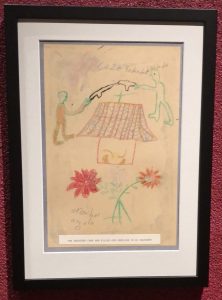
There are some sleepless nights for anyone. Although the body is exhausted and craving for a nice peaceful sleep, somehow brain keeps working, playing back events from the day and keeps one awake until one is able to nail the messiness of the memory. It seems like muddy stream of memories and thoughts is flooding into the brain and being sluggish, being unable to process the memory. Well, I admit that a freshman at university, struggling to deal with so many things going on and being sleep deprived is a common experience and it is not a big deal. However, this drawing made me wonder what it is like for a child, to process the memory of her family killed.

The exhibit of “Arts of Resistance” was open from May 17th to September 30th in the Museum of Anthropology on the UBC Vancouver campus. As the homepage of the exhibit states, most of the objects express “contemporary political realities” by using “traditional or historical art forms” of Latin America. However, this picture drawn by Maribel Ayala in 1983 appeared slightly different from others to me. While the process of creating art works which include the intention of political resistance is somewhat retouching and editing the memory in order to express “neo-colonialism and racism”, a drawing of what a child saw seemed to be depicting the lurid reality and his or her own feeling straight forward.

Looking at the term, “editing”, this procedure can make the work concise and comprehensible, or can add and drop one’s purpose or bias. The movie we watched for our ASTU class, “Stories We Tell” by Sarah Polley, describes numerous perspectives to a story of a family by filming many people telling the “story” in front of the camera. In the movie, Michel Polley (Sarah’s foster father) points out that it is impossible for the movie to equally incorporate each perspective, since once she “edits” it, it will become Sarah’s perspective, which includes her thoughts or messages. Likewise, most of the artifacts at the exhibit can be said that it was edited in the meaning of adding Latin American people’s purpose, which facilitate them to convey the message of resistance. In contrast, the society’s purpose or others’ perspectives have not been added to Maribel’s drawing. It expresses only her subjective perspective, such as what she saw, felt, and remembered ― the story of her own memory. We can say that this drawing is edited by the exhibitor, added with a caption which includes the intention of letting know us the cruel story of genocide. However, the drawing itself shows how Maribel processed her memory of the murder of her family, regardless of the political issue.

Thinking about how Maribel didn’t include a political intention in the drawing as a being in a “group”, made me remind what we learned in our SOCI class, about how people connect oneself with the society. For instance, sociological imagination is the ability to consider the interconnections between the social history and individual biography. Being able to name a personal issue, such as “gender discrimination” or “racism”, sometimes becomes a source of liberation, by acknowledging the limitation of one’s control on one’s life. While the story is still catastrophic and painful, one can also gain solidarity with others who have the same experience. Yet, as I consider, as a child, Maribel must have not been able to understand what is happening for the whole society by using her sociological imagination. This must have made it harder to process the memory of her family killed for her than for an adult. Maribel must have suffered not only from the fact that her family was killed, but also from the isolated feeling of being unable to connect her incident to other’s experiences.

Including sociology or political issues, the world seemingly focuses primarily on the social issues, and this seems to be reasonable. However, what would happen for those who don’t know how to raise their voice to the world? What would happen for those who can’t use their sociological imagination to connect oneself to the society? Presumably, the big flow of memory will have to swirl forever.

Categories
Uncategorized

Hello world!

Welcome to UBC Blogs. This is your first post. Edit or delete it, then start blogging!

Spam prevention powered by Akismet