Hello and welcome back to our blog! Quite a lot of exciting progress has been happening and we are glad you are here. First off, we finalized our proposal report and got a better sense of the direction that our project is going. Here is the link to the Proposal Report.
Weekly Objectives

Weekly Achievements

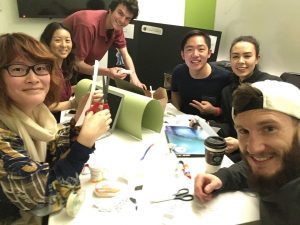
This is us busily working on our poster for the BCAFM conference!
Upcoming Objectives and Strategies
March 2-4: BCAFM Conference Weekend!
Objectives:
- Present some of the data from our survey in a poster at a booth on Saturday
- Interview farmers’ market managers, and also ask for their help to get more vendor’s to fill our survey
- Find out if market managers have archived data of entering and exiting vendors over the past few years.
Strategies:
- Obtain business cards from market managers to be able to contact them after the conference
After the BCAFM Conference
Objectives:
- Extract data from surveys and analyze results and trends
- Find data on entry barriers for farmer vendors in BCAFM, and to come up with preliminary recommendations for creating a tool to help new farmers enter farmers’ markets
- Create our final project presentation and infographic
- Continue updating our blog with objectives, achievements, and reflections
- Write our final project report along with a cleaned dataset that will help BCAFM and future LFS 350 students understand and address the current trends and barriers to the entry farmers into BC Farmers’ Markets
Strategies:
- Creating a weekly schedule to keep on top of our work, meeting weekly, maintaining continuous contact with our community partner.
- Using knowledge of statistics to analyze our dataset on Excel.
- Using knowledge of statistics as well as data analysis tools in Qualtrics and Excel to analyze our dataset for trends related to barriers to entry.
Reflections
While developing our survey, we decided to include some questions to get information on the participants’ demographics, such as their ethnicity and gender. We chose to do this because there is currently very little data on what ethnicities are represented at BC farmers’ markets. Additionally, we learnt in class that many roles in the food system are ‘genderized’. For example, from the reading Feminist food justice by Sachs (2014), we learnt that gender is a key issue in food production, and the smaller the farm, the more likely women (especially those from marginalized racial and ethnic groups) are doing the farming. We wanted to investigate the gender ratio of those farmers who wish to enter the farmers’ market sector, as well as those wanting to exit. By taking a quick glance at the survey results from those who have completed it so far (our survey is still running so our results are not final), we did notice a higher proportion of participants who identified as female.
We also wanted to learn more about which ethnicities are represented as vendors at the farmers’ markets. For our survey, we based our categories for ethnicity on Stats Canada’s population census. We found our categories on Question 17 of this 2016 census: http://www23.statcan.gc.ca/imdb-bmdi/instrument/3901_Q8_V1-eng.pdf. However, we did make three small changes to the census’ ethnic categories. First, the Stats Canada Census contained several other questions meant for Aboriginal Canadians, but did not include a category for Aboriginal in the broader ethnicity question. For the purpose of our survey, we thought it might seem inappropriate or unnecessary to have separate questions regarding Aboriginal ethnicity or legal status, so we decided to include Indigenous as one of the categories in our ethnicity questions. Second, Stats Canada uses ‘White’ and ‘Black’ as ethnic categories. Our group deliberated and debated whether we should include those terms, or whether we should alter the terms to make them sound more sensitive. We knew ‘White’ and ‘Black’ were the official terms, but they didn’t sound right to us, partly because of their sometimes negative or informal connotations. In the end, after talking to our community partners as well, we decided to use ‘Caucasian’ and ‘Black/African’ as our categories. We know that ethnicity is a sensitive and nuanced topic, due to the many current and historical injustices that have been related to or perpetrated in the name of ethnic differences. We chose the ethnic categories for our question with the highest hopes that we would not offend or misrepresent anyone taking or coming across our survey.
From the current data, it seems like the majority of participants identify as Caucasian. This reminded us of the reading Parallel alternatives: Chinese-Canadian farmers and the Metro Vancouver local food movement by Gibb and Wittman (2013). This paper discusses the existence of a “parallel” local food system where the Chinese-Canadian farmers have been engaged in producing and distributing local food well before the existence of the popular farmers’ markets channels of today. However, farmers’ markets are still given much of the limelight of the local food movement. As a group, we have been realizing that the narrative around the local food movement in BC is largely centred on farmers’ markets and other channels that are popular with Caucasian British Columbians. While we understand that farmers’ markets are an important aspect of the local food movement, we also see the prevalence of farmers’ markets in the narrative around local food as problematic — for example, Caucasian British Columbians may be considered the top authority on local food, despite other parallel and viable local food systems. Guthman (2008) further explores the “whiteness” of the local food movement, and how markets become an exclusive environment where only people of a certain demographic and class become involved. The two aforementioned papers, coupled with our preliminary findings from the survey, shed light on how food justice may not be fully realized in Vancouver’s local food movement.
What, So What, Now What Framework
What
Our group agrees that our moment of significance occurred during the process of going over our project proposal. We had created a timeline that included a literature review, survey creation, data collection via the release of the completed survey, data analysis, trend identification, and creation of a tool based on our findings to help BCAFM address barriers to entry and ensure adequate number of vendors at farmers’ markets. This was a lot to do and, initially, we felt overwhelmed with the amount of work we saw ahead of us. Upon talking to Prof. Will, we were advised that we should cut down the amount of goals we had, in order to focus on the quality of our work. We were recommended to remove the creation of a tool from our list of goals in order to focus more thoroughly on data collection.
So what
This was significant for us because removing the tool creation would allow us to focus solely on the creation, implementation, and analysis of the survey, which is valuable for BCAFM to fill the current knowledge gap around farmer succession at markets. This also reminded us that we had freedom and agency to be flexible and in control of our project.
Now what
Refining our goals helped us come up with a clearer set of realistic objectives. With our focus now centred on the survey, we will hopefully end up with the chance to focus more on quality analysis. We will also gather more data by talking to the market managers/vendors at the conference. The information that is collected through our survey will inform the BCAFM on data they are currently missing. It will also aid in the continuation of the collaboration between BCAFM and future LFS 350 groups, possibly with the creation of a tool to address the trends that we will identify.
We will be off to Victoria for the BCAFM Conference in two days, check back with us next time to find out how that went!
References:
Gibb, N., & Wittman, H. (2013). Parallel alternatives: Chinese-Canadian farmers and the Metro Vancouver local food movement. Local Environment, 18(1), 1–19.
Guthman, J. (2008). Bringing good food to others: Investigating the subjects of alternative food practice.Cultural geographies, 15, 431-447.
Sachs, C. (2014). Feminist food justice: Crafting a new vision. Feminist Studies, 40(2), 396-410.
