Categories
Uncategorized

A new level of Fundraising

I have no idea if this exists.  I’m on the hunt for a Boutique Consulting Firm that specializes in social media or eMarketing strategies for organizations dedicated to improving health care, like any Hospital Foundation.  Or even bigger institutions like UNICEF!

I was lucky enough to attend a guest speaker presentation that inspired me to, yet again, think about new ideas.  It was a founder of a really cool boutique consulting firm.  Think! is a Boutique Consulting firm focused on social strategies for Destination Marketing Organizations.  They found their niche and are having tremendous success in what they’re doing. 

Doing a quick google search, I didn’t find a similar firm in health care but I found someone that I would probably want working in such an agency.  They are the creators of SMiCH.  In fact, it would be tough to argue that they aren’t doing this already!  They look and talk about just anything…  It is fascinating to look at the numbers they have compiled. 

Here’s a sample of information you can find on their site:

  • There are 91 Facebook accounts nationally, representing 193 different hospitals 
  • There are 57 Twitter accounts representing 201 hospitals
  • There are 48 YouTube channels, representing 69 hospitals
  • BC has the most hospitals represented by social media pages/accounts/channels, but Ontario has the largest number of unique pages/accounts/channels. 

This led me to wonder (off on a different tangent) if there was a top objective behind these different Facebook accounts or Twitter accounts?  And what might it be?  I also would like to know how effective they’ve been in reaching their goals.  I should get in touch with the creators of SMiCH. 

I’m inspired that SMiCH exists! 

A double- dose of inspiration day.  Awesome.


Categories
Uncategorized

I call them gamechangers.


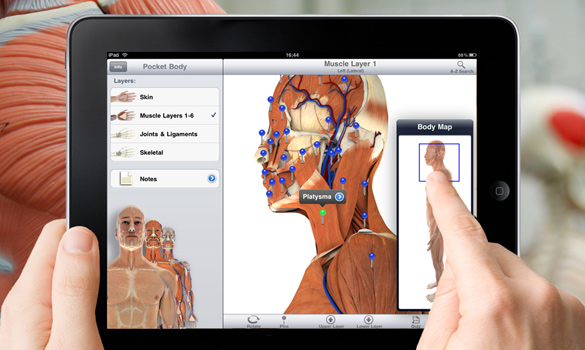
The iPad, OK… the “Tablet”, is a total game changer in my opinion.  Someone working in sales for a medical device company can, in seconds, call up presentation material or technical pocket guides to answer any question their customer might have.  And there’s something about the brightness of a screen that makes material like that pop!  Immediately, the game has changed for a salesperson – they don’t need to carry around a briefcase with a bunch of printed materials anymore.  And they can serve their customers better and faster.

What if Surgeons were armed with tablets that could educate patients about their surgery in the office or at the bedside?  What if Public Health nurses could show students the effects of smoking through an interactive “app”?  What if an Emergency Room Physician could call up a patient’s file on their iPad… and use drop-down menus to input the blood test they’d just taken… which would send a cost amount, over the network, to a Health Economist tabulating hospital costs in real time?  What if each patient was given an iPad when they came in the door of a hospital and they used this to “Facetime” with a centralized call centre (a pooled resource of professionals!)?  Interfacing with a healthcare professional right away!  Instant triage.  …..Endless options. 

I call them gamechangers.

Categories
eMarketing Medical Devices

#talkshit

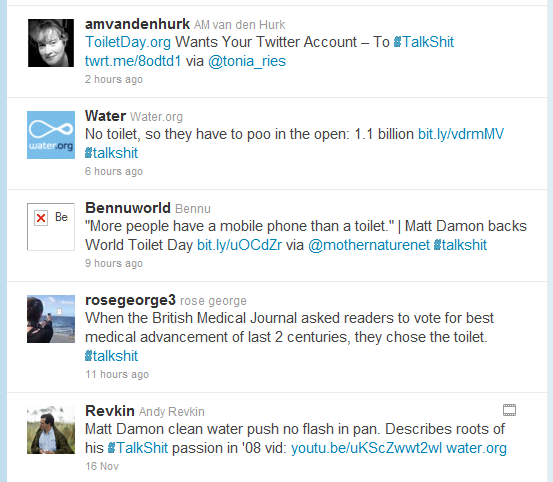
What is World Toilet Day?  A day that creates awareness about the 2.5 billion people living without proper sanitation, which leads to diarrheal disease.  Poor sanitation kills 4,000 kids per day.  Matt Damon’s organization used #talkshit to raise awareness of this subject on Twitter.

#talkshit is a “hashtag”:  Hashtags group comments on Twitter.  You can search #talkshit through the site and see what everyone is tweeting related to that hashtag. 

Here are some recent posts:  (Notice how users are sharing more and more information about the cause.  Not only is awareness being raised but some are engaging themselves in the subject and taking initiative to educate us further.  Powerful.  Knowing that we hold devices in our hands that enable us to absorb all of this content in an instant is even more powerful.)


Hashtags also allow us to count the tweets the #talkshit hashtag is in – check out hashtags.org to track impact.

Powerful Communication:  Twitter is undoubtedly a powerful way to communicate.  But it’s worth noting that TV media picked up this story and I learned about it on The Hour with George Strombolopoulous.  Yes, I saw this on TV, but I forwarded it to my wife on Facebook – and surely someone else will see my post and the hashtag I told her about.  And hopefully that cycle continues.  Exactly what we want to happen is happening, and it is happening within minutes.  Literally! 

Literally…  Within minutes of my Facebook post, my wife texted me from her iPhone to ask what that post was on her Facebook wall (I don’t always write “shit” on her wall, so she felt compelled to ask what I was up to).  I replied.  Now she knows.  And you can consider awareness raised. 

Multiply the “cycle” by the millions and millions of others that are “tweeting”, “liking”, Youtube’ing, or just watching plain old TV.  Don’t roll your eyes yet.  Think about how limited we were 10 years ago.  We might have caught this message in a Newspaper if we missed the 30-second ad on TV, right?  Talk about inefficient communication!  Now we zap messages to each other with devices the size of credit cards. 

Implications for marketers in Health Care:   Read above.  🙂


Categories
Uncategorized

Article Review: Starwood is putting their money where their (review) is

Article Review:  Starwood asks guests to share opinions in-house” – The Economist (10/26/11)

The Starwood Hotel GroupSheraton, Westin and W brands – is enabling customers to post reviews of its hotels directly on its company website.  As of late October 2011, they are the only hotel group to be doing this.

This direction draws immediate criticism.  Why?  If it isn’t an independent/third-party site, reviews could be “adjusted” to represent Starwood favourably.  Fair enough, if you want to think cynically!

The Economist’s article cites three major arguments against Starwood’s big idea:

  1. Customers can’t compare across other brands and hotel groups.
  2. Guests likely won’t use Starwood’s site as their forum of choice.  (Guests are more likely to mouth-off cowardly (anonymously) elsewhere.)
  3. Reviews may be unnaturally positive.

Before reading more, if you have similar reservations (pardon the pun), ask yourself if you might find skewed or fake posts on TripAdvisor.  Keep in mind that a third-party does not, and cannot, verify that a reviewer actually stayed at the hotel they reviewed.

Starwood can verify that reviewers are legit because a reservation number is required to make a post.

Regardless, my belief is that Starwood has different intentions here – more than merely enabling reviews to be posted for all to see.

Groundswell Thinking

I suspect that someone at Starwood read Groundswell.

To the author at the Economist: Read this book to better understand the opportunities available for businesses in this era of “everything-social”.

Never before has there been more channels for consumers to easily communicate with each other.  Anderson Cooper isn’t the only one “keeping them honest” anymore.  Sorry, Anderson.  We all have that ability now – and the more the merrier.

But let’s flip this around for a second.  This newfound communication does not need to be uni-directional.  Groundswell explores strategies that uses this growing phenomenon to engage customers, improve customer service, and increase sales.  They call is “Energizing the Groundswell”.

How do Executives at Starwood know their hotel brands are performing well?  How do they “keep them honest”?  Total annual sales, likely.  But how are mediocre sales evaluated?  Without perfect information (i.e. knowing everything about everything), the economy can be blamed, or the decline of local tourism could be blamed.  It really doesn’t matter.  Surely, the manager of an under-performing hotel will take the lowest hanging fruit of an excuse to report to their boss.  That dynamic isn’t important to this conversation, however.

If the Executives at Starwood could pull together extensive focus groups to tell them what is wrong at their hotels, the known reason behind failures would likely be different than “the economy”.  Reasons for failure, or lost sales, would be honest and more specific.

(Chicago has 18 Starwood-operated hotels.  How does a loyal “Starwood Preferred Guest” choose where to stay?  Think about that).

I suspect Starwood is “energizing the groundswell” by focusing on their loyalty program followers.  For the travelling salesperson wanting to stay at a “Starwood” to use their points and upgrades to get the best rooms available, knowing where to find the best Starwood property is a great thing.  If you don’t understand this, ask someone to explain it to you.  People who travel, all of the time, get it.

I agree that it would be tough to argue that this is a sustainable competitive advantage.  Any hotel group can create this service.  However, with this idea, Starwood is saying that they want to improve their product, and they are willing to own the mistakes they make – they want to be kept honest.  The frequent traveller appreciates that – it is going that extra mile for customer service.  Anyone would appreciate that.

Implications for eMarketers in the Travel Industry:

This poses an interesting threat to TripAdvisor.  Suddenly, with one swift blow (done right), all those loyal to the Starwood brand stop visiting TripAdvisor because what they need is on the Starwood site.  Of course, this concept must be implemented in the correct way – with honest and quick reaction.  A negative post must be visible to all, and swift correction must follow.

Starwood is leading the way in segmenting the “review market” and I applaud them for it.  Instead of sitting back and taking steps to, hopefully, garner positive reviews on independent sites, Starwood took to the offensive.  They changed the game for, perhaps, a segment that generates the most revenue.

This concept inspires us to think differently about user-reviews.  (Shocking that we now see TripAdvisor as a normal way to seek travel reviews – The times sure have changed).  Perhaps this is too far outside of the box, but what independent/third-party platforms could be moved in-house in other markets?  We will leave that to your marketing-genius-imagination.

Implications for marketers in the Medical Device Industry:

This concept can be applied anywhere, including medical devices and health care.  If you’re a large manufacturer of medical devices, would you value the wiki-feedback of surgeons or nurses everywhere?  Maybe, maybe not.  The competitive landscape here is much different than hotel accommodations – which I won’t get into with this post.  Your business might take a turn for the worse, if all of your competitors or physicians knew what was negative about your product!  However, there is nothing stopping an internal forum or review site, accessed by username and password.  Having real-time feedback of products could improve product design, innovation, and ultimately patient care.

This is inspiring.


Categories
eMarketing Medical Devices

“Group people based on the groundswell activities in which they participate”

My post on October 27th presented the idea that social media, eMarketing, and other new technologies could have a profound impact on health care, if that “community” embraced them.  However, engaging stakeholders with this movement would be the ultimate hurdle to get over – or would it?

The Challenge:

Any reasonable person would agree that it wouldn’t be easy to convince a health care professional to “use this app all day, every day to drastically improve how we interact, educate patients, train new nurses, or perform health care services”.  We need to engage the right people to make this happen.  We need to energize the groundswell, but that can only be done by knowing who the people are that would embrace being “energized”.  …Not everyone is excited to “like” something on Facebook, or writing a 200 word blog-post, if that makes any sense.  But some people love it. 

Direction:

One way to think about this is to evaluate the social technographics profile of our user-base, (see Groundswell by Charlene Li & Josh Bernoff), and enable specific groups of people with a means to communicate that is natural to them.  The challenge here is to identify who’s who within each hospital micro-market and and enable a method of communication that would be the most impactful (The “like” button vs. the blog).    


 Recommendations:

We could cast a wide-net and let the chips fall where they may.  From personal observation, I think we could compare this strategy to Facebook’s, where there is a wide variety of users from “Creators” to “Spectators”.  Facebook has had a tremendous amount of success casting a wide-net-platform that allows individuals to decide how involved they want to be.  


 Another option would be to pigeon-hole, say, nurses into one of the broad segments on the technographic ladder, and ensure that the right way to participate in the community is a means they are comfortable with.  This specific direction might be the most impactful, especially within a market that is incredibly sophisticated, and where people’s lives are at stake.  But maybe not.  This raises another question.        


Spam prevention powered by Akismet