Categories
Upcoming Café

December Biorenewables Café

The last Biorenewables Cafe of 2012 will be next Monday, December 10th at the Railway Club. Hope you can join us from 6-8 pm to network and learn about Harvest Power’s perspective on anaerobic digestion.

Empowering Organics: Harvest Power’s Perspective Organics diversion, anaerobic digestion (AD), and soil revitalization have gained attention as the Metro Vancouver region pursues aggressive sustainability agendas. This changing landscape has begun to transform the solid waste logistics and processing businesses. In this presentation, Meredith Sorensen of Harvest Power will sketch out the evolving organics management landscape addressing:

· The role of anaerobic digestion in the sustainable management of organics

· The concept of “completing the organic cycle” and keys for success!


Speaker Bio: Meredith Sorensen is the Marketing Manager for Harvest Power. Harvest (www.harvestpower.com/bc) is creating a more sustainable future by helping communities better manage and beneficially re-use their organic waste. Harvest accomplishes this mission by using industry leading technology to transform organic waste into valuable products, including renewable energy, soil, compost, mulch and fertilizer.

Categories
Upcoming Café

November Biorenewables Café

Our next Biorenewables Café will happen on Tuesday November 13th, from 6-8pm at at the Railway Club on 579 Dunsmuir St. The talk will begin at 6:30 pm followed by a Q&A session and networking.

The speaker for the evening will be Mahmood Ebadian, PhD candidate  in the Department of Wood Science, University of British Columbia (UBC).  Title, abstract, and Mahmood’s bio are below:


Challenges of commercial viability of advanced biofuel production from a supply chain perspective

Abstract

After years of R&D, planning and operating at pilot and demonstration scales, the advanced biofuel industry has now reached the Hillary Step of the scale-up Everest. Although the industry is nearing the Summit and the big breakthroughs in the biofuel conversion process are coming up, the last technical and commercial obstacle to reach the Submit is the biomass supply chain. Biomass supply chain is responsible for a secure and steady delivery of right quantities of biomass to the biofuel production system at the right time, low-cost and desired quality. This presentation will provide an overview of the weaknesses of the current practices in the biomass supply chain and their negative impacts on the commercial viability of the advanced biofuel industry. Lessons from similar industries to enhance the performance of the supply chain will be also discussed.

Bio:

Mahmood is currently a Ph.D. candidate in the Department of Wood Science, University of British Columbia (UBC). He received his B.Sc. and M.Sc. in industrial engineering. His Ph.D. research concerns the development of a decision support model to develop a robust and cost-efficient biomass supply chain in bioenergy production. He has four years of work experience in educational, consulting and manufacturing sectors. In the past six years, he has been doing research in the fields of operations research, supply chain management and bioenergy.

Categories
Upcoming Café

October Biorenewables Café

Hello Biorenewable enthusiasts!

Biorenewables Cafe is back for the month of October. Our next cafe will be:

Tuesday, October 9 at the Railway Club on 579 Dunsmuir St. from 6:00-8:00 pm.

The talk will begin at 6:30 pm followed by a Q&A session and networking.

Stefan Muller, Senior Vice President Research and Development at Ensyn Technologies Inc. will be speaking about Ensyn’s technology to produce commercial renewable liquid fuels and chemicals from biomass. Title, abstract, and Stefan’s bio are below:

 
Producing Commercial Renewable Liquid Fuels and Chemicals from Non-food Biomass with Proven Technology

Abstract:
Ensyn is a producer of cellulosic renewable liquid fuels and renewable chemical products. Ensyn has had continuous commercial operations for several years, producing over 30 million gallons of renewable fuels and chemicals from wood residues. Supported by a strategic alliance with UOP, a Honeywell company, Ensyn is now initiating a significant expansion of production capacity. Ensyn’s core technology, Rapid Thermal Processing, or RTP™, converts residual biomass from the forest and agricultural sectors as well as cellulosic-based, post-consumer wastes to high yields of light liquids. These RTP liquids are a source for a wide range of applications, some of which have already been commercialized and others which are poised for commercial introduction. The presentation will provide an overview will of Ensyn’s technology, current product portfolio as well as new product developments.

Speake Bio:
MÜLLER, Stefan, P. Eng., M. Eng.
Senior Vice President Research & Development at Ensyn Technologies Inc. Stefan has extensive experience developing biomass derived chemicals and products. Since joining Ensyn in 2007, Stefan has been responsible for the development and commercialization of new applications and products from RTP Liquids, produced using Ensyn’s patented pyrolysis process, RTP™. Stefan previously had 11 years of experience in chemicals, 3 of which were in the syngas industry and the other 8 years were in the bioproducts and forestry industries. During this time Stefan held various roles in plant operations, ranging from engineering to plant management to various roles in senior management. Stefan received his Bachelors and Masters in Chemical Engineering from McGill University.

For more information about the Biorenewables Cafe, please join us on LinkedIn and visit our website: www.blogs.ubc.ca/biorenewablescafe

For more information about the Forest Products Biotechnology/Bioenergy Research Group please visit: http://www.bioenergy.ubc.ca/

Hope to see you there!
Categories
Upcoming Café

September Biorenewables Café

We are pleased to inform you that we are back this Fall and our next event will be on Tuesday, September 11. We will be moving our meetings to the Railway Club on 579 Dunsmuir St. from 6:00-8:00 pm. The talk will begin at 6:30 pm followed by a Q&A session and networking.

Dr. Richard Chandra, Research Associate in the Forest Products Biotechnology/Bioenergy research group at the UBC Faculty of Forestry will be speaking about bioconversion of biomass to fuels and chemicals. Abstract and title below:


Bio-fuels and Bio-products from Biomass: Breaking apart something that’s meant to stay together!

The major hurdle to overcome when trying to unlock the energy in leftover agricultural biomass and woody waste to supply our needs for renewable fuels and products is the inherent recalcitrance of the biomass itself.  Nature has interwoven the chemical components of biomass into a structure that resists breakdown by biochemical means, thus necessitating various processes called pretreatments. Pretreatments aim to cleanly separate these chemical components in a usable form and, in many cases are analogous to processes used in the pulp and paper industry.  This presentation will examine the biology, chemistry and physics responsible for the resistance of biomass to breakdown, while detailing the various pretreatment processes that are currently being examined at UBC which aim to maximize the value obtainable from biomass.


For more information about the Biorenewables Cafe, please join us on LinkedIn.

For more information about the Forest Products Biotechnology/Bioenergy Research Group please visit: http://www.bioenergy.ubc.ca/

Hope to see you there!
Categories
Upcoming Café

April Biorenewables Café

Our next Biorenewables Café will happen on Friday April 27th, 2-3:30pm at Forest Science Centre (CAWP Building, 2424 Main  Mall, Room 2964/65 – UBC Point Grey Campus). The speaker for the evening will be Olga Petrov, PhD student at the UBC Chemical & Biological Engineering Department.


Abstract – Forest residues to energy: Local air quality, health risks and energy policies

Biomass-based district energy systems (DES), are rapidly growing in BC and Canada.  Utilization of bioenergy could be beneficial to the province’s economy, provide improvements in energy efficiency and reduction in greenhouse gases (GHG). However, the impacts of biomass-based technologies are still not completely understood.  The overall aim of my research is to estimate, over the entire life cycle, emissions from biomass-based DES compared to fossil fuel-based systems such as natural gas and diesel, commonly used in BC at present. The effects of such emissions will include global warming impacts, resulting ambient (outdoor) air quality, and associated health risks in exposed local populations. A unique combination of complementary modeling systems will be used in this multiple-case research study to address the study aims.  The results of this study will benefit  biomass technology developers and engineers in designing systems with higher efficiency and cleaner emissions; health scientific community and health professionals in improved understanding of health risks associated with biomass-based energy systems, and will assist policy-makers and city planners in future emission and air quality regulations and zoning practices.


Biography: Olga Petrov is a second year PhD student with Chemical & Biological Engineering at UBC and Bridge Strategic Training Fellow. She holds a BSc in Atmospheric Sciences (major in meteorology) and MSc in Environment and Management. Olga is a faculty member, Environmental Engineering program at BCIT and Associate with Envirochem Services Inc. She has more than 20 years of experience in the environmental field with a focus on air quality/management and pollution prevention. Olga is a student development director, board of directors, Air & Waste Management Association, BC & Yukon Chapter.

Categories
Upcoming Café

March Biorenewables Café

Our next Biorenewables Café will happen on Thursday March 29th, 5-6:30pm at Forest Science Centre (CAWP Building, 2424 Main  Mall, Room 2964/65 – UBC Point Grey Campus). The speaker for the evening will be Dr. Scott Stanners, Director of Research at BC Bioenergy Network.

.

Abstract – BC Bioenergy Network Projects from the Past, Present and Future

BC Bioenergy Network (“BCBN”) turns 4 years old on March 31, 2012. Dr. Scott Stanners, Director of Research at BCBN will take the audience on a tour of the organization from start up at UBC to where it is today. As a non-government not-for-profit funding agency created by the BC Government to be the funding vehicle of the provincial Bioenergy Strategy, BCBN has made 24 investments into innovative bioenergy projects across the province to date. Scott will describe past projects, plus projects currently in his portfolio and then conclude the bioenergy tour with a countdown of the top ten bioenergy opportunities.

.

Categories
Upcoming Café

February Biorenewables Café

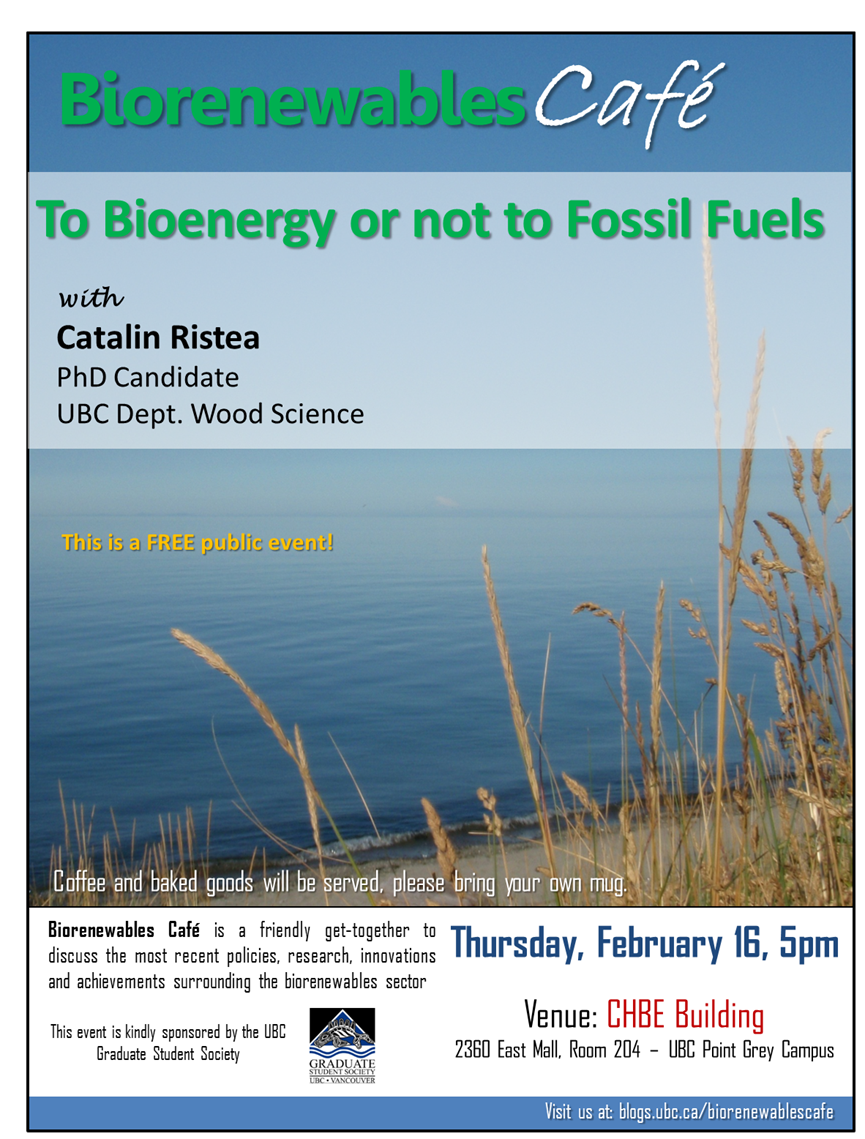
Our next Biorenewables Café will happen on Thursday February 16th, 5-6:30pm at the Chemical and Biological Engineering Building (CHBE Building, 2360 East Mall, Room 204 – UBC Point Grey Campus). The speaker for the evening will be Catalin Ristea, Ph.D. Candidate at the UBC Department of Wood Science.

Abstract – To Bioenergy or not to Fossil Fuels

In light of recent biofuel policies in BC and Canada, we try to answer the Question: “Under what conditions it is feasible to displace fossil fuels with renewable wood biofuels, from both a financial and a greenhouse gas balance perspective?” First we analyze the climate mitigation potential of biofuels from wood, and we submit that both space and time matter, and they need to be considered in life-cycle GHG analyses. Then we take a closer look at the “magnificent three” – the carbon, the land, and the dollar. We discuss their impact on the Question and, in turn, what variables are they impacted by.

About Catalin Ristea

Catalin is a PhD Candidate in carbon and bioenergy modelling in the Faculty of Forestry at UBC. Catalin’s research interests include multi-objective forest planning to meet environmental, social and economic criteria. More recently, Catalin’s focus has been the development of decision support tools for modeling of large-scale wood bioenergy production operations, which include tactical forest planning, economic analysis, greenhouse gas balances, carbon budgets, and systems analysis approaches for life-cycle studies of renewable bioenergy projects.


Categories
Past Café

January Biorenewables Café

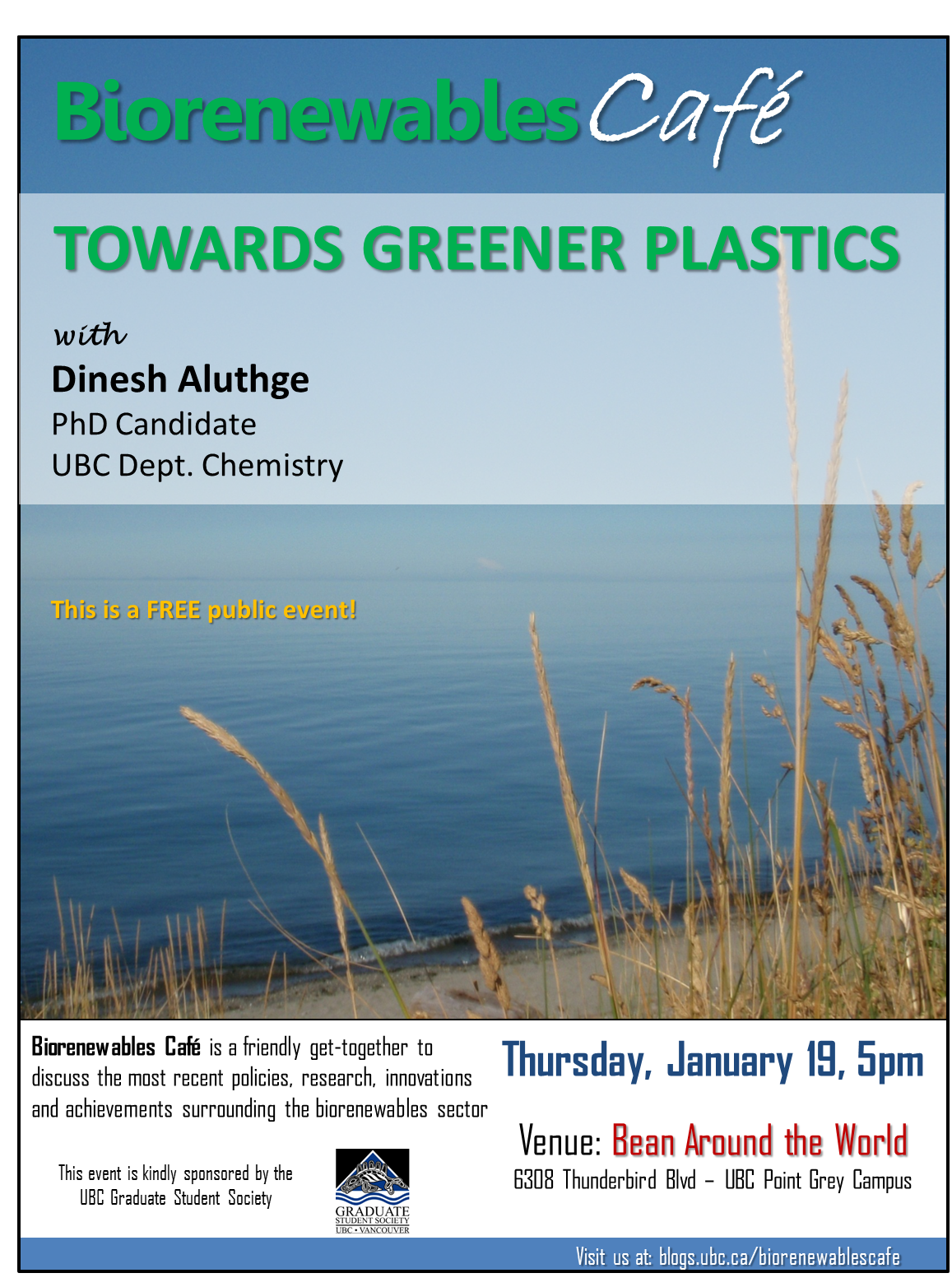
Our first Biorenewables Café will happen on Thursday January 19th, 5pm at the Bean Around the World (6308 Thunderbird Blvd). The speaker for the evening will be Dinesh Aluthge, Ph.D. Candidate at the UBC Department of Chemistry

More info (soon)!

Spam prevention powered by Akismet