Categories
Uncategorized

The Facebook “Buy” Button

A big issue for social networking sites is how to monetize websites. Sites who have huge followings that consume so much content must find a way to present advertising content that will be engaging with viewers and not distract them too much from the functions of the site.

Since July of this year, Facebook has been testing a “buy” button in their News Feed to allow Facebook users to purchase goods featured in ads or posts directly from Facebook. The company that will be processing the payments is a small startup called “Stripe”, who offers a similar service to Paypal.

 

facebook-buy-button2

It will be very interesting to see if Facebook users, firstly, react positively to this change. And if they do, will they actually use the “buy  button” to make purchases? This is a relatively new idea, although it is important to note that Twitter is using the same company to experiment with a buy button of their own.

Personally, I do not see myself purchasing products from Facebook as I am not that big of an online shopper, nor do I yet trust making a purchase from within Facebook. I do think this idea does have potential. A lot of my friends shop online, and click on advertisements on Facebook.

A company that I see frequently on Facebook ads s “Jacks Threads” who sells men’s apparel. I think companies that would benefit from this feature, are ones that rely on customers making impulse decisions. Clothing especially, is something that you see online, and may make an impulse decision to purchase. A company that I see frequently on Facebook ads is “Jacks Threads” who sells men’s apparel. By having the buy button, it reduces the steps required to make a purchase, which makes an impulse decision easier to make.

When the feature is launched it’ll be interesting to see how well-recieved it is. Hopefully this will have positive implications on the way that digital marketers reach their audience base.

See below, the “buy button”.

facebook-buy-button-21

Categories
Uncategorized

Google AdWords

I wanted to do a posting on Google AdWords just because I know it’s a tricky topic that can get quite confusing for digital marketers. My understanding of it was pretty limited, so I did some research on it, and it turns out it’s not as daunting as I originally thought.

Google-adwords images

Google-adwords

So, the key to how Google AdWords works is the “Quality Score”. Depending on the keywords in your advertisement, Google generates the Quality Score to indicate how well an ad relates to what a person is searching for, and how likely they are to click on the ad.

When some one does a search on Google, an AdWords auction is created where every advertiser whose keyword matches the search query will “compete in the auction. The advertiser that wins this auction will be the one who is granted the spot.

It actually all comes down to a very simple formula. The Ad Rank is determined by two metrics: the “quality score” (as discussed above), and the advertiser’s “bid” amount (the maximum amount they are willing to pay)

Ad Rank = Quality Score * Bid

Th ads are placed in order based on Ad Rank. The highest Ad Rank gets the top spot and so on down to either the last ad qualifying for the auction or the last position on the page.

$$ = Ad Rank to beat / Quality Score + $0.01.

Using the above formula, the amount that the winning bidder has to pay for their click is calculated. The winning bid will always pay 0.01 cent more than the ad that they have beaten.

YouTube Preview Image

Make sense? It’s may be slightly difficult to learn through words, but if you head on over to https://www.google.com/adwordsor watch the simple video above, you can try it for yourself! My group member who was in charge of Google AdWords for our client project told me it’s all about practice, practice, practice… 

Categories
Uncategorized

Facebook to Acquire Whatsapp

Facebook is nearing the finish line of its $19 billion dollar acquisition of the Internet messaging service WhatsApp.

A crazy amount of money in my opinion for such a simple app. To contrast this, Facebook purchased Instagram for a mere one billion, and offered Snapchat 3 billion for ownership rights. So, I thought it would be helpful to try to break down why Facebook is willing to pay this much for Whatsapp.

Facebook-Whatsapp-image1

Reason 1: The next billion users

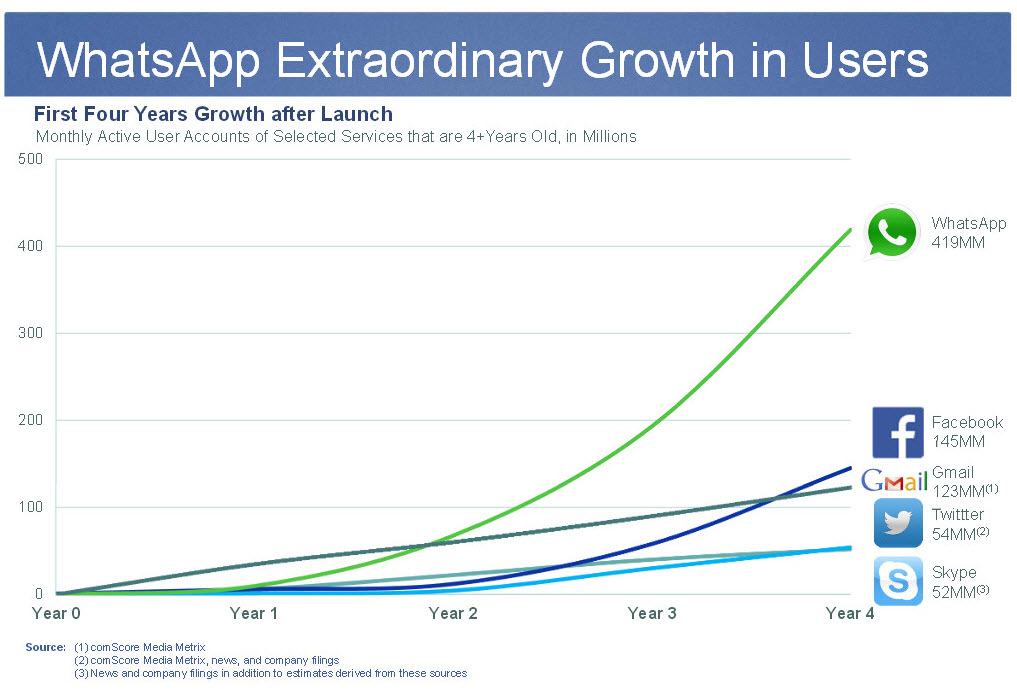
Facebook may have a whopping 1.2 billion active users, but their growth has been slowing and shrinking over the past few years. With most of Facebook’s user base from North America and Europe, Facebook does not have the user base that Whatsapp has in Asia and Latin America. I’m guessing that once Facebook gets their service to 2-3 billion people, there will be even more profound ways that they can monetize the site.

WhatsApp-growth1

Reason 2: Alternatives to SMS

Whatsapp is becoming the SMS of the future. Myself, along with many of friends use Whatsapp much more than we do SMS. Being a sales rep at a cell phone retailer, I can attest to the fact that consumers at large are purchasing high-usage data plans. With Whatsapp having features such as group-chat and the ability to send messages through wifi/cellular networks, it is making SMS become obsolete.

Reason 3: Engagement

WhatsApp appears to be the only app that has a higher engagement levels than Facebook itself. Mark Zuckerberg, the founder of Facebook has admitted this and believe it is a crucial acquisition because it is an app that users are extremely passionate about. When users are passionate and engaged with the content of an app, integrating advertisements and finding sources of monetization becomes a lot easier.

Watch the video below to see a panel discuss the impact the acquisition of Whatsapp will have on Facebook

YouTube Preview Image
Categories
Uncategorized

Mobile Phone Marketing

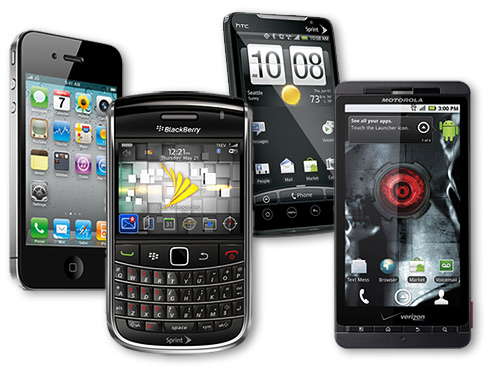
In September 2011, 20.1 million Canadians ages 13 and older used mobile devices according to research firm comScore. Notably, in the past couple of years, more and more people have been incorporating smartphones into their lives…. and downloaded applications were used by 40.9% of regular phone users, compared to a whopping 84.2% of smartphone subscribers!

Clearly, mobile phones are a very lucrative avenue for marketers to promote their products/services. However, how exactly will they do that? Since smartphones are relatively new to the world – and much like when the internet first became mainstream, advertisers and online stores had to initially experiment on what worked the best – which took a couple of years, and is still ongoing! This has been mentioned in class – company websites used to be primarily for information, but now have become online stores that are user-friendly, interactive and try the best they can to make online shoppers feel like they are physically in the stores!

But what is the appropriate way to advertise on mobile phones but still generate profits? Advertisers are still searching for the winning formula, but I believe that since mobile screens are much smaller, ads need to be kept at a minimum, and should not be intrusive to the point that they distract from the app itself. For example, I used to use an app called “OMG Facts” which would post interesting facts a couple times everyday – and I would read them every day. Every so often an ad would pop up, which I didn’t mind, but one day the app was updated and it now included a “floating ad”, which is basically an ad that moves up and down the screen as you scroll. It became so distracting, that within 5 days I had already deleted the app. And for the record, not even once did I even think of clicking the ad.

I constantly read articles about how companies with apps, such as Facebook and Twitter are struggling to generate revenue… so what are some innovative ideas to make mobile advertising more profitable? Well, Sauder superstar Brian Wong who, became the world’s youngest entrepreneur to get venture capital funding for his latest project, “Kiip” at the young age of 19!

“Kiip” involves advertising in which players of mobile app games receive free gift certificates or samples of a company’s product, which are sent to a person’s house as a prize when the individual reaches a certain stage in a game. Personally I think this is a great idea because the individual will feel like they have earned the product as a prize… and perhaps feel more of a connection to the product – at least more so than your typical mobile advertisement would.

That’s him!

I think what Brian Wong’s idea is a good one, because it integrates itself into the app – which is what I feel mobile advertising as a whole needs to do, be more INTEGRATIVE and less BOMBARDING. However… time can only tell whether this will result in a success… can’t wait to find out!

Sources: http://www.digitalhome.ca/2011/12/report-smartphone-adoption-reaches-40-in-canada/, http://www.sauder.ubc.ca/News/News_Listing/News_Item_-_Kiip_4_mill

Categories
Uncategorized

Will NFC Technology Eliminate The Need for Wallets?

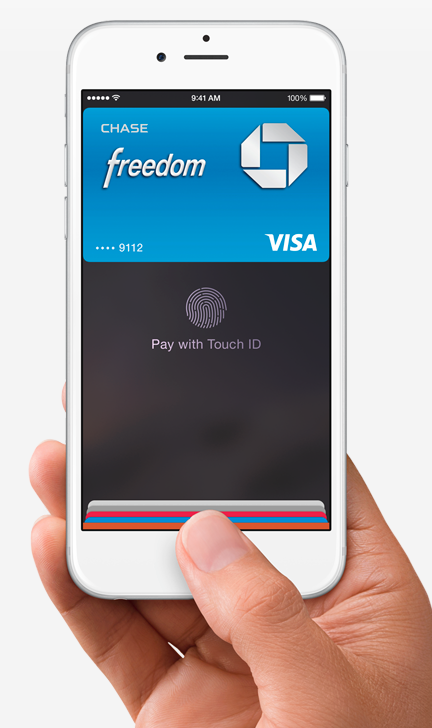
Are the days of searching for your wallet finally past us? With Apple’s introduction of “Apple Pay”, they claim it will change how the world pays with its new payment technology that is built right into the new iPhone 6.

This new technology is called “Near Field Communication”, where one has the ability to  make in-store payments with their iPhone 6 by holding it next to a store’s “contactless reader” which will then process the payment.

Screen Shot 2014-10-04 at 12.18.14 AM

As it stands, the three major credit card companies have all signed up for this service – Mastercard, VISA and AMEX. Furthermore, in the states, big retailers like McDoanlds, Duane Reade, Whole Foods & Macy’s have all shown their support by adopting this service.

The fact that Apple has been able to garner this level of support from these major retailers speaks miles as to how influential Apple is. Their innovation has the power to alter the way people make payments, and essentially, it changes how society goes about their day to day to life.

I think that this technology will make plastic cards such as credit cards & membership cards obsolete in the next 50 years. It will be very strange to live in a world where the only thing you need to bring when you go out being a smartphone.

Spam prevention powered by Akismet