Categories
Uncategorized

Life of a student teacher

Work for a cause, not for applause. Live life to express, not to impress. Don’t strive to make your presence noticed, just make your absence felt.


Being a teacher is hard work. Student teaching follows an extremely steep learning curve, and it is one that requires me to be completely humble. I enjoy the new routine, waking up early and looking forward to an early bedtime. I love being with my students at school, and I feel comfortable and completely at ease in the school environment. However, it is incredibly trying just to be responsible for many, many things all at once.

I appreciate the great feedback I am getting on my teaching, from all perspectives (my mentor, my own reflections, my student’s reactions, my colleagues’ discussions). It is just scary to be so transparent and have to make myself vulnerable to critique in order to grow the most, best.

While I am working on incorporating “Big Ideas” into my lessons, I must also focus on the big idea for me as a teacher. I want the students to love learning. I want to impart strategies that they can use to work together, as well as independently. I want to make learning meaningful for the students by facilitating discussion and exploration of real life events and objects.

Tomorrow is another day.


Categories
Uncategorized

More Music in the Classroom!

Playlist by Mr. Vasicek, a teacher in Michigan

found here and his philosophy behind it found here


Come-In Songs — Bouncy songs to start the day off right.


Morning Kickoff — These songs provide a short, interactive way to start the day as soon as that bell rings. In my class we accompany the songs with motions and peer interaction. Positive touch each day can really help to build relationships (see Dr. Becky Bailey).

Writing Time — During writing time, I play slow-paced songs that have no recognizable lyrics, which would create a distraction. I play these selections ONLY when the students should be writing. The last song is ALWAYS the same so they know they need to wrap up their thoughts. Works like a charm . . . just like Pavlov’s experiment.


Subject Anchors — I use these songs to indicate the start of the next subject. The songs signal what books and folders students will need for the next lesson.

867-5309” by Tommy Tutone for math “Weird Science” by Oingo Boingo for science”Supercalifragilisticexpialidocious” for spelling Pink Panther theme for mystery reading “America” by Neil Diamond for social studies lessons on American history “Pizza” by Gemini for lunch on pizza days “Peanut Butter Jelly Time” by Chip-Man & the Buckwheat Boyz for lunch on other days “Who Let the Dogs Out” by Baha Men for recess

Timed Transitions — I find TV theme songs work great for this.

  • Thirtysomething theme song — one minute  (The link goes to an extended version of the song.)
  • ER TV theme song — one minute
  • Malcolm in the Middle TV theme song — 30 seconds (Again, this links to an extended version of the song.)
  • A reader’s comment on my first post about music alerted me to this Web site as a source of free downloads of commercial jingles, video game soundtracks, and TV theme songs.

End of the Day


Class Songs — A song we pick to sing every Friday during our reflection and share time, which we call “Highs and Lows.”

Categories
Uncategorized

District Regional Conference 2013

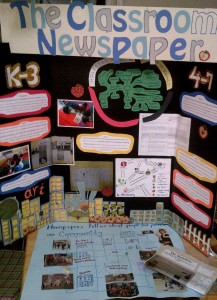
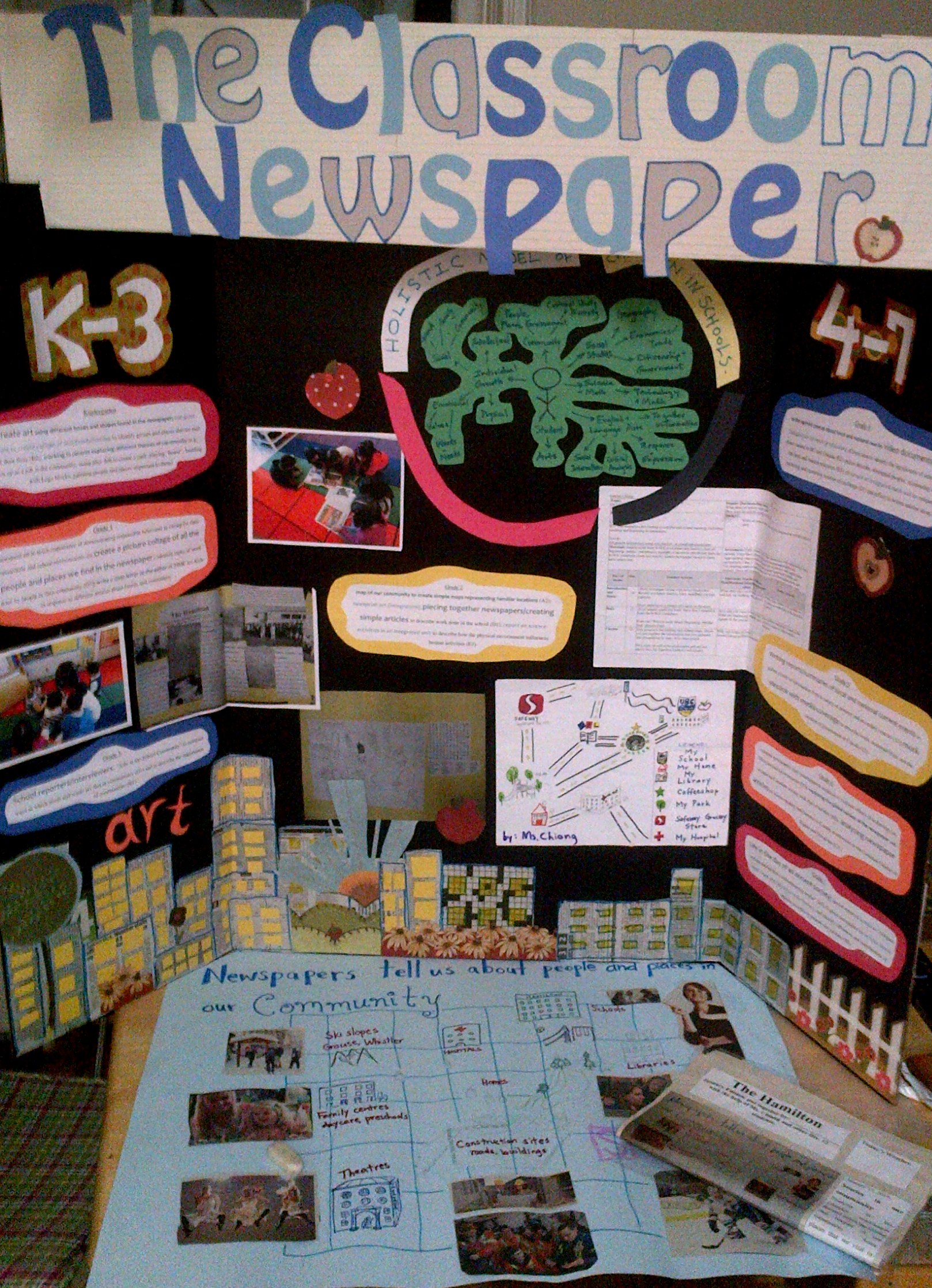
I did it. Here is my posterboard for my kiosk on Friday. I will be introducing my integrated unit for Language Arts and Social Studies.
Here is a short reflection on how Aboriginal ways of knowing have influence my approach to this enactivist project.
Holistically Informed (Aboriginal influences)

Specific to this project:

The Aboriginal approach to teaching is very holistic and natural, valuing students to teach them about the interdependency and interrelationships between humans, nature, communities, and ecosystems. My plan to support my students in the publication of a classroom newspaper is informed by the holistic integration of all subjects. My vision for the classroom newspaper is that it will involve every student’s writing, reading, and presenting skills valuable in language arts education. It is also my intention to guide students in “big ideas” thinking, or to understand by design that both the creation or and content within newspapers is a reflection of community.

Students will learn to listen to stories and interviews from different people in our community, such as other teachers, older students, younger students, and their peers. In creating and reading their own newspapers, students may also become more aware of their school community and share what they are learning by oral tradition, to their families and friends. Students might demonstrate their willingness to participate in a variety of sharing activities that include the use of pictures, charts, storytelling, songs, lists, menus, and story books as part of the process of the newspaper production.

Additional learning:

The common thread between the stories by our Aboriginal speakers within this SSAEd course, as well as those that I’ve attended outside of the program, seem to be the place- based identity that weave their identity and ways of knowing together. It is one goal of many First Nations communities to re- integrate holistic understandings of space and time into a contemporary curriculum. I have learned to value all stories, and to appreciate the delicate threads that sometimes link a student’s connection to the lesson being taught. Sometimes that fragile connection bridges to a valuable teachable moment. Aboriginal culture teaches us to be respectful and patient with the patterns and circular nature of thinking. I particularly appreciate the layering effect, or scaffolding, of a student’s learning which is represented by the traditional valuing of seasonal knowledge.

There is room for further inquiry into how local Aboriginal history and culture can be incorporated into the classroom newspaper. It is possible to arrange a gallery walk of tools and objects valued by the local Aboriginal group. In this particular project plan, students will focus more on their school community in their writing and reporting. Regardless, the collection and compilation of stories, advice, personal opinion, and personal artwork will result in a holistic integration across many curricular subjects. Through the enactivism, students will use their mind, spirit, heart, and body to collaborate on this community project by generating understanding through connections with the world around us, then reflecting on feelings to engage in action and information sharing. This is a cyclical process that is in alignment with the Aboriginal medicine wheel representation of balance within self and society.
Spam prevention powered by Akismet