Categories
Uncategorized

Managing Road Congestion in Singapore

I am going to talk about the sunny little island on the equator today (that is where I spent 15 years of my life in).  Specifically, Singapore has very precious land space and high population density; hence, it is necessary for her to tackle the congestion externality on the road (time delay and extra fuel consumption).


Some data in 2011


Land Area 714.3km2
Population 5.184 million
Road 3411km
Expressway 161km

Data Source: Department of Statistics, Singapore (www.singstat.gov.sg).


The policy

In 1998, Singapore introduced the Electronic Road Pricing (ERP) System. As the name suggests, it is an electronic toll system, which makes use of the pay-as-you-use principle. Basically, the motorists are billed when they travel on the roads during some busy times of a day.

The ERP rates are reviewed and calculated by a quarterly examination of traffic speeds of tolled roads and during the school breaks (June and December).

The rates are dependent on:

–Passenger Car Unit (PCU) equivalent

Cars, taxis and light goods vehicles = 1PCU

Motorcycles = 0.5PCU

Heavy goods vehicles and small buses =1.5 PCU

Very heavy vehicles and big buses = 2PCU

–The time of entrance to the bounded area

Toll prices change every thirty minutes according to traffic volume during       peak hours. This methodology will lengthen the traffic flow time.

— The location of the ERP gantry

We can see from above that all vehicles are not exempted from the ERP. Only special vehicles such as the police cars, ambulances and fire engines are not subjected to the toll. Residents of Singapore are not subjected to any form of privilege too.

There are currently 80 ERP gantries located in the Central Business District (CBD), expressways and Outer Ring Roads and the Orchard Cordon.  However, when ERP was first implemented on 1 September 1998, there were only 33 gantries.  In addition, the number of gantries was 46 as of 1 August 2005. Hence, we can see that there is a stark increase in the number of ERP gantries and the quantity almost doubled as compared to ten years ago.

In February 2003, graduated electronic pricing was introduced to refrain motorists from speeding up or slowing down in order to pay less ERP charges. This is a very sound alteration of the policy because sudden changes of speed would either increase the probability of accidents or slow the traffic flow down. In addition, the graduated ERP is put forward in the relatively expensive bands and lower the ERP charges for commuters generally.


Effectiveness of the policy


Olszewski and Xie (2005) used a discrete choice based model to conclude that the ERP is an effective method to control congestion. The authors collected and examined traffic data before and after the initiation of toll on specific roads, and looked into discrete toll locations. They found out that cars are more responsive to ERP changes than other kinds of vehicle. They also mentioned that peak period road pricing would make other timings and other routes busy. However, it was explained that the above scenario was not as consequential as the horrible congestion existing before ERP. One thing to take note here is that this study is done in 2005 which means that the situation may have changed. The proliferation of ERP gantries in the recent years suggests that other roads in the city centre area (CBD) are getting congested too.

They then provided and analyzed empirical evidence on the impact of the variable pricing on the traffic flow in Singapore. Although there may be some methodological difficulties, it can be shown that the ERP effect on traffic volume can be measured.

This suggests that ERP is a success in terms of feasibility and functionality and could reduce the demand for commuting during peak hours and central areas. However, one drawback is that there is not cost-benefit analysis done for the program.

In addition, in terms of price variation, Santos (2007) stated that if road pricings change according to location, time and type of automobile, the toll scheme would reflect social cost more effectively. Hence, Singapore’s ERP system fulfils the criterion and account for the social costs of congestion very efficiently.


Distributional effects of the policy


The system is definitely not fair (Santos, 2007) because the poorer drivers pay the same amount as the better-off ones. In other words, ERP is regressive in nature. I think that regressive road pricing is very common and it is not feasible to charge different amount of tolls according to income levels. In addition, Santos (2007) stated that the regressive nature could be overcome by optimal usage of toll revenue. For example, the government could return part of the revenues to the low-income groups in a lump sum manner.

In Singapore, everyone knows that it is extremely to own a car. Hence, Santos (2007) claimed that congestion prices might be fair for the case of Singapore. Only the rich people could afford cars and by paying ERP, they are indirectly financing the public transport infrastructure. By doing so, the poor will benefit from the fast and efficient public transport.

In conclusion, I believe that the ERP system is very efficient for the toll is constantly and reliably changing according to location of the gantry, time and traffic condition. Although it maybe regressive in nature, the ERP is a success story as long as the government uses the toll revenues to expand road capacity or to improve the public transport system.


References:

Olszewski, P., & Xie, L. (2005). Modelling the effects of road pricing on traffic in singapore. Transportation Research Part A:Policy and Practice, 39(7-9), 755-772.


Santos, G. (2007). Urban congestion charging: A comparison between london and singapore. Transport Reviews: A Translational Transdisciplinary Journal, 25(5 ), 511-534.
Categories
Uncategorized

France Water Effluent Tax

It is been historically well known that the US prefers tradable permits, especially the freely allocated, grandfathered permits while the EU prefers taxation. This difference could be seen as a reflection of a stronger belief in individual private rights and specifically the “prior appropriation” doctrine (the right of the first user) in the US. On the other hand, Europe is rather in favor of the benign and paternalistic state, working with “societal” interests in mind. Therefore, I would like to write about a EU pollution tax, particularly the France water effluent tax.


Basically, France has no considerable problem with quantity aspect of water resources due to favorable climatic conditions. Hence, France focused on the quality aspect of water management policy, which is the reduction of water pollution.


The players and coverage of the France water effluent tax system


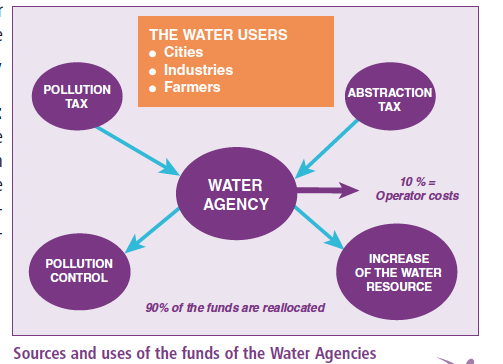
  • The framework for water charges was created in 1964 and was managed by six basin-wide institutions, the Water Agencies that are jointly controlled by the State and municipalities. The water charges system covers the whole of France.
  • Charges may be levied on any agency (public or private groups) or any individual if they:

-Lead to the deterioration of water quality:

-Extract water for use from natural sources; or

-Change a river basin’s marine environment.

  • The effluent tax is proportionally imposed on the polluters by the quantity of pollution they discharge.
  • The charge includes a wide variety of pollutants (suspended solids, biological oxygen demand (BOD), chemical oxygen demand (COD), toxic substances, phosphorus, nitrates and several heavy metals).


The use of revenue from tax


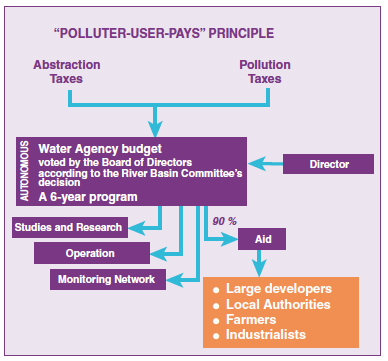
The effluent charges collected are earmarked for promoting pollution abatement activities (to build waste treatment plants). In other words, a compensation system, known as the subsidy for wastewater treatment, was used to offset the water pollution charge for those people or bodies who treat water before discharging it into rivers and lakes. Revenues are thus totally redistributed to those engaging in pollution abatement (industrialist or municipalities responsible for treating household effluents), according to investment costs, and not pollution performance.


The ‘last time’ Problem


Since the creation of Water agencies in 1964, there has been an incessant disagreement over charge rates between the State and the municipalities. The political economy is central to the evaluation of the effluent tax rate. To be precise, the charge rate could be perceived as the outcome of a three players’ game involving the Ministry of Environment (maximizing polluter’s compliance with water regulations), the Ministry of Finance (minimizing Agencies’ budget), and the municipalities (maximizing political support).  As a result, the rate of the effluent tax maybe too low to stimulate a noticeable incentive effect on water consumers and polluters.

The gist of the story is that the charges and subsidies are effective in promoting regulatory compliance among the individuals and groups but is not effective enough to induce the polluters to go beyond regulatory requirements (the French water system is constrained to a role of enforcement of public regulation due to the hybrid nature of the Water Agencies).


The current France Water System


  • There are two categories of tax: the pollution tax (aims at preserving water quality) on the emission of pollutants and water abstraction tax (to promote water saving).
  • 7 types of taxes:

-Water pollution tax

-Tax for modernization of wastewater drainage systems

-Tax on non-point agricultural production (farmers)

-Water abstraction tax

-Tax for water storage in low flow periods

-Tax on obstacle on rivers

-Tax for the protection of aquatic environment

  • Tax calculation is based on a regular follow up on discharges.

-For households, the water tax is calculated for each municipality according to permanent and seasonal populations and levied through drinking water bill paid by consumer in accordance to the consumed volume measured by the meter.

-For agricultural uses, a new tax has been implemented in 2008 by all distributors of phytosanitary products according to the quantity of dangerous/ toxic substances contained in the marketed products.

  • The tax revenue is not tax neutral, as the population is not being paid back the tax. As mentioned before, the tax is earmarked for investments mad by municipalities, industrialists, farmers and other users to preserve the water resource and to improve the performances of the treatment plants.  One thing to note here is that a proportion of the investment is subsidized relative to the size of the investment and not the overall pollution performance. This may be a little undesirable as there may be no evaluation (cost benefit analysis in terms of net present value) of the projects before giving out the subsidies to the industrialists.


In conclusion, France’s water allocation and pollution control is a “public utility” model and rely on centralized administrative discretion and less on the preference and initiatives of private individuals. Water charges are set without regard for scarcity values based on bids and offers by consumers. In addition, there may be a lack of congruence between regulation and economic incentives (taxes) rooted in the competition between the two institutions. The water tax is definitely effective at the regulation level, however, it may not be high enough to promote initiatives by the polluters to take a step further to reduce water pollution.


References:

http://www.rff.org/documents/RFF-DP-01-58.pdf

http://www.iisd.org/greenbud/france.htm

http://www.fao.org/docrep/003/t0800e/t0800e0c.htm

http://www.oieau.org/IMG/pdf/IOWater-WaterManagementFrance.pdf

http://www.cerna.ensmp.fr/Documents/MG-Sub-EuropeanJalLawEco.pdf

Spam prevention powered by Akismet