Categories
Uncategorized

Sweatshop Turnaround

Remember around 1995, when all of a sudden the social conscience of the world seemed to explode in a wave of pre-millennial guilt? That was when Nike, global athletic wear brand, came under a harsh spotlight for allegations regarding its labour abuses in overseas countries. Images such as the one shown below ran rampant:
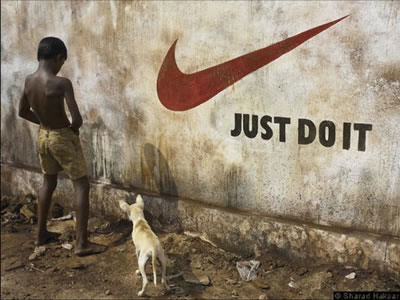
The interesting thing about this public reaction was that Nike was not alone in outsourcing its labour and paying peanuts for wages. Many other manufacturers, those of clothing especially, saw in the rise of cheaper global transport an opportunity to cut costs.  It is likely that Nike came under such harsh criticism initially due to its strong position as an industry leader and a well-established brand, especially one with humble, ‘of the people’ origins.  However, once this snowball of criticism had started, ordinary consumers found themselves caught up in protests and boycotts that shook Nike’s brand value around the globe.

And then, what happened? Nike is currently an extremely popular brand, and through the years it has expanded its offerings beyond simply athletic clothing to include a women-specific apparel line and many lifestyle pieces, most recently focusing on hip-hop apparel and shoes.  In doing so, Nike has solidified its role as a leader, both in its original field and in apparel industries beyond this.  Although there are still some individuals who bring up sweatshops as a sticking point when refusing to purchase Nike apparel, the bulk of consumers (at least the observable ones) in Nike’s target markets seem to have forgotten this unfortunate incident, or at least find Nike’s new offerings more favourable than a boycott at this point.  I am an example of this; although I consider myself to be socially responsible, one of my favourite pairs of shoes is a pair of Nike hightops.

Yes, it is true that Nike made commitments to improve working conditions.  Yes, they did employ more transparency methods in their manufacturing processes, and begin a Nike Corporate Responsibility handbook.  But many of these issues, while somewhat addressed, were not solved and still exist to this day. 44cent wages and cramped spaces still exist, as they do in the factories of many firms. It’s almost as though we’ve stopped caring…

But I don’t think that’s it.  We just care about our shoes more.

Categories
Uncategorized

Re: Google’s Usurper

vs. 

When perusing my friend and classmate Daniel Kong’s blog The Black Renaissance, I stumbled upon this post from last week regarding the supplanting of Google by Twitter.  In his post, Daniel discusses how via Twitter, consumers and marketers are now able to perceive trends and find changes in public perception before they have even become noticeable enough to be picked up by major search engines – namely, Google.

This leads to an interesting thought process regarding the nature of each website.  When originally released, Twitter was thought of as a social media network, meant for businesses to keep target consumers updated, while Google has always been primarily a search engine, albeit the most well-regarded and powerful in the world.  However, as each firm seeks to develop their product and domain further, the inevitable is happening: turf wars.  Google has Gmail, Google Docs, and Google chat, each of which, while not directly competing with Twitter, competes with Twitter for consumers’ time when they are online.  Twitter. on the other hand, is being used at an increasing rate by trend watching websites and consumer behaviour analysts as influential individuals are likely to post their thoughts on, say, a fashion show via their Twitter immediately after it happens. Thus, consumer ideas and burgeoning trends are available for comment before they can even become substantial enough to register in a search engine.

However, I am still of the belief that Twitter could never compete with Google where it matters.  While it may be fabulous for monitoring trends, the only way that these trends hit the population as a whole in this modern day and age is via a solid page or domain that can generate the hits necessary to create a stir among consumers – thus, Twitter may catch on to the ideas first, but the ideas become trends via hits on Google.  This applies not only to the fashion industry, but also to general trends regarding consumer preferences, reactions to new products, and changing social movements. All in all, I feel that the two regard each other with a competitive mindset, but can in fact benefit each other. The competition only starts once Facebook is factored in…

Categories
Uncategorized

Rebranding Remembrance

This past Remembrance Day was marked by the lowest ever attendance of WWI and WWII veterans to ceremonies across Canada, and it is no surprise why: as the years from these wars grow in number, the remaining veterans conversely decrease in number. There are currently only 3 or 4 surviving WWI veterans in the world (depending on how veteran is defined – http://en.wikipedia.org/wiki/List_of_surviving_veterans_of_World_War_I, and when they no longer remain, the entire global perception of the First World War will change. It will change from being within living memory to suddenly being a conflict long past, the details of which are remembered only in textbooks rather than in the vivid and fresh stories of individuals.

Our collective memory of WWII faces a similar, if not as urgent, problem.  It has been estimated that approximately 1700 WWII veterans pass away each month. Soon, this too will pass from living memory.

How will this change our perception of Remembrance Day? The poppies have always been associated with John McCrae’s iconic poem In Flanders Fields, relating directly to the First World War.  Even though the message of Remembrance Day and the significance of the moment of silence at the time of Armistice have transcended the boundaries originally set by WWI, for many the perception of the day is one of recognition primarily of veterans from wars long past, and of modern day veterans second.  In light of this, many Remembrance Day celebrations have started to include costumed individuals to represent the war veterans who can no longer be with us, yet the gravity of whose sacrifice must still be acknowledged.

However, I believe for Remembrance Day to continue to carry the weight and significance that it deserves into the future, a shift needs to be made in its focus.  By 2015, modern-day veterans will outnumber the veterans from WWII and the Korean War by approximately three to one (http://www.theglobeandmail.com/news/national/Remembrance_Day/veterans-by-the-numbers/article1794591/?from=1794568).  Canadians need to understand that even though the scope of our wars may have changed, this does not change the enormity of the sacrifice that our soldiers make for this country.  Veterans Affairs Canada needs to seriously consider rebranding Remembrance Day to put a much more emphasized focus on today’s veterans, who are coming home with a vastly different psychological landscape to a much more lukewarm reception.  In order to truly allow Canadian citizens to feel motivated to participate in Remembrance Day once more, we must be forced to recognize that today’s veterans are among us, and deserve our  appreciation.  I would suggest the creation of more informative advertisements and documentaries by Veterans Affairs Canada, as well as increased funding for celebrations putting a strong focus on modern-day veterans.  The symbols of Remembrance Day, such as the poem and the poppy, should not be dropped, but rather should be used to help put focus on modern-day veterans and warfare.  We cannot afford to forget the past, but in order to keep this memory alive we must keep the tradition alive, and the only way to do this is to adapt the traditions of Remembrance Day for today.

Categories
Uncategorized

Broccoli: The Miracle Ad

Do you remember those TV spot ads that aired last January about Broccoli, the miracle food? If you haven’t seen it yet, check it out, it’s pretty funny: YouTube Preview Image There was also a pretty strong website going, which can be found here: http://themiraclefood.ca/

However, in late September the Television Bureau of Canada revealed that the ads were not, in fact, an actual ad campaign. No, it was an effort on the part of the TVB to prove that advertising can sell anything. And it’s true. The TV ad alone was able to create a huge fan following after just five weeks, seen in the Facebook pages that attracted more than 20,000 followers and the video’s high ratings on YouTube. More importantly, broccoli sales were 8% higher than they had been the previous year – or, 188,574 lbs more.

So, is it true that advertising can sell anything? Or was the broccoli campaign so successful because it merely repeated what our mothers have always been telling us – but in a much less menacing way? Regardless, I know that I have a new appreciation for broccoli’s health benefits that isn’t going to disappear just because the man with the parachute is no longer on TV.  Without this ad campaign, I would probably still be missing out on all those essential nutrients.

Categories
Uncategorized

The Guiness Project: Re-branding a National Symbol

In honour of Halloweekend and all the rowdiness that surely took place (by which I mean too much candy – OBVIOUSLY), I have decided to devote this post to the new Guinness ads that I saw everywhere this weekend.

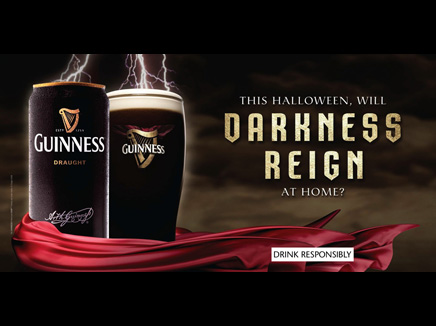
Anyone who has haunted an Irish-type pub in the last month or so (my choices would be Mahoney’s or Dentry’s, but any will do!) has surely seen these ads, although I couldn’t seem to find one one their website and had to use one from 2008 instead.  Basically, the Guinness Halloween campaign seeks to link the darkness and mystery of Guinness with the darkness and mystery of Halloween – a seemingly difficult task for a brewing company with such a rich history (dating back to 1930) with a traditional focus on its heartiness, high comfort association and classic Irish brewing methods.

However, a closer look makes it clear that this Halloween marketing is a stroke of brilliance.  After all, everyone loves to share a pint or two at Halloween, but it lacks the traditional attention of alcohol companies as there is still a strong association with children at Halloween, and I suppose that while skimpy adult Halloween costumes are one thing, pushing alcohol at this primary school holiday is another.  However, without specifically saying on its packaging that Guinness is the new Halloween drink, all of the ads made the association very clear.  New this year was a drink called Guinness and Blood or some variation on that, which sought to also tap the growing health trend by creating a pomegranate-Guinness mixed drink. I personally never tried it, but I’m sure the bitter beer would have gone beautifully with the rich tang of pomegranate.

All in all, as strange as the Guinness Halloween campaign may seem, it appears to have been successful; why else would it be kept running for four years in a row? It makes sense that management, resenting the brand’s sudden North American popularity on March 17 and much lower, more constant sales throughout the rest of the year, would seek to create a second push. As for me, I am happy to enjoy a Guinness any day of the year… but at Halloween, maybe I’ll have two.

And here are two Guinness ads, one from Halloween 2008 and one from 1930.

Spam prevention powered by Akismet