Author Archives: Bernice Huynh

Increased screen time can lead to deficient brain development in children

Have you ever seen a tablet or phone given to a child as a solution periods of crying or whining? Giving an infant a portable device is an easy and harmless remedy to infant tantrums right?

Not exactly, a recent study published by JAMA pediatrics reveals that an increased amount of screen-based media use can lead to lower language retention and literacy skills in prekindergarten children.
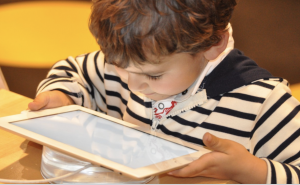
Child playing with tablet Source: PxHere

Researchers studied 69 children from ages 3-5, to determine a possible existing relationship between screen-based media use and brain development. From their study, they were able to conclude that children with an increased screen time, compared to the guidelines of the American Academy of Pediatrics (AAP), showcased a lower microstructural organization and myelination of white matter tracts that support language and literacy skills.

Myelination of white matter tracts is crucial to the cognitive development of infants as it involves the formation of a myelin sheath around a nerve to allow the a quicker displacement of nerve impulses in the brain.
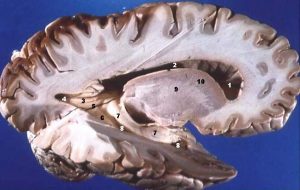
Cross section of human brain, the lighter parts are the white matter and the darker parts are grey matter. The white matter is coloured white because of the myelin that surrounds the nerve fibers in the brain. Source: Wikipedia

From their research, lower amount of white matter in childrens’ brains lead to a decreased level of derivation of meaning of objects, symbols, and letters, which scientists believe plays a crucial role in literacy development.

To develop these conclusions, scientists analyzed the results of a ScreenQ survey (completed by the child’s parents), which is based off of four main factors of the AAP guidelines involving the child’s access to screen, their frequency of use, the content viewed, and interactivity or co-viewing. From the survey, the researchers compared the survey results to MRI scans of the the children’s brains and also to results from a series of communication tests designed for children with developing literacy skills.

The solution to these neurobiological risks in children may be very tricky as screen-based devices can be found in almost every household and are used daily by the general public. However, a way to prevent deficiencies in child brain development can be to follow the guidelines proposed by the AAP. Some of the recommendations are:

  • For toddlers younger than 18-24 months, avoid any form of media other than video chatting
  • For children ages 18-24 months, only allow children to watch media with parents (co-viewing) to begin communication development though watching and talking with parents
  • For children ages 2-5, allow only 1 hour a day of media exposure (educational programming) through co-viewing if possible.

To see another take on the topic, how portable device use may be beneficial to child cognitive development, check out this video:

YouTube Preview Image

-Bernice Huynh

Mars: The New Earth?

If Earth becomes inhabitable due to the alarming rate at which climate change is occurring, is there a possibility for humans to live on Mars?

Previously, the idea of human life proliferation on Mars was mainly expressed in science-fiction. However, a recent study reveals a new application of a material to make Mars habitable for human life.

picture of Mars

Source: Pixabay

Scientists have investigated a new approach to the obstacle of terraforming Mars and making it a habitable planet through the usage of silica aerogels.

Silica aerogel is a solid and transparent material with extreme low density, and thermal conductivity. Its structure is composed of microscopic networks of silicon oxide; therefore, allowing it to be an extremely porous material with 97% of its volume composed of air. Because of these factors, currently, aerogels are widely known for its use as insulators and can be found in wetsuits, firefighter suits, skylights, windows, rockets, paints, cosmetics, and even on NASA’s Mars Rovers.

picture of silica aerogel Source: NASA

Scientists believe that due to its insulating properties, when placed in the atmospheric regions over surface areas that are ice carbon-dioxide rich on Mars, a 2 to 3cm layer thick of silica aerogel could allow constant visible light to transmit onto the surface and melt the Mars’ solid carbon dioxide into gas. The aerogel would trap the carbon dioxide gas to mimic the Earth’s greenhouse gas effect and as a result, allow for base photosynthesis to occur, perhaps granting the beginnings of life proliferation on our neighbouring planet. Additionally, this porous material is found to successfully block both ultraviolet and infrared radiation and its thermal conductivity characteristics can raise temperatures underneath to above the melting point of water, without the need for any internal heat source. The discovered key features of this material could provide scientists with the early steps to Mars’ terraformation.

The application of the silica aerogel can be tested in hostile environment currently on Earth that mimic the environmental conditions on Mars, such as Antarctica and Chile’s Atacama desert to study its effectiveness. However, additional factors to the living conditions on Mars such as atmospheric pressure, nutrient availability and dust deposition still need to be considered in this on-going research.

Although this discovery does not provide us with a solution to the Earth’s climate change, this new application of the aerogel could shift the focus on the solution to global warming indefinitely. Through this finding, perhaps the there is a possibility for humans to live on Mars after all.

More information about the synthesis of the silica aerogel can be found here:

YouTube Preview Image

– Bernice Huynh

Mars: the new Earth?

With the alarming rate of climate change occurring on Earth, will the planet the we call “home” eventually become uninhabitable?

Although it was previously believed that human life could only survive on Earth, a recent study reveals a way to make Mars habitable.

picture of Mars  Source: Pixabay

Instead of trying to make Mars more similar to Earth through atmospheric modifications, Scientists have discovered a new approach to the obstacle of finding a second habitable planet through the usage of silica aerogels.

This material, when placed over regions that are ice-rich on Mars could allow constant visible light to transmit onto the surface for photosynthesis to occur. It could also block ultraviolet radiation and even raise the temperatures underneath to above the melting point of water, without the need for any internal heat source. In addition to these factors, scientists believe that a 2 to 3cm layer thick of silica aerogel get could potentially be equivalent to the Earth’s atmospheric greenhouse effect, thus allowing the beginnings of life proliferation on our neighbouring planet.

Silica aerogel is a solid material with extreme low density, and thermal conductivity. It is an extremely porous material and is currently widely known for its use as an insulator. Currently, aerogels can be found in wetsuits, firefighter suits, skylights, windows, rockets, paints, cosmetics, and even nuclear weapons. However, this new application of the aerogel could shift the focus on the solution to climate change and global warming indefinitely.

The application of the silica aerogel can be tested in hostile environment currently on Earth, such as Antarctica and Chile’s Atacama desert. However, additional factors to the living conditions on Mars such as atmospheric pressure, nutrient availability and dust deposition still need to be considered in this on-going research.

But, through this discovery, perhaps the idea of living on Mars not too far-fetched after all.

Image of Fingers Source: flickr

– Bernice Huynh