Last transmission and thoughts on libr559m

I recently posted my evaluation of the class. I was struck how one of the early themes in the class came and bit me in the ass: on the separation of the personal and professional. Something like a school class seems to straddle that divide since classrooms are not as formal as the workplace but not as casual as a pub. This particular class was somewhat of an experiment for me: could I successfully leave behind my old conceptions of professionalism and actually engage in a class for the first time in six or seven years?

Certainly it started out that way. I was so engaged and immersed in the class that I was chastised for ‘babbling’ by our instructor: it was likely meant to be lighthearted but it still stung. This was quickly followed by the debates surrounding the professional and personal in the field (or any field, I suppose). In this debate, I continuously did my best to point out how even having this distinction apply to you is a privilege. There are many folks in the world who simply don’t have that luxury. In other words, the only way for a person like me to be ‘professional’ is to entirely erase large portions of my personality. Ultimately, I ceded the field and allowed myself to be silenced. It is possible no one noticed, but I certainly noted a distinct downgrade in my participation, engagement, and immersion in the class. I quickly became concerned only with fulfilling the requirements and getting my three credits, just like every other class I’ve had in the past five years.

I bring all this up in context of the evaluation because I didn’t write many of my comments because they would have clearly identified me: I’m back to being a professional. Even now, I’m not really leveling any actual criticisms and I won’t. This class has certainly re-affirmed that I must allow myself to continue to be erased if I wish to succeed in my chosen field.

On other matters, I noticed another theme in the class: a distinct pessimism about the field as a whole. A lot of negative feelings about the direction and future of the information profession. This pessimism is not unique to this class, it appears endemic amongst professionals today. In some ways, I see this as a direct consequence and fault of the usual way history and narratives are taught in this culture. That Marxist notion of revolutions and constant breaks from tradition to carve new paths in history. I don’t buy this narrative and my optimism about the profession remains unchanged.

Instead, I’ve also been arguing for a perspective of continuity to a few different people and on a few different topics. I think it is important to always locate current trends and notions in the larger context of history and human nature. There are no radical breaks or revolutions: simply transitions from one state to another, each determined by what came before. There is also far, far more stability in humans than many people in this class seem to think.

In terms of the profession, all I can see are the exciting opportunities. I can also see how there is room for everyone in a field as diverse as information. There are those in the class who want to be children’s librarians. I’ll agree that the outlook can be disheartening. However, people are still having babies. They still like having these babies read to. They still need these babies to grow, learn, and be educated. How can there ever be an end to children’s librarians? Maybe you’ll be reading from an iPad with data projector. Or whatever. But the basics remain the same. The only thing that could bring this niche to an end is if there are no more babies. Focusing on continuity and what is stable is how I maintain my biyuti. Simply a suggestion.

I live my life with the belief that there is room enough for all of us. For me to be a ‘professional’ as myself, instead of being Abraham cast in the role of Librarian. I would like my performance to actually be one that represents me. I dream of this day. There is also room for those who do not wish to constantly be learning new social media tools and only want to deal with rare books. The world is vast and we can make space for everyone.

And, thus, I bid farewell to Libr559M. I learned a great deal (many of the lessons weren’t on the syllabus and not all were positive — but I *learned*). To those I argued with, I want to you to know that I hold no grudges. While I took much of what occurred very personally, I remain focused on the bigger picture. I leave this class not with resentment or ill-will, but with greater resolve to create a world where all people are free.

Peace.
Categories
Immersion

I finally try second life and fail to immerse myself

And, unsurprising, was unable to find an avatar that even represented a portion of myself. I realize that part of the appeal of second life is the ability to come as you aren’t, but I find it interesting that (apparently) *no one* wants to be Asian. Of course, this could be because I was using the basic, free account. Perhaps they have more diverse and inclusive avatars if you pay. Maybe they have *Asians* at a higher pay grade. Of course, I didn’t have to try and pick Asian. But they still didn’t even have my skin tone or anything close to it.

This, of course, doesn’t even begin to touch the gender thing. I wish I could say that I was surprised to find my gender entirely erased from the virtual world. I mean, my gender is erased in the *real* world. I could say more about this, but isn’t this enough?

I will say that this module is supposed to be about immersion and it uses, frequently, these virtual worlds as examples. Except, I don’t understand how a 3D virtual world supports immersion anymore than other social, text based, media? Is not one able to deploy several different tools to immerse themselves in a virtual but non-graphic world? I feel like this is what I do with blogs.

The problem with holding up these virtual worlds as the only or best examples of immersion is how they, at their very construction, have been built to exclude certain types of people. I can be cat but I can’t find a human representation of myself: this will always prevent me from immersing myself in this environment. How could it not?

But in the world of text, especially text written by other POC, I don’t find myself erased or excluded. Thus, I tend to immerse myself in those communities. If anything, these worlds are more *virtual* than something like Second Life. For it is only in the imaginations of the oppressed that communities outside of or safe from their oppressors exist. Since they definitely don’t exist in the off-line world.

Whereas, in Second Life, I am unable to be myself. Just like the real world. At least with the ‘virtual’ world it is because I’m not even a part of the world. For the real world, however, it is to preserve a false sense of safety. To keep my job. To, essentially, survive.

Categories
aggregation

Drupal and aggregation

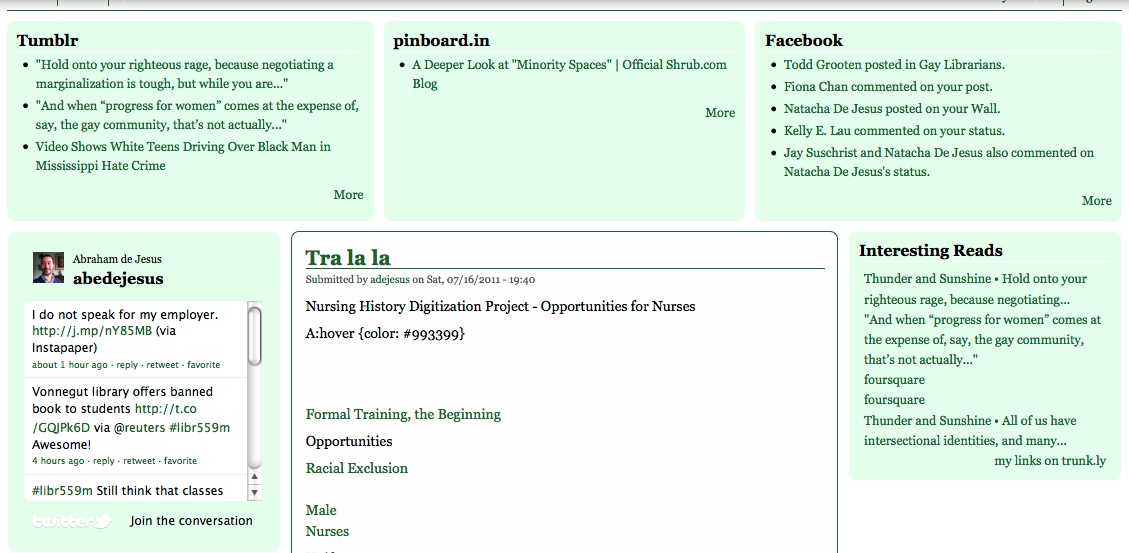
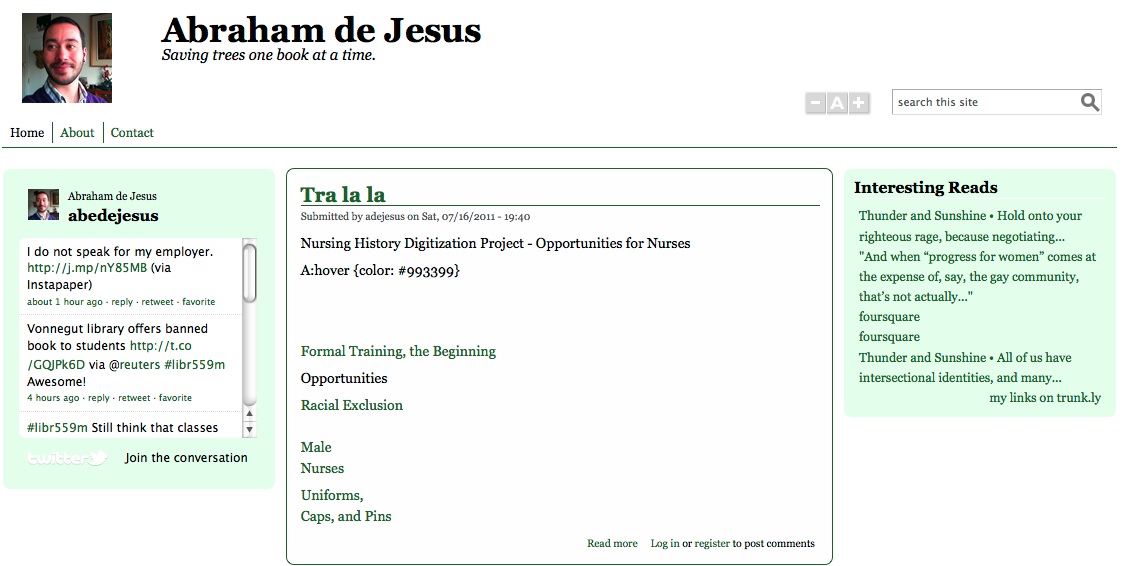
Since everyone’s been talking about what Drupal can do, I thought I’d do a quick post showing how aggregation works on it. This was easy for me to set up because I’ve been building my personal site on Drupal for the past few months or so (not much spare time but I’m getting pretty happy with it). This is my current version:

My planned website built with Drupal

Here is a more busy version with even more feeds aggregated into the front page (that centre area is for blog posts):

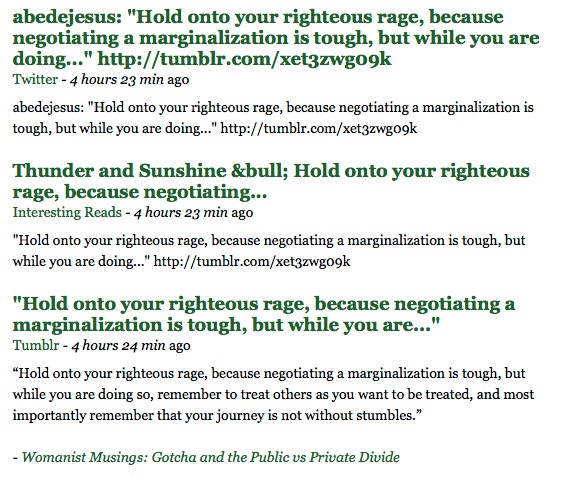
What I’m really liking is the ability to lifestream, the major reason why I’m interested in using Drupal. Lifestream is aggregating all of your created content into one chronological post (i.e., stream). In the next image look at how the three posts are from Tumblr, Twitter, and Trunk.ly:

(although, amusingly, it is a little redundant since I currently use Tumblr to simultaneously publish to Facebook and Twitter and Trunk.ly sucks in those links…)

Categories
creation

One last thought about creation…

A classmate had a very interesting criticism of my podcast: namely that it was hard to follow along with. Now, part of this was a basic criticism of the form, namely that in today’s multi-media culture audio without video (or visual content) is a bit of an aberration.

It made me recall some of my research into the form of podcasts themselves, which is a way to stream audio content. It served to do to radio what blogs did for newspapers. It was one of the earlier new forms or participatory medias of the internet.

When I originally told my chum that I was considering switching to podcasts, he wasn’t very enthused about it because he felt that most people (including him) would prefer to read (or possibly watch) something on the internet.

One criticism that I did feel was apt, was that the content of the podcast was not well-suited to the audio format. It really made me realize that oe always needs to consider the medium before devising the message, since some content is better suited to some mediums.

Although, now that I’m thinking about it, I’m starting to feel that this is false. When new media arise, they immediately begin to determine which kinds of expression are well suited to them. Yet, how were people expressing these same thoughts before the medium in which they are communicated? Seems like a chicken/egg scenario. Perhaps my original feelings were right: any content can suit any medium. The only substantive difference is the audience.

Categories
creation

Creation

So, I’ve lately become interested in trying my hand at podcasting. I’ve downloaded the open source audio software, Audacity and recorded my first podcast! Now, this is a combination of module 4 activities because in Dean’s slides he mentions that doing an outline is one personal activity. I actually did an outline for our group but decided, instead of posting the text, to create a podcast of the outline.

You can listen here!

LIBR559 Final Group Project Outline

Now, we just need to get some server space…

Spam prevention powered by Akismet