Day: January 6, 2014
Call For Papers:
Special Issue of New Media & Society on the Democratization of Hacking & Making
Research on hacker culture has historically focused on a relatively narrow set of activities and practices related to open-source software, political protest, and criminality. Scholarship on making has generally been defined as hands-on work with a connection to craft. By contrast, “hacking” and “making” in the current day are increasingly inroads to a more diverse range of activities, industries, and groups. They may show a strong cultural allegiance or map new interpretations and trajectories.
These developments prompt us to revisit central questions: does the use of hacking/making terminologies carry with them particular valences? Are they deeply rooted in technologies, ideologies or cultures? Are they best examined through certain intellectual traditions? Can they be empowering to participants, or are they merely buzzwords that have been diluted and co-opted by governmental and business entities? What barriers to entry and participation exist?
The current issue explores and questions the growing diversity of uses stemming from this turn of hacking towards more popular uses and democratic contexts. Submissions that employ novel methodological and theoretical perspectives to understand this turn in hacking are encouraged. They should explore new opportunities for conversations and consider hacking as rooted in a specific phenomena, culture, environment, practice or movement. Criteria for admission in this special issue include rigor of analysis, caliber of interpretation, and relevance of conclusions.
Topics may include:
• Disparities of access and representation, such as gender, race and ethnicity
• Open-access environments for learning and production, such as hacker and maker spaces
• “Civic hacking” and open data movements on city, state and national levels
• Integration of hacking and making within industries
• Historical analyses of making/hacking such as phreaking and amateur computing
• Popularization of terms like “hacker” in newspapers, magazines and other publications
• Open-source hardware and software movements
• Appropriation of technology
• Hacking in non-western contexts, such as the global south and China
• Political implications of a popular shift in hacker/maker culture
Please email 400 word abstract proposals, along with a short author biography, by May 1, 2014 toaschrock@usc.edu and jhunsinger@wlu.ca. Final selected articles will be due during September 2014 and will undergo peer review.
Jeremy Hunsinger
Communication Studies
Wilfrid Laurier University
Center for Digital Discourse and Culture
Virginia Tech
ORIENTATION is this week. Please remind your incoming graduate students of New Graduate Student Orientation. The complete schedule is available at http://orientation.grad.ubc.ca/schedules/january-2014/
Thursday, Jan 9th: Main orientation for all new graduate students (Graduate Student Resources, How to be Successful and Financial information)
(Register for January 9th’s event at https://www.surveyfeedback.ca/surveys/wsb.dll/s/1g2e67 )
Jan 10th: Graduate Student Society open house and club social (open to new and current graduate students)
Student Leadership Conference:
For all graduate students, colleagues asked if I could alert students to this Saturday’s (January 11th, 2014) Student Leadership Conference being held at UBC. New this year are workshops run by and for grad students looking for ways to expand their leadership skills. Students may register at slc.ubc.ca.
For information about January’s GPS sessions, please visit www.grad.ubc/gps .
Jacqui Brinkman
I am a presenter at a symposium taking place in February (see attached pdf). I think it would be of great benefit to education policy and administrators, teacher educators, teacher candidates, and education researchers interested in the future of education in this province.
Jenny Arntzen, BFA, MA, PhD Candidate
This message is being sent to notify that the deadline for submissions to the “Queer U” Academic conference has been extended to January 15th. We are currently accepting abstracts from graduate students, established scholars and strong undergraduates. If you have not already submitted your abstracts that you may have been working on, now is the time to do so!
Categories
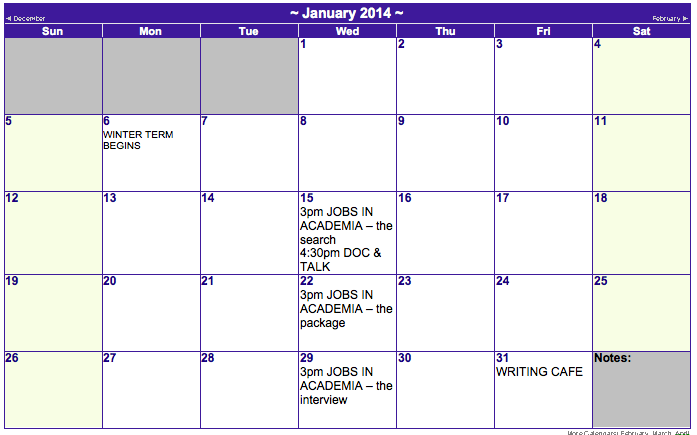
January At A Glance
The EDCP Peer Advisors have many exciting things planned for the month of January. Enlarge the image to check out the calendar.