Categories
Uncategorized

Gamechangers: David Suzuki

From my experiences volunteering with S.U.C.C.E.S.S.’s Youth Leadership Millennium Program, I’ve had the privilege to work with many community activists. One of the program’s partners is the David Suzuki Foundation. Obviously, if we’re talking gamechangers and we’re talking Vancouver, David Suzuki’s name should be near (if not right at) the top of the list.
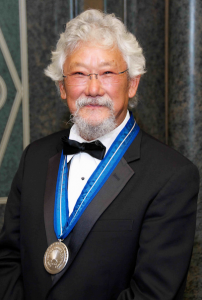

David’s passion for protecting the environment is notorious. From his academic pursuits in zoology and genetics, he became a professor at our very own UBC, teaching for almost forty years and publishing over 30 books during this time. Somehow, David also found time to host The Nature of Things, a weekly television series that was broadcast in over fifty countries worldwide – one of the reasons for David’s international fame and recognition.

After his retirement from UBC in 2001, he became Professor Emeritus at the university and continued his climate change activism work through the David Suzuki Foundation. He is a highly in-demand speaker and commentator, but has stated that he prefers speaking via video conference technology because of the excessive carbon footprint from his traveling to engagements.

David is, I think, one of the main reasons Vancouver is also known to be a highly environmentally-conscious city. With such a powerful and convicted figure living among us, how could we not “get the message”? B.C., Canada’s west coast, is blessed with the abundance of visible nature that many other places in the world don’t have the privilege of having direct contact with. Our lifestyle will always be intensely connected to nature here, and it’s part of the reason why Canada, as traditionally “governed” by the East, had dramatically declined in terms of environmental protection regulations. It really needs to change from the federal level down. No matter how many inititaives are produced from the municipal or provincial level, the ripple effect quickly wears off as a united national movement is lacking. If only there were more climate change activists who were also politically engaged. Let David be all of our role models. If they don’t hear us, they’ll forget we’re here. 

And of course…here’s David’s daughter speaking at the Rio Summit of 1992. Sadly, while words are very powerful, if action does not follow, we’ll never progress.

P.S. The second half of the post is a little sad…but of course, we can’t lose hope!
Categories
Uncategorized

Spotlight: Brinkman Earth Systems

I live in the Vancouver Quadra federal electoral district, and our MP is Liberal politician Joyce Murray. Joyce is currently running for the Liberal Leadership Race and I’m 100% behind her campaign and would love a woman from the West Coast to lead the Liberal Party to a much more sustainable future.

But political agendas aside, Joyce Murray also has a very legitimate background for envisioning a “Sustainable Society”. She and her husband, Dirk Brinkman, founded a tree planting company in the 1970s. Brinkman & Associates, which has now grown to the Brinkman Earth Systems Group of Companies (including Brinkman & Associates, BARCA, and Brinkman Forest Restoration), has planted over 1 billion trees in over 6 countries.

I found an excellent article profiling Dirk Brinkman on The Walrus, where he argues for carbon markets so that environmental protection can also be a profitable business venture.

“It’s too late to avoid catastrophic climate consequences by reducing energy emissions, but it isn’t too late to avoid catastrophic climate consequences altogether. We’ve just got to mount an equal initiative to increase removals.”

It’s an debatable topic that is probably best left to the experts, but there are advocates such as Annie Leonard who are adamant that cap and trade and other types of carbon markets are detrimental to progress on combating climate change. See her “The Story of Cap and Trade” video below:

What’s your stance on carbon markets? Is it wrong that people like Dirk Brinkman are looking out for their self-interests in the name of environmental advocacy? I think I agree with the last quote of Brinkman’s in the article, “You can’t apologize for the fact that what you’re advocating is congruent with your self-interest if it is truly in the public good.” Right?

Source.

Categories
Uncategorized

Gamechangers: Bill Morrissey @ The Clorox Company

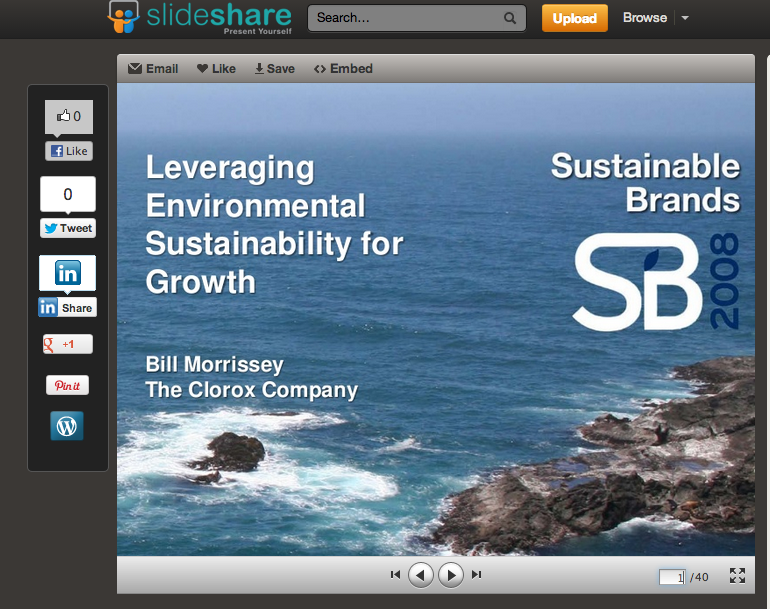
Recently, I stumbled upon this presentation on Slideshare.

It gave me a really interesting “insider” perspective into how Clorox made an obvious shift in strategy in regards to environmental stewardship and corporate social responsibility. Bill Morrissey, the Vice President of Environmental Sustainability, played a huge role in developing this new eco-strategy.

In 2007, when The Clorox Company was given a score of 1 (out of 100) in the inaugural Climate Counts rankings (the rankings have a comprehensive 22-criteria scorecard available here), the company decided that it needed to change its ways and do its part in ensuring that future generations can have a healthy and desirable environment to live in. They created an Eco Office that executed the company’s “sustainability strategy”, and Bill Morrissey returned to The Clorox Company after acting as the COO of Naturize Biosciences.

Bill outlines in his presentation (the video is also available here) how the company has not only acquired or architected “green brands”, but have found ways to profit from these brands as well. The successes of Brita and Greenworks is admirable, and Burt’s Bees penetration has also evidently skyrocketed in the past couple of years. Even I have noticed it in more and more distribution channels! (I love their lip balms!)

It’s also quite remarkable how Brita achieved such growth in sales simply from a marketing campaign. As my group is working on a social marketing plan to discourage the consumption/purchase of plastic water bottles, I am pleased with Brita’s campaign that highlights the number of water bottles it is diverging from landfills if consumers use one Brita filter; however, in Vancouver, our tap water is completely safe for direct consumption, and the act of filtering is really quite unnecessary.

After a little research (Googling) of the event where Bill’s presentation originated from, I found that it’s an annual conference that brings together sustainability, brand, and innovation professionals. It sounds really cool and I’d love to attend one day! This year’s is in San Diego from June 3rd to 6th. If I didn’t already have travel plans for May, I’d definitely head down to California for this!

Source.

Categories
Uncategorized

Gamechangers: Ray Anderson, Interface Inc.

Having never heard of Interface, the U.S.-based (and “world’s largest”) carpet manufacturer, before this year, I wanted to find out more about how the company evolved in a sustainable and innovative direction. Seeing the Founder and Chairman, Ray Anderson, the a short clip from The Corporation, especially captured my attention. You could just tell that his actions were genuine.

Ray Anderson’s TED Talk from 2009 about the manipulation of the I = PAT formula and his company’s Mission Zero plan was uplifting. The abundance of people who think “differently” and “challenge the status quo” in the sustainability field is what captivates me to study it. From every single issue in our world today, using a sustainable perspective forces you to think collaboratively with people in different backgrounds. The poem he read at the end, Tomorrow’s Child, inspired me to reflect on the challenges future generations will face because we have been such a consumption-fuelled society in the past. But if Ray Anderson can completely revamp his carpet manufacturing company, then there must be hope, right?

That Anderson made it his signature speaks volumes about this Southern industrialist, a businessman thoroughly committed to all that sustainability stands for. ~ Joel Makower, Green Biz

a man with a vision.

Spam prevention powered by Akismet