12/28/24

Hudson’s Bay Company

Hudson’s Bay Company was chartered on May 2, 1670. It began as a fur trading business as aresult of the increasing demand in beaver fur, and it would later become one of the largest furtrade companies in the world. As of today, Hudson’s Bay Company is a private business ownedby a holding company. The company was founded when French traders Médard Chouart desGroseilliers and his brother-in-law, Pierre-Esprit Radisson, after being rejected Quebec andFrench support, sought patronage of England by proposing a trading route that reached theinterior part of the continent. This route eventually gave traders easy access to fur resourcesfrom the local indigenous people. After being persuaded by Prince Rupert of the idea of a furtrade and its economic potential of that region, King Charles II agreed to finance a voyage toHudson Bay.
The first voyage happened on June 3, 1688 with Radisson setting out on the Eaglet and desGroseilliers on the Nonsuch. The Eaglet was damaged by a storm, however, the Nonsuchreturned a year later with a cargo of beaver pelts. Convinced by this return, later on May 2,1760, King Charles II granted a Royal Charter to Prince Rupert and his “Company ofAdventurers of England trading into Hudson’s Bay,” hence the Hudson’s Bay Company wasofficially established. This royal charter gave the company the control of trade and ownership ofall lands surrounded by the water flowing into the Bay, which was later named Rupert’s Land,this totaled to be more than 3 million square miles of land. This territory ultimately becameprovinces of Manitoba, Saskatchewan, southern Alberta, parts of British Columbia, northwest-Nunavut Territory, northern Ontario, and northern Quebec. It also covered regions of present-day Montana, Minnesota, and North and South Dakota. In fact, many parts of Rupert’s Landlater became known as “Métis Homeland” by the Métis people.
As a result of the fur trade, Indigenous people’s lifestyle and economy has changed; manycame to rely on European manufactured goods and food for survival, and led to an increasedcompetition among Indigenous peoples for European goods. Previously, Indigenous tradersmostly acted as the middlemen, as they brought furs from communities hidden further inland totrading posts. Later more indigenous people moved away from their territory in search of furanimals in order to obtain a better trade position.
Among the goods traded, beaver pelts were the most valuable to the settlers, and they wereconsidered the highest quality after trapping during fall and winter months. The indigenoustraders traded beaver pelts for metal goods like guns, also textiles and food. They had acurrency of the fur trade which was the Made Beaver coin, this was introduced in order tostandardize trade; one beaver coin was equivalent to one prime beaver skin.

Suggested Sources:

Arthur J. Ray, “Hudson’s Bay Company,” The Canadian Encyclopedia, Nathan Coschi, Leanna Fong, Sasha Yusufali, Nathan Baker, and Jessica Poulin (eds.). Published online, 2 April 2009; Last edited, 19 January 2013. Accessed online, 6 March 2025, https://www.thecanadianencyclopedia.ca/en/article/hudsons-bay-company

Harris, Carolyn, “Rupert’s Land,” Canada’s History. Published online, 26 October 2016. Accessed online, 6 March 2025, https://www.canadashistory.ca/explore/exploration/rupert-s-land 

“What is Rupert’s Land?” Rupert’s Land Institute. Accessed online, 6 March 2025, https://www.rupertsland.org/about/what-is-ruperts-land/ 

“The Fur Trade,” The Canadian Encyclopedia, Accessed online 6 March 2025, https://www.thecanadianencyclopedia.ca/en/timeline/the-fur-trade.

“Hudson’s Bay Company Beginnings,” ‌CBC History, Accessed online, 6 March 2025, https://www.cbc.ca/history/EPCONTENTSE1EP6CH1PA5LE.html 

Related Contents:

Métis People

Other Materials:

Film about Métis struggles with monopoly of HBC: https://www.nfb.ca/film/mistress_madeleine/

Synopsis (NFB): Part of the Daughters of the Country series, this film, set in the 1850s, unfolds against the backdrop of the Hudson’s Bay Company’s monopoly of the fur trade. In protest, some Métis engage in trade with the Americans. Madeleine, the Métis common-law wife of a Hudson’s Bay Company clerk, is torn between loyalty to her husband and loyalty to her brother, a freetrader. Even more shattering, a change in company policy destroys Madeleine’s happy and secure life, forcing her to re-evaluate her identity.

12/28/24

J’entends le moulin

French Lyrics:

J’entends le moulin (tique tique taque)

Mon père a fair bâtir maison.
La fait bâtir à trois pignons.
Sont trois charpentiers qui la font.
Le plus jeune c’est mon mignon.

Qu’apporte-tu dans ton jupon?
C’est un pâté de trois pigeons.
Asseyons-nous et le mangeons.

En s’asseyant il fit un bond,
Qui fit trembler mer et poisson
Et les cailloux qui sont au fond.

English Translation:

I hear the millwheel (tique tique taque)
My father is having a house built.
It’s being built with three gables.
There are three carpenters building it.
The youngest is my darling.
What do you have in your apron?
It’s a pie made of three pigeons.
Let’s sit down and eat it.
While sitting down they all lept up,
Causing the sea and fish to tremble,
and the stones on the bottom of the sea.


Selected Sources:

12/28/24

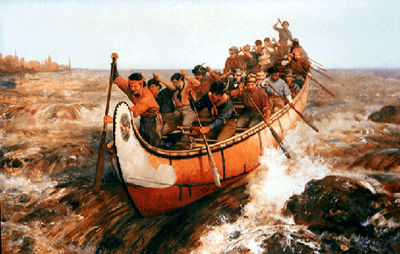
Les voyageurs

[Add text here]

 “Shooting the Rapids”

Top: “Quetico Superior Route, passing a waterfall.” Painting by Francis Anne Hopkins, 1869.
Botton: “Shooting the rapids, in a master canoe.” Painting by Francis Anne Hopkins, [date].


Suggested Sources:

Related Contents:

“C’est l’aviron” (traditional)

“J’entends le moulin” (traditional)

“V’là le bon vent” (traditional; France)

“Chevaliers de la table ronde” (traditional)

“Auprès de ma blonde” (traditional; France)

“À Saint-Malo beau port de mer” (traditional; France)

Other Materials:

12/20/24

Pauline Julien (1928–1998)

[Add text here]

Related Contents:

“La manic”

Suggested Sources:

Marthe Léger & Sarah Hanahem, “Pauline Julien : naissance de la ‘passionaria du Québec’,” Bibliothèque et Archives Nationales du Québec. Published online: 12 June 2024. Accessed online [date]: https://www.banq.qc.ca/explorer/articles/pauline-julien-naissance-de-la-pasionaria-du-quebec/


https://ici.radio-canada.ca/nouvelle/1126694/pauline-julien-quebec-politique-archives

12/20/24

Claude Gauthier (1939–)

[Add text here]

Related Contents:

“Le grand six pieds,” Claude Gauthier chante Claude Gauthier (1961)

“Le plus beau voyage,” Le plus beau voyage (1972)

Suggested Sources:


12/20/24

Paul Piché (1953–)

Paul Piché was born in 1953 in Montréal and grew up in Laval and La Minerve. Originally trained as an archeologist, he began singing and songwriting at university, performing in many boîtes à chansons in Québec. His first big breakthrough began when he opened for Beau Dommage (one of the most prominent rock groups in Québec) in the 1970s and was scouted by one of its members, Robert Léger.

Léger encouraged Piché to record his first album, helping him find a record company that would be interested. This was the Kébec-Disc label, which also recruited such talent as Diane Dufresne, Gilles Rivard and Marie Denise Pelletier. An amusing anecdote that Piché and Léger recounted in a 40-year retrospective of the recording of his first album was that Piché initially refused to record with an electric bass, thinking that the sound would overwhelm his voice and the other acoustic instruments.[1]

Piché’s first album, À qui appartient l’beau temps? (1977) had a measured success when it was initially released. Still, eventually, the song “Heureux d’un printemps” helped the album reach sales of between 100,000 and 200,000 copies in 1978, making it one of the most successful albums of Québécois music.

Along with his musical career, Piché is also devoted to political and environmental activism and was a prominent member of the Sovereigntist movement. In 2002, he travelled 550km by bike to deliver a letter to the premier of Québec, protesting the continued construction of hydroelectric dams on Québécois rivers.[2] He continues to be an active member of the artistic and political landscape of Québec and published his first book in 2007, which talks about some of the political events and trends he participated in.

[1] “Heureux d’un printemps, Paul Piché|La Trame sonore du Québec,” posted December 3, 2024 by Bibliothèque et Archives nationales du Québec, Youtube, 6 min., 28 sec,  https://www.youtube.com/watch?v=cDhaYpZufp4.

[2] “Paul Piché.” Panthéon des auteurs et compositeurs canadiens, accessed March 16, 2025, https://www.cshf.ca/fr/songwriter/paul-piche/.

Suggested listening:

Piché, Paul. À qui appartient l’beau temps (Version Deluxe). Audriogram, 2012. https://www.youtube.com/watch?v=BSoQQBWOvfk&list=PL9V-Gix3aQTlYmCaL0VooYwb9sLbdsvIy.

Piché, Paul. L’escalier. Audiogram, 1991. https://www.youtube.com/watch?v=OBik9_JR6Wk&list=PL9V-Gix3aQTldbFms-xZexQCO5CO5npht.

Suggested sources:

“Heureux d’un printemps, Paul Piché|La Trame sonore du Québec.” Posted December 3, 2024 by Bibliothèque et Archives nationales du Québec. Youtube, 6 min., 28 sec. https://www.youtube.com/watch?v=cDhaYpZufp4.

“Paul Piché.” Panthéon des auteurs et compositeurs canadiens. Accessed March 16, 2025. https://www.cshf.ca/fr/songwriter/paul-piche/.

Boisvert-Magnen, Olivier. “Anniversaires des Albums Marquants : Il y a 40 ans : Paul Piché- À qui appartient l’beau temps?.” Voir, March 9, 2017. Accessed March 16, 2025. https://voir.ca/musique/2017/03/09/paul-piche-il-y-a-40-ans-a-qui-appartient-lbeau-temps/.

Thérien, Robert. “Piché, Paul.” The Canadian Encyclopedia/L’Encyclopédie Canadienne,  December 16, 2013. Accessed March 16, 2025. https://www.thecanadianencyclopedia.ca/fr/article/piche-paul.

Related Contents:

Québec

Beau Dommage

Boîtes à chansons

“Heureux d’un printemps”

12/20/24

La bitt à tibi

Moi je viens de l'AbitibiMoi je viens de la Bittt à TibiMoi je viens d'un paysQui est un arbre fortMoi je viens d'un paysQui pousse dans le NordTam didelam tadlédidelidelam

Dans ce pays qui était comme un oeufLe treize février mille neuf cent trente-neufJe suis né à Val d'Or en AbitibiDans ce pays qui est encore touttt neuf

J'avions connu Harnest TurcotteQui vivait entre de beaux bois rondsQui parlait aux ârbres et aux taonsQui chaque matin chaussait ses bottesPour aller comme Ti-Jean HébertFendre la forêt avec ses nerfsQui n'avait pas de chain sawQui avait hache et boxaPis des bras durs comme la rochePis des cuisses comme des troncs d'arbrePis du front tout le tour de la têtePis qui n'était pas si bête

En mille neuf cent dix en Abitibi dans mon paysColoniséTam didelam tadlédidelidelam

Moi je viens de l'AbitibiMoi je viens de la Bitt à TibiMoi je viens d'un paysQui a un ventre en orMoi je viens d'un paysOù c'que le poisson mord

Quand j'étions petitJ'allions jouer aux boisAvec les épinettes et les bouleauxJ'aimions gazouiller avec les oiseauxQuand j'étions petitJe suivions le ruisseauJe jouais de l'HarricanaSur la rivière HarmonicaJe regardions passer les gros charsSur ma petite cenne qui venait en orDans un banc de neige je creusais maisonEt dans la glace j'écrivais ton nom

Et l'hiver à l'arénaOn patinait touttt en tasL'été près du lac BlouinOn faisions semblant de rienOn ramassait des bleuetsQu'on vendait pour presque rien

En mille neuf cent quelquesEn Abitibi dans mon paysColoniséTam didelam tadlédidelidelam

Moi je viens de l'AbitibiMoi je viens de la Bittt à TibiMoi je viens d'un pays qui a un ventre en orMoi je viens d'un pays où c'qui neige encore

Dans mon pays qu'on dit hors de la carteMon oncle Edmond travaillait sous la terreMais il creusait dans l'or sa propre mortMon oncle Edmond nous a mis sur la carte

Dans mon pays qui a grandiIl paraît qu'aux tous premiers tempsOn y gagnait beaucoup d'argentY a de l'or en barre qui dort icittY a même des poignées de porte en orEn cuivre en fer qui vont de l'autre bord

J'aimions jouer dans la fanfarePour épater toutes les pétardsQuand j'allions au Château-InnBoire et rire avec mes piastresJe revenions comptant les astresAu petit matin près de la mine

Tamdidelam tadlédidelidelamTam didlididelidelamEn mille neuf cent toutttEn Abitibi dans mon paysColonisé à libérerTamdidelam tadlédidelédelam

MORE:

Live performance, Parc Jarry, Montréal (Québec), 1978: https://www.youtube.com/watch?v=O8p728qg96k

Anodajay et Raoûl Duguay, “Le Beat à Tibi,” Septentrion (2006): https://youtube.com/watch?v=k5KQEnSeSZc