12/28/24

Les voyageurs

[Add text here]

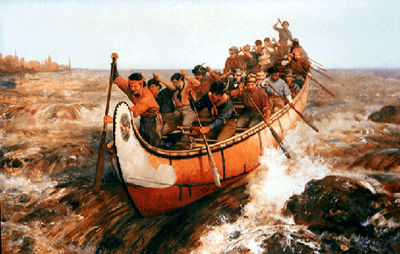
 “Shooting the Rapids”

Top: “Quetico Superior Route, passing a waterfall.” Painting by Francis Anne Hopkins, 1869.
Botton: “Shooting the rapids, in a master canoe.” Painting by Francis Anne Hopkins, [date].


Suggested Sources:

Related Contents:

“C’est l’aviron” (traditional)

“J’entends le moulin” (traditional)

“V’là le bon vent” (traditional; France)

“Chevaliers de la table ronde” (traditional)

“Auprès de ma blonde” (traditional; France)

“À Saint-Malo beau port de mer” (traditional; France)

Other Materials:

12/20/24

Pauline Julien (1928–1998)

Pauline Julien was a singer, actress, songwriter born May 23, 1928 in Trois-Rivières, Québec. Her father’s first cousin was Maurice Duplessis, the former Premier of Québec, who was apparently a source of encouragement for her at the beginning of her career.

Julien was known for her expressive power — likely influenced by her experience as a theatre performer — earning her the nickname “the passionara of Québec.” In 1951, she went to Paris to study theatre, finding a place for herself in bohemian Parisian circles, where she met artists like Boris Vian, Bertolt Brecht, and Léo Ferré. It wasn’t until 1954 that Julien made her debut as a singer while on tour with the Bernard Bimont Company in France. The public responded very positively, and she started to make the transition to spending more time on music, spending a lot of her time singing in Left Bank cabarets.

Also around the mid-50s, she had two children with her then-husband, actor Jacques Galipeau, from whom she later separated in 1957. She made her return to Canada the same year that they separated, where she continued pursuing music, incorporating local songwriters and composers into her repertoire — particularly Gilles Vigneault. She released her first album, Enfin … Pauline Julien, in 1962, then Pauline Julien the following year; she worked with artists like Claude Gauthier and Claude Léveillée, and performed in major venues in both Canada and Europe. At the International Song Festival in Sopot, Poland, she sang Vigneault’s “Jack Monoloy” and won second prize.

Julien was very politically active, dedicated to feminism and the fight for Québec’s independence. During Queen Elizabeth II’s visit to Canada in 1964, Julien was invited to perform for the queen but refused. She was also arrested and imprisoned for eight days — as was her second husband, Gérald Godin, a poet and Parti Québécois politician — during the 1970 October Crisis. In 1969, she interrupted a speech by the Canadian Secretary of State Gérard Pelletier’s at a ministerial conference on Francophonie by yelling, “Vive le Québec libre!” She also regularly participated in rallies and events organized around humanitarian aid.

In 1985, Julien had to stop performing due to degenerative aphasia, which affected her ability to speak, and she committed suicide in 1998.

Suggested Listening:

Sources:

Léger, Marthe and Sarah Hanahem. “Pauline Julien : naissance de la ‘passionaria du Québec.’” Bibliothèque et Archives Nationales du Québec, 4 June 2024, https://www.banq.qc.ca/explorer/articles/pauline-julien-naissance-de-la-pasionaria-du-quebec/

Rioux, Christian and Betty Nygaard King. “Pauline Julien.” The Canadian Encyclopedia, 4 March 2015, thecanadianencyclopedia.ca/en/article/pauline-julien. 

“Pauline Julien, la pasionaria du Québec.” Radio-Canada, 28 Sept. 2018, https://ici.radio-canada.ca/nouvelle/1126694/pauline-julien-quebec-politique-archives.

12/20/24

Claude Gauthier (1939–)

Joseph Pierre Claude Gauthier was a singer, songwriter and actor born January 31, 1939 in Lac-Saguay, Québec. He’s still going strong—he celebrated his 86th birthday just last month and even released music as recently as 2023. Over his approximately 65-year career, Gauthier has written over 100 songs, which have since been performed by other big names in Québec’s musical history, like Renée Claude, Louise Forestier, and Pauline Julien, among others.

Second to Félix Leclerc, Gauthier was one of the first singer-songwriters to release an album in Québec. He was also the first French-Canadian to record with labels Columbia and Gamma in the early 1960s, then with Presqu’île in the 1970s. He’s spoken publicly about how Leclerc has been one of his biggest musical inspirations throughout his career; at 12, Gauthier told his mother he wanted to write songs like Leclerc, so she ordered him a $17 guitar from an Eaton’s catalogue. In an interview, Gauthier mentions seeing Leclerc at La Butte à Mathieu and exchanging guitars with him, but being too scared to ever actually use it for fear of it getting stolen.

Gauthier grew up in a musical family; his father led the congregation in singing during mass, while his mother created music in her spare time. He moved to Montréal in 1954, the same year he wrote his first songs, which he performed in boîtes à chansons around the area. Five years into writing music, his song “Le soleil brillera demain” won a contest at CKVL radio station. He recorded his first LP in 1961, with original songs he had written. The 1960s saw Gauthier’s career really start to take off. Notably, he shared the prestigious Carnegie Hall stage in New York with Buffy Sainte-Marie, with whom he wrote “T’es pas une autre” (“Until It’s Time For You To Go”), which has been covered in both French and English, including by Elvis Presley and Neil Diamond. In 1967, Gauthier made his film debut in Michel Brault’s Entre la mer et l’eau douce, in which he also sang his original song “Geneviève.”

In the early 1970s, Gauthier represented Canada in Spa, Belgium, at the Festival international de la Francophonie before taking a break from live performances to focus on his career in film, starring in three movies before making his return to music. After one of his shows, a journalist for the Montréal-Matin noted he had “the facility and the poetry for singing of his roots, his wife, his childhood, his land, his life.” He became somewhat of a cultural ambassador for Québec, representing it on stages all over the world, especially in France, where he found a lot of success as an artist. However, he was still gravitating away from music and towards film well into the 1990s, and didn’t shoot his last film until 1991, when he did Brault’s Quand je serai parti… vous vivrez encore, which tells the story of the 1837 Rebellion in Lower Canada.

Although he started slowing down, Gauthier kept releasing albums throughout the 2000s and 2010s, including L’homme qui passait par là and Pour la suite du monde, the latter of which is thought to be a tribute to Brault, with whom Gauthier had collaborated on many films at this point.

Gauthier was at the peak of his career during the October Crisis and is very passionate about preserving the French language as a key facet of Québec’s cultural identity. During the crisis, he was visited by six law enforcement officers demanding to search his home—though he was not imprisoned, many people he knew had been among the 450-some people who were. He acted in Brault’s Les Ordres, a film about the imprisonment and mistreatment of Canadian citizens enacted by the government in October 1970. One of his biggest hits, “Le plus beau voyage,” also centres themes of Québec independence and his ties to the province.

Sources:

  • “Cinq minutes avec Claude Gauthier.” Radio-Canada, 11 Dec. 2020, youtube.com/watch?v=rFQbm-vX3jk (Accessed January 24, 2025)
  • “Claude Gauthier.” La Butte à Mathieu: A Place of Hope, Songs and Dreams, 2 May 2023, communitystories.ca/v2/la-butte-a-mathieu_the-butte-a-mathieu/gallery/claude-gauthier/. (Accessed January 24, 2025)
  • “Claude Gauthier est loin d’avoir dit son dernier mot.” Radio-Canada, 27 Oct. 2016, ici.radio-canada.ca/nouvelle/811178/claude-gauthier-dernier-album-politique?depuisRecherche=true%5C. (Accessed January 24, 2025)
  • Fortier, Marco. “Le «plus beau voyage» de Claude Gauthier dure depuis 65 ans.” Le Devoir, 22 Jan. 2024, ledevoir.com/culture/805747/plus-beau-voyage-claude-gauthier-dure-depuis-65-ans (Accessed January 24, 2025)
  • Plouffe, Hélène. “Claude Gauthier.” The Canadian Encyclopedia, 6 Jan. 2016, thecanadianencyclopedia.ca/en/article/claude-gauthier-emc. (Accessed January 24, 2025)

Songs + Performances:

12/20/24

Paul Piché (1953–)

Paul Piché was born in 1953 in Montréal and grew up in Laval and La Minerve. Originally trained as an archeologist, he began singing and songwriting at university, performing in many boîtes à chansons in Québec. His first big breakthrough began when he opened for Beau Dommage (one of the most prominent rock groups in Québec) in the 1970s and was scouted by one of its members, Robert Léger.

Léger encouraged Piché to record his first album, helping him find a record company that would be interested. This was the Kébec-Disc label, which also recruited such talent as Diane Dufresne, Gilles Rivard and Marie Denise Pelletier. An amusing anecdote that Piché and Léger recounted in a 40-year retrospective of the recording of his first album was that Piché initially refused to record with an electric bass, thinking that the sound would overwhelm his voice and the other acoustic instruments.[1]

Piché’s first album, À qui appartient l’beau temps? (1977) had a measured success when it was initially released. Still, eventually, the song “Heureux d’un printemps” helped the album reach sales of between 100,000 and 200,000 copies in 1978, making it one of the most successful albums of Québécois music.

Along with his musical career, Piché is also devoted to political and environmental activism and was a prominent member of the Sovereigntist movement. In 2002, he travelled 550km by bike to deliver a letter to the premier of Québec, protesting the continued construction of hydroelectric dams on Québécois rivers.[2] He continues to be an active member of the artistic and political landscape of Québec and published his first book in 2007, which talks about some of the political events and trends he participated in.

[1] “Heureux d’un printemps, Paul Piché|La Trame sonore du Québec,” posted December 3, 2024 by Bibliothèque et Archives nationales du Québec, Youtube, 6 min., 28 sec,  https://www.youtube.com/watch?v=cDhaYpZufp4.

[2] “Paul Piché.” Panthéon des auteurs et compositeurs canadiens, accessed March 16, 2025, https://www.cshf.ca/fr/songwriter/paul-piche/.

Suggested listening:

Piché, Paul. À qui appartient l’beau temps (Version Deluxe). Audriogram, 2012. https://www.youtube.com/watch?v=BSoQQBWOvfk&list=PL9V-Gix3aQTlYmCaL0VooYwb9sLbdsvIy.

Piché, Paul. L’escalier. Audiogram, 1991. https://www.youtube.com/watch?v=OBik9_JR6Wk&list=PL9V-Gix3aQTldbFms-xZexQCO5CO5npht.

Suggested sources:

“Heureux d’un printemps, Paul Piché|La Trame sonore du Québec.” Posted December 3, 2024 by Bibliothèque et Archives nationales du Québec. Youtube, 6 min., 28 sec. https://www.youtube.com/watch?v=cDhaYpZufp4.

“Paul Piché.” Panthéon des auteurs et compositeurs canadiens. Accessed March 16, 2025. https://www.cshf.ca/fr/songwriter/paul-piche/.

Boisvert-Magnen, Olivier. “Anniversaires des Albums Marquants : Il y a 40 ans : Paul Piché- À qui appartient l’beau temps?.” Voir, March 9, 2017. Accessed March 16, 2025. https://voir.ca/musique/2017/03/09/paul-piche-il-y-a-40-ans-a-qui-appartient-lbeau-temps/.

Thérien, Robert. “Piché, Paul.” The Canadian Encyclopedia/L’Encyclopédie Canadienne,  December 16, 2013. Accessed March 16, 2025. https://www.thecanadianencyclopedia.ca/fr/article/piche-paul.

Related Contents:

Québec

Beau Dommage

Boîtes à chansons

“Heureux d’un printemps”

12/20/24

La bitt à tibi

Moi je viens de l'AbitibiMoi je viens de la Bittt à TibiMoi je viens d'un paysQui est un arbre fortMoi je viens d'un paysQui pousse dans le NordTam didelam tadlédidelidelam

Dans ce pays qui était comme un oeufLe treize février mille neuf cent trente-neufJe suis né à Val d'Or en AbitibiDans ce pays qui est encore touttt neuf

J'avions connu Harnest TurcotteQui vivait entre de beaux bois rondsQui parlait aux ârbres et aux taonsQui chaque matin chaussait ses bottesPour aller comme Ti-Jean HébertFendre la forêt avec ses nerfsQui n'avait pas de chain sawQui avait hache et boxaPis des bras durs comme la rochePis des cuisses comme des troncs d'arbrePis du front tout le tour de la têtePis qui n'était pas si bête

En mille neuf cent dix en Abitibi dans mon paysColoniséTam didelam tadlédidelidelam

Moi je viens de l'AbitibiMoi je viens de la Bitt à TibiMoi je viens d'un paysQui a un ventre en orMoi je viens d'un paysOù c'que le poisson mord

Quand j'étions petitJ'allions jouer aux boisAvec les épinettes et les bouleauxJ'aimions gazouiller avec les oiseauxQuand j'étions petitJe suivions le ruisseauJe jouais de l'HarricanaSur la rivière HarmonicaJe regardions passer les gros charsSur ma petite cenne qui venait en orDans un banc de neige je creusais maisonEt dans la glace j'écrivais ton nom

Et l'hiver à l'arénaOn patinait touttt en tasL'été près du lac BlouinOn faisions semblant de rienOn ramassait des bleuetsQu'on vendait pour presque rien

En mille neuf cent quelquesEn Abitibi dans mon paysColoniséTam didelam tadlédidelidelam

Moi je viens de l'AbitibiMoi je viens de la Bittt à TibiMoi je viens d'un pays qui a un ventre en orMoi je viens d'un pays où c'qui neige encore

Dans mon pays qu'on dit hors de la carteMon oncle Edmond travaillait sous la terreMais il creusait dans l'or sa propre mortMon oncle Edmond nous a mis sur la carte

Dans mon pays qui a grandiIl paraît qu'aux tous premiers tempsOn y gagnait beaucoup d'argentY a de l'or en barre qui dort icittY a même des poignées de porte en orEn cuivre en fer qui vont de l'autre bord

J'aimions jouer dans la fanfarePour épater toutes les pétardsQuand j'allions au Château-InnBoire et rire avec mes piastresJe revenions comptant les astresAu petit matin près de la mine

Tamdidelam tadlédidelidelamTam didlididelidelamEn mille neuf cent toutttEn Abitibi dans mon paysColonisé à libérerTamdidelam tadlédidelédelam

MORE:

Live performance, Parc Jarry, Montréal (Québec), 1978: https://www.youtube.com/watch?v=O8p728qg96k

Anodajay et Raoûl Duguay, “Le Beat à Tibi,” Septentrion (2006): https://youtube.com/watch?v=k5KQEnSeSZc

12/20/24

Veillées du bon vieux temps (1921–1941)

[Add text here]

Suggested Sources:

Guilbert, Daniel. 2010. “La légende des ‘Veillées du bon vieux temps’ (1ère partie).” Bulletin Mnémo 12 (4). https://mnemo.qc.ca/bulletin-mnemo/article/la-legende-des-veillees-du-bon.

__________. 2011. “La légende des ‘Veillées du bon vieux temps’ (2ème partie).” Bulletin Mnémo 13 (1). https://mnemo.qc.ca/bulletin-mnemo/article/la-legende-des-veillees-du-bon-vieux-temps-2e-partie.

__________. [date]. “La légende des ‘Veillées du bon vieux temps’ (3ème partie).” Bulletin Mnémo 13 (4). https://mnemo.qc.ca/bulletin-mnemo/article/la-legende-des-veillees-du-bon-vieux-temps-3e-partie.

__________. [date]. “La légende des ‘Veillées du bon vieux temps’, 4ème partie (suite et fin).” Bulletin Mnémo 14 (1). https://mnemo.qc.ca/bulletin-mnemo/article/la-legende-des-veillees-du-bon-vieux-temps-4e-partie-suite-et-fin.

Risk, Laura. 2022. “Les Veillées du bon vieux temps, 1919–1922.” Bulletin Mnémo 22 (1). https://mnemo.qc.ca/bulletin-mnemo/article/les-veillees-du-bon-vieux-temps-1919-1922.