Categories
Shklovsky

It Takes All Kinds of Kinds?

Hello everyone,

I like the way we’ve been introduced to the world of literary and cultural theory with this first round of readings. The one notion that I find myself thinking about most after completing the readings is one that I’ve always found most fascinating about literature: fiction’s potential to reflect the human condition in all of its multifaceted complexity more potently than non-fiction. I believe this has a lot to do with, as Rivkin and Ryan explain in their discussion on the thoughts of idealist philosophers that “art provides access to a different kind of truth than is available to science, a truth that is immune to scientific investigation because it is accessible only through connotative language (allusion, metaphor, symbolism, etc.) and cannot be ren

dered in the direct, denotative, fact-naming language of the sciences” (3). I definitely do share the tendency of the American New Critics to assert that literature does possess unique truths that can be conveyed only through literary language.
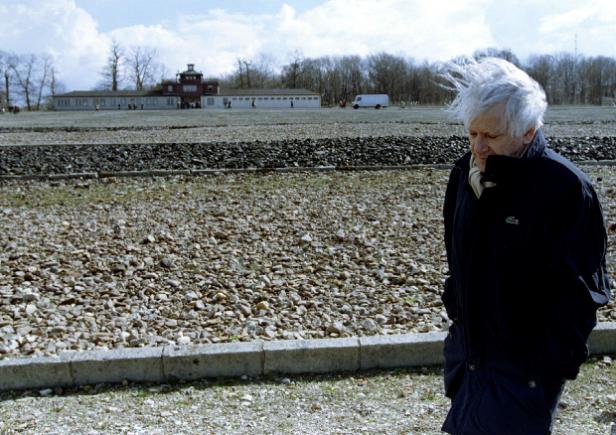
 
Jorge Semprun Returning to the Buchenwald Concentration Camp Years After the End of WWII

While I was reading this discussion, my mind was immediately jolted to a very vivid moment in Jorge Semprún’s ‘Literature or Life,’ his deeply personal account of his time in Buchenwald, a Nazi concentration camp in World War II. There is a retelling in the work about a conversation that several of the academics who were detained in the camp had once they were liberated; in this dialogue, they ponder how they might tell those in the outside world what had happened within the confines of the camp:

“—I imagine there will be an abundance of testimonies … Their value will be the value of the acuteness, the perspicacity of the witness … and then there will be documents… Later, historians will collect them, compile them and analyze them, and will write learned works… Everything will be said, everything will appear there … And it will all be true … But the real truth will be missing, the truth that no historical reconstruction, however accurate and all-embracing, can achieve…

The others look at him, nodding, apparently relieved to see one of us able to formulate the problems so clearly.

—Another kind of understanding, the essential truth of experience, is not transmissible … Or rather, it is only transmissible through literary writing.

He turns towards me, smiling.

—Through the artifice of the work of art, of course!” (140).

This segment underscores to me that there is an inherent quality in fiction (as opposed to documentary as specifically identified in this example) that has a very powerful potential to harness unique truths, in this case about a very particular experience in human history.

However, I also passionately believe in the Russian Formalists’ insistence on the importance of the act of defamiliarization, the action of removing objects from the automatism of perception. As explained on page 16, this is because “the purpose of art is to impart the sensation of things as they are perceived and nor as they are known”. It is also because “the technique of art is to make objects ‘unfamiliar,’ to make forms difficult, to increase the difficulty and length of perception because the process of perception is an aesthetic end in itself and must be prolonged” (Shklovsky 16). The book’s examples of Tolstoy’s mastery are chilling; especially the excerpt that details the concept of private property from the point of the view of the horse. When I read the lines “Many of those, for instance, who called me their own never rode me – although others did. And so with those who fed me. Then again, the coachman, the veterinarians, and the outsiders in general treated me kindly, yet those who called me their own did not” (17), I actually get chills – and maybe if those lines were written from a human point of view, it would not hit me quite that hard – and that would be because the effect of defamiliarization would not occur. This discussion makes me think of the Dada artistic movement or of performance theatre that unexpectedly involves the audience – both artistic actions that aim to create a species of rupture with what can sometimes be a detached, passive audience. By creating this sentiment of defamiliarization, the audience can no longer be passive and they must be an active participant. In my opinion, the most important thing here is that this action in turn opens up the possibility of active critique and reflection on the part of the audience members themselves.

Perhaps it doesn’t just take one type of approach or technique; perhaps one must use all kinds of kinds in order to get closer to these “unique truths”…

Categories
Foucault

The Éffet Foucault

Foucault had me thinking in his highly abstract «Archeology of knowledge». After a few hours of reading and re-reading it, both in French and in English, I am still not sure of what he was saying. Here is what I think I understood: The discourse is a social performative entity and its unification takes place […]
Categories
introductions

Hello

Categories
Shklovsky

The Beauty and the Form

In Art as Technique, Viktor Shklovsky asserts that when perception becomes habitual, then everything becomes meaningless: “Habitualization devours work, clothes, furniture, one’s wife, and the fear of war” (16). So, he argued, Art is a way of breaking that state of catatonia that also could transforms a life into nothing: “Art removes objects from the automatism of perception in several ways” (16).

When I was reading this essay, I immediately remembered one of my favorite novels, Death in Venice (1912), by Thomas Mann. In this story, a man (Gustav von Aschenbach) with a life full of habits and whose favorite word is “resist” suddenly discovers the Beauty (or what he thinks is Beauty) represented in the body of an efebo (Tadzio). His habitual –and orderly- perception of life suddenly breaks and ironically conducts him to death. As in the first example of Tolstoy that Shklovsky gives, in his work Mann “makes the familiar seem strange”: a trip to rest in Venice suddenly becomes a trip from the Apollonian to the Dionysian.

But, this “des-habitualization” doesn’t come in a form of a narrator (as the second example of the novel of Tolstoy that Shklovsky gives) or any other literary motif; it comes from the inside of the novel, from the philosophical idea of what Beauty is. Of course, Mann configures a narrator that makes possible to the audience to get inside the character feelings and thoughts, but it is subordinated to the essence of the text, which is, in my opinion, a classical conception of Beauty combined with a cruel irony.

My point with this comment about Death in Venice is that the “technique of defamiliarization” not necessarily comes from a formal resource; it could directly come from the thematic that is exposed. In that sense, the technique is subject to the idea and not at the inverse as Eichenbaum propose in The formal method. If we follow the idea that “[form is] substantive itself, and unqualified by any correlation” (9), then the exposition of Beauty, which is the most powerful “des-habitulization” that Death in Venice has, will be meaningless. In the First Surrealist Manifesto, Bretton said, “Beauty must be convulsive –or then it is nothing”. In the novel of Mann, exists that convulsion not only in the prose of Mann, but in the content.

A consideration that I could extract is that every theory (in any field) is a useful tool to approach a topic, but has his limitations. The fictional world of Literature and the real world are more complex than a theory. In the case of Formalism, I think that its most valuable input was to give to Literature his own space of study, separating it from other fields. It opens the doors to specific studies that came later, such as the ones presented on the book, but also one that I like, Palimpsests. Literature in Second Degree, by Gerard Gennette, which is, I think, a very useful manual of narratology.

[This is a screenshot from the movie Death on Venice (1971), by Luchino Visconti. We can see in the face of Aschenbach (Dirk Bogard) the consternation for his beloved Tadzio (Björn Andrésen). The form is very important here, but again, it is at the service of a deep feeling. This gesture is only possible because an intense feeling (content) is there]

Hello

Hello everyone,

My name is Han and I’m in the French Master’s program.
To be honest, since I have little background in literary theory, the amount of reading and the efforts needed to digest all the information are overwhelming this first week. I hope this is only temporary and it gets easier as I read more and after we talk about it in class.
Back to reading!

Categories
introductions

Hello

Hello everyone, My name is Han and I’m in the French Master’s program. To be honest, since I have little background in literary theory, the amount of reading and the efforts needed to digest all the information are overwhelming this first week. I hope this is only temporary and it gets easier as I read […]
Categories
introductions

Exploring Theory

Hi everyone! My name is Liliana Patricia Castaneda Lopez, and I am very exciting (and a bit scared) about this class, I have to confess.

I hold a B.A. in Communications and Journalism from Colombia, and have pursued graduate studies in Pol. Science and Latin American Studies in both Colombia and Canada. My current academic interest is in memory and reconciliation through literature in countries affected by civil wars. I would like to apply for a Ph.D. program in Hispanic Literature in the near future.

Rather than talking about my expectations, which some of you have brilliantly exposed in your postings, I would like to reflect on my fears regarding this class as theory can be an enticing trap too difficult to escape from. I remember I took an intensive course on semiotics several years ago during my major, and I became obsessed with trying to find the meaning behind everything I perceived. Now, reading about the formalists and structuralists brought me back to that time as I tried to look for symbols everywhere and tried to unveil an author’s intention or meaning. Surprisingly, sometimes I realized such intention does not exist or is misinterpreted.

Although for the Formalists motivation seems to go to a second place compared to the procedure and the devices that make literature something autonomous, there seems to be an obsession of overly using a method to explain everything while diminishing other variables.

Intro…

My name is Liza Navarro. I was born and raised in Houston, Texas. My parents are from Puerto Rico so I grew up in a bilingual household which proved to be very beneficial when learning other languages (ie - French). I started taking French classes when I was in middle school and have had several opportunities to travel to France whether on a grant, trip, or job. My fascination for the language has now led me to UBC where I will be continuing my studies at the graduate level (Masters phase.....and hopefully PHD phase).

I am very excited to be in such a "large" class full of people from different backgrounds, ages, and ways of life. I think it will add to the discussions in class and bring new ideas and topics to the table. Although I  don't have much experience in theory, I hope to learn a lot not only from the professors but from my classmates as well.


Intro…

My name is Liza Navarro. I was born and raised in Houston, Texas. My parents are from Puerto Rico so I grew up in a bilingual household which proved to be very beneficial when learning other languages (ie - French). I started taking French classes when I was in middle school and have had several opportunities to travel to France whether on a grant, trip, or job. My fascination for the language has now led me to UBC where I will be continuing my studies at the graduate level (Masters phase.....and hopefully PHD phase).

I am very excited to be in such a "large" class full of people from different backgrounds, ages, and ways of life. I think it will add to the discussions in class and bring new ideas and topics to the table. Although I  don't have much experience in theory, I hope to learn a lot not only from the professors but from my classmates as well.


Categories
introductions

Hello world!

Hello everyone

My name is Sinead and I am very excited to be sharing my first blog with you all!

I am in my second semester of the first year of my masters in French here at UBC. I studied at The University of Birmingham in the UK where I completed my BA in French Studies.

My background in literary theory is fairly limited, which is the reason for me taking this course.  I am somewhat familiar with Vladimir Propp’s theory on the structure and sequence of fairy tales. I am also interested to learn more about psychoanalytic literary theories and have touched briefly upon Freud in some courses, though not in any great depth.

I am intrigued to discover new insights and different approaches to literary criticism and to share ideas with everyone. I am excited about the blogging component of the course as often so many things are left unsaid in class just due to time restraints. It will be enlightening I’m sure to continue debates and discussions outside the walls of the classroom. I hope that by the end of the course I will have gained access to a deeper understanding of theories and critics which in turn will hopefully help me enrich and further my own studies and interpretations.

Spam prevention powered by Akismet