On April 7, Dr. Dharamsi delivered the closing keynote address at the 2013 CAHSMUN Conference, the largest high school conference of its kind in Western Canada. He reminded students that in his presentation at last year’s conference he challenged the taken-for-granted view that education serves primarily as a vehicle for monetary success and social status.
The Universities Allied for Essential Medicines, an organization of medical and public-health students interested in promoting academic attention to global-health needs, has released the University Global Health Impact Report Card. Of the 54 American and Canadian research universities evaluated, only the University of British Columbia has received an “A” for contributions to “urgent global health” research and treatment.
Since May 2011, The Compassionate Children, Caring Community Project has engaged over 2000 people living in our neighbourhood to think, talk and dream compassion. This partnership between Frog Hollow Neighbourhood House and the Dalai Lama Centre for Peace and Education has now begun its action phase. The project is open to people of all ages and from allcultural, religious, and language backgrounds.
The Design Event
Wednesday April 18th
11:30am – 4:30pm Lunch will be served at 11:30am
The Vancouver Aboriginal Friendship Centre Society
1607 E. Hastings St., Vancouver
On March 27th from 1:30pm – 2:30 pm, join us for an exciting and thought provoking presentation on One Health to be given given by Dr. Craig Stephen, Director of the Centre for Coastal Health.
The phrase ‘One Health” has gained international prominence in the past decade, mostly on the heels of emerging zoonotic infections. In an era where chronic disease and the social determinants of health predominate much of the public health agenda, what is the relevance of an approach founded on the prevention or response to emerging zoonotic diseases, most of which create low burdens of human morbidity and mortality?
This Fireside chat will explore:
– How a perspective that links human well-being to the health of the world around us can provide insights into how to deal with complex health issues.
– Current research that demonstrates how paying attention to the world around us may help in detection and triage of environmental hazards; foster more resilient landscapes which provide important environmental health services and create capacity that will allow us to realize the Health for All ideal.
Presenter: Dr. Craig Stephen, Director, Centre for Coastal Health, Professor- Department of Ecosystem and Public Health, University of Calgary.
Dr. Stephen is an epidemiologist and veterinarian who founded the Centre for Coastal Health (CCH) in British Columbia. The CCH is an NGO that acts to investigate and support decisions on the detection, control and management of health issues at the interface of people, animals and our shared environment. Dr. Stephen is a Professor at the University of Calgary in the Department of Ecosystem and Public Health (Faculty of Veterinary Medicine) and Community Health Science (Faculty of Medicine) as well as a clinical professor at the UBC School of Population and Public Health. His research interests include the environmental determinants of health and the socio-ecology of emerging environmental health hazards.
NOTE: Simultaneous interpretation will be provided for this Fireside Chat.
University of Washington students from across disciplines have come together to create a conference focusing on issues they feel are critical but largely ignored in global health in hopes of bringing a new direction to the global health agenda.
The 9th Annual Western Regional International Health Conference titled “At a Crossroads: Choosing Hidden Paths in Global Health” will take place on UW campus April 27-29. “We are trying to identify topics in global health that get marginalized and elevate them at our event,” said Colleen Fulp, the graduate student lead organizer of the event.
The keynote speaker is acclaimed human rights advocate and thought leader Kavita Ramdas, the executive director of a newly launched program on social entrepreneurship at Stanford University. Her talk is titled, “Nothing Less than a Revolution: Why I’m Preoccupied with Inequality, Social Justice and Health.”
“Kavita was chosen by students because she is a visionary who believes in grassroots organizing as a way of changing the world,” said Daren Wade, director of the Global Health Resource Center, the networking center within the Department of Global Health. “She addresses topics of women as agents of social change, peace building, and human rights and her work is such a match for the areas in global health our students want to showcase in this conference.”
The conference, co-sponsored by more than two dozen universities and colleges along the West Coast and Canada, is organized around six tracks – global mental health, marginalized populations, organizing and funding of global health, clinical issues in global health, communications and technology in global health, and the environment and global health. Within these tracks are 18 breakout sessions with some of the top leaders in global health in this region.
More than 25 UW undergraduate and graduate/professional students across disciplines have been organizing this conference.
Three evocative plenary panels covering global health diplomacy, funding and the future of global health; global mental health; and global health and the environment will also be presented. Speakers include Jaime Sepulveda (UC-San Francisco), Timothy Brewer (McGill University), Guy Palmer (Washington State University), Judith Wasserheit (University of Washington), Jurgen Unutzer (University of Washington), Deepa Rao (University of Washington), Paul Bolton (Johns Hopkins University), Benita Beamon (University of Washington), and Lori Hunter (University of Colorado at Boulder).
Sixty abstracts touching on a wide variety of topics were accepted as posters will be displayed per day on Saturday and Sunday.
Among the many breakout sessions, topics include “The Understudy’s Role: Global Health’s Next Challenge;” “Non-communicable/Chronic Diseases;” “Super Powers in Global Health;” “Trauma and Conflict in Global Health;” “Health Care, A Human Right?” “Utilizing Storytelling and Multi-Media Tools in Global Health;” “The Environment and Food and Water Security;” and “Improving Global Health with New Technology.”
On Saturday evening, the event, “Testify, Demystify, Electrify, Occupy!” will be presented in conjunction with the Global 99 group on campus to address the ways occupy movements have the potential to improve the lives of people on a global scale. A closing session will address how we can move “Beyond Good Intentions” in global health and showcase ways participants can take action in ways that make a difference and consider important ethical concerns.
CO-SPONSORED BY: University of British Columbia, Global Health Initiative, Division of Global Health, Department of Family Practice; University of British Columbia, School of Population and Public Health.
The International Conference on Global Public Health 2012 is seeking papers that are working towards fostering an integrated global health perspective so as to assist in developing sustainable health for our future.
Themes
1. Social determinants of health
2. Climate change and its impact on human health and health systems
3. Oral health as part of primary health care in global health contexts
4. Gender, Women and health
5. Health and social policy
6. Double burden of diseases
The Conference involves Umea University’s International Center for Research and Development, the online journal Global Health Action, and others.
Imagine a neighbourhood where all children feel safe, seen, cared for and encouraged to become compassionate,
cooperative and confident. Imagine growing up among neighbours, schools, community centers, businesses, sports and
recreation organizations, health centres, community police, social services, faith organizations and others whose values of kindness, compassion, and respect are the foundation for all relationships.
On Friday, February 17th, you are invited to a dynamic afternoon session educators, business leaders, program and service providers, faith leaders, parents, youth and other community stakeholders will explore how they can best encourage young people to develop as compassionate, confident and cooperative individuals. This event is part of an ongoing appreciative inqui0ry change process within the community that is:
• Community-based and community-wide in scope;
• Inclusive, meaningful and engaging for all who participate;
• Supported by the most highly recognized, current and relevant research and practical knowledge available
On Friday, February 24th at 12:00pm the Neglected Global Diseases Initiative UBC invites you to hear Dr. Keith Martin speak about the work he is doing to bridge the knowledge-action gap in global health.
Dr. Martin explains:
“We have an abundance of knowledge Research findings at UBC and beyond can save millions of lives. Yet, there is a gap. A chasm exists between the knowledge we possess and the needs of communities that need this information. A multidisciplinary approach utilizing a broad range of skills and 21st century communication tools can create the partnerships needed to bridge this gap. New partnerships are developing and UBC is ideally poised to maximize its ability to address the global health challenges before us. This talk will focus on how this can be achieved.”
Dr. Martin is a physician who served as a Canadian Member of Parliament for 17 years. He held shadow ministerial portfolios in foreign affairs, international development, and health. He also served as a Parliamentary Secretary for Defense.
The Academic for Higher Education and Development (AHED) is seeking a volunteer for a project at the Universitas Islam Negeri Sunan Kalijaga (UIN Suka), Yogyakarta, Indonesia.
The job is to: work on a team with staff from the Centre for Disability Studies and Services (PSLD) and library and IT staff in the university to provide accessible library services to students with disabilities as a step in the creation of the first inclusive university. The assignment will include training, consulting, research and technical assistance in assistive technology.
Dr. Dharamsi, Faculty Lead for the LIU Global Health Network recently participated in and helped to organized an international colloquium on establishing and evaluating health promoting schools with reference to WHO Guidelines,held at The Wallenberg Research Centre, Stellenbosch Institute for Advanced Studies, Stellenbosch University, South Africa, November 9-11, 2011.
Schools have a responsibility to improve the knowledge and change the attitudes and behaviour of learners regarding HIV/Aids, said Dr Jyothi Chabilall of the Faculty of Health Sciences at Stellenbosch University (SU) on Wednesday (9 November).
Drs Jyothi Chabilall (right) and Therese Fish, Deputy dean: Community Service and Interaction, at the colloquium. (Photo: Alec Basson)
She was one of the speakers at a three-day international colloquium held at the Wallenberg Research Centre at the Stellenbosch Institute for Advance Study (STIAS).
The colloquium was organised by STIAS and the Peter Wall Institute for Advanced Studies (PWIAS) at the University of British Columbia (UBC),Vancouver,Canada.
Themed “Many Voices One Song.” Health-Promoting Schools: Evidence, Strategies, Challenges and Prospects, the colloquium offers opinion leaders and educators the opportunity to evaluate school-based health promotion programs and to discuss the implementation of this health model with reference to the World Health Organisation guidelines.
Chabilall said adolescents are the most vulnerable to HIV but also the most likely to change their behaviour if guided correctly.
“It is important that teachers help develop healthy attitudes and behaviour among adolescents. School laws, customs and policies need to ensure that there is a focus on information regarding HIV/Aids.”
There is a need for a safe school culture that is conducive to learning, Chabilall said.
“Teachers much be trained adequately to transmit the necessary information about HIV/Aids confidently and accurately.”
According to Chabilall, this will ensure that learners receive reliable and beneficial information.
“Schools can sometimes be guilty of creating the scope for myths and misconceptions among adolescents concerning HIV/Aids. One misconception is that the youth is safe, and therefore HIV/Aids should not be taken seriously.”
Chabilall pointed out that in some areas the school culture did not ensure the well-being of learners. Many schools are dysfunctional and unsafe, she added.
The youth must be resolute to change their behaviour, and communities must be involved in promoting the health of adolescents, Chabilall said.
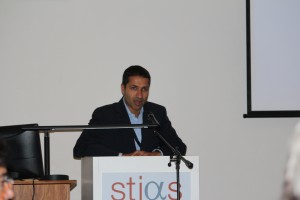
Dr Shafik Dharamsi speaking at the colloquium (Photo: Alec Basson)
Dr Shafik Dharamsi of UBC is of the view that health-promoting schools can create an environment that will enable young people to respond to needs of their communities.
According to him, educators should prepare future health-care professionals to serve their communities.
“How we educate them will determine their sense of social responsiveness and social responsibility,” Dharamsi said.
Professor Russel Botman, SU Rector and Vice-Chancellor, welcomed the delegates and said the promotion of health in schools should be linked with wellness which includes not only physical aspects, but also social, emotional, intellectual, and spiritual and financial wellness.
Health promotion in schools is a way of building hope in situations where despair is threatening to overwhelm people, he added.
The three-day colloquium ended on Friday (11 November).