Categories
Uncategorized

“Disgrace”

Isabel Ochoa

“Disgrace”

For the past few weeks, our ASTU class read “Disgrace” by JM Coetzee. This book won the Booker prize in 1999. The author mentions delicate topics in the book, such as sexual assault and the insecurity in South Africa, it is important to mention that these issues are tied to gender and race. This issue is first seen when David Laurie, the main character of the book, is accused for sexual misconduct with one of his university students, Melanie. Later on, he left Cape Town and went to live the “country life” with his daughter Lucy. One day, Lucy’s farm is attacked by three black men; one of them raped Lucy and at the same time, David was beaten up. After this tragic event, Lucy decides not to report her rape, since it is her story, “…a purely private matter”.  In this blog post, I would like to talk about rape since it is such a big issue in this book and in real life; more specifically I would like to relate it to South Africa.


Sexual assault is a very serious issue and there has been no clear solution for it. Unfortunately, many people that have assaulted another person manage to get away with it. According to Amnesty International, one in four men (in South Africa) have raped someone, and out of these men half of them have done it more than once. Only one out of nine rapes are reported and a very small amount of them get to go to trial.


As a “solution”, ex-president Jacob Zuma (he was in power from 2009 to 2018), set up a ministry to reduce crime, focusing primarily in women and children and their rights. Ironically enough, he raped a woman in 2006 because she was dressed “provocatively”. I happen to agree with Amnesty International, that it is important that men in power show the population how women should be treated, they shouldn’t be promoting violence in any way. I believe that education about this serious issue could have a worldwide impact. In some way, it is beginning to happen, however we are still a long way to go. Women should be able to wear what they please without feeling uncomfortable; they should feel safe no matter what.


P.S. It is also important to mention that women are not the only gender that get to deal with this issue.


References:


Categories
Uncategorized

Representation of time in “Maus”

A few weeks ago, our ASTU class read “Maus”, a comic by Art Spiegelman. “Maus” is the first graphic memoir that is about a serious topic, such as the Holocaust. Before this, comics were known by being funny and for children. However, Spiegelman “broke” this stereotype, by narrating his father’s experience in Auschwitz. The book had such an impact that it won a Pulitzer Prize in 1996.


There are many interesting characteristics in this particular comic, such as portraying the Jews like mice and the Germans like cats; the use of black and white in the images, among other things. However, the thing that was most interesting for me was the representation of time in the comics. Throughout the book, it is seen that there are two “eras”: the first one is when Artie is interviewing his father, and the second one is the WWII era, where the memories of Vladek (Artie’s father), are being portrayed.


First of all, when Vladek is telling his story about Auschwitz, Artie won’t appear in the scenes. When the WWII era is happening, Artie is no longer narrating the story, Vladek is. A clear example of this is: “But I kept shooting and shooting! Until finally the three stopped moving. Who knows; otherwise he could have shot me!” (Spiegelman 50). It is important to mention that this is not a dialogue in a frame, it is actually the narrator’s voice.


Another important thing to notice is that every time the time is changing, especially from the World War scenes to Artie talking to his father, the first panel isn’t surrounded by a border, like it usually is.


Lastly, the characters are portrayed different in the times. As mentioned before, Artie doesn’t appear in the war scenes but Vladek shows a lot of differences throughout the scenes. Vladek seems like a nicer person when the war scenes happen, since he is always trying to be really supportive and positive to his wife. When he is talking to Artie, you can sense that he is no longer that person, in the sense that he is really mean to his new wife and pretty impatient with his son. Also, when reading the comics, sometimes people forget that the icons also have a meaning, the words in the book aren’t the only thing giving a message. Taking this in mind, you can see how Vladek seems older and younger on the different panels, depending on the time.


Overall, I really enjoyed this book since it was the first time I read about the Holocaust in a comic form. Also, the fact that this is someone’s story had a bigger impact on me because in a way, it is felt more personal than historical facts or narratives. If you haven’t read the book, I strongly suggest you to do so.


References:

  • Spiegelman, Art. Maus: A Survivor’s Tale. Penguin Books, London;New York;, 2003.
  • https://www.washingtonpost.com/news/comic-riffs/wp/2016/08/11/why-maus-remains-the-greatest-graphic-novel-ever-written-30-years-later/?noredirect=on&utm_term=.1ae676a49328
Categories
Uncategorized

Mental Health Back Then vs. Nowadays

For the past few weeks, our ASTU class has been reading “Mrs. Dalloway” by Virginia Woolf. This book has the setting on one specific day, where Clarissa Dalloway, the main character, hosts a party. Throughout the book, we get some insight to Mrs. Dalloway’s ideas and memories from the past to understand the context and situation the of the day of the party.


However, what I want to focus on this blog is one of the main characters of the book: Septimus. He enlisted in WW1, but ever since he returned from it, he hasn’t been the same. It appears that he is always re-living these terrible experiences from war, he was traumatized by it. This trauma is also known as “Shell-Shock”.


Back then, Shell-Shock was “poorly understood”. Military officers even perceived this as a symbol of cowardice or lack of moral character. This non-physical illness was not understood and treated properly. This was the reason why Septimus ended up killing himself. He thought that suicide was the only option to go through this non-physical pain.


However, nowadays mental health is treated much better and taken much more seriously (in Canada). One recent example where this can be seen clearly is on January 31st, the “Bell Let’s Talk” day. On this day, when the hashtag “BellLetsTalk” was used, 5 cents were donated to mental health in Canada. By the end of the day, the institution gathered around $7 million Canadian Dollars. This day is also encouraging the people “to end the stigma and start a conversation”. To speak up and talk about your problems; for you to know that you are not alone.


I can tell you from personal experience that speaking up can really help you feel better. At the beginning of this school year, I was feeling overwhelmed and everything I did seemed wrong, whether it was academic, social or economic “stuff”. I was feeling really sad. However, one day I decided to talk to my mom and she helped me a lot. She also suggested me to use one of the multiple resources on campus, so I did. I visited the “Wellness Center” and they also gave me strategies to make me feel better.


I strongly recommend that if you’re feeling “low”, speak up; call a loved one, a friend, use the resources the university has for us or call institutions like “Bell Let’s Talk” or “Empower me”. You are not alone.


References:

https://letstalk.bell.ca/en/

http://www.studentcare.ca/rte/en/UniversityofBritishColumbiaAMSGSS_EmpowerMe_EmpowerMe

“Shellshock”

Categories
Uncategorized

Negative Media

Over the last few weeks, our ASTU class read and analyzed “Persepolis” by Marjane Satrapi. (If you haven’t read it, I strongly recommend it.) While discussing this “Graphic Narrative” (Chute and DeKoven) in class, we got to the conclusion that Satrapi wants us (the readers) to understand the way Iranians live; that they are people too and not all of them are extremists, like the media claims they are.


My trip to Iran 

My family and I went to Iran in 2015. I remember that all of my family (grandparents, cousins, uncles, etc) and friends were truly concerned about that trip of ours. Most of them called us “crazy”. A friend of mine actually asked me if I had a death wish. To be completely honest, I was quite scared of going there too. I had the idea that Iran was just like they said in the media…

I remember that we were on the plane from Dubai to Tehran, and I was sitting next to an Iranian girl that was about my age. We started talking, and she began to tell me about her culture and country. I was surprised to what I was hearing, she didn’t mention anything about terrorists or war. By the end of the flight, I had a totally new perspective about the country I was about to visit.

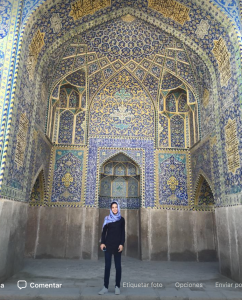
It would take me forever to talk about my wonderful experience in this country. However I do want to mention one day of this holiday that reminded me so much about Satrapi’s purpose of writing the book. After visiting the “Jardín de Fín” in Kashan, the tour guide thought it was a good idea to take us to a place that sold local/typical bread from Iran that was just around the corner. I can’t remember the context really well, but I remember that the person selling the bread drew a heart on the bread and gave us the bread for free. He didn’t accept the money and he had the biggest smile on his face. Just after that, my family, the tour guide and I hopped into the van, then the tour guide said “Not all Iranians are terrorists, just like not all Mexicans are drug dealers.” That really hit me. The media had given us an awful idea about Iran and it was the complete opposite. Most of the people we got to meet were really friendly, just like the baker; my family and I felt really safe when walking around the city; I didn’t get to see a single gun or hear an explosion.

A picture of me in Iran


The Media

As I mentioned before, I had the idea that Iran was a totally different country due to the media. Bush’s “Axis of Evil” harshly targeted Iran among other countries ( speech on: https://www.nytimes.com/video/us/politics/100000004021075/the-axis-of-evil-speech.html). The thing is that the media hasn’t stopped . Just out of curiosity I typed “Iran news” on Google, and the first thing that came up was a picture of a man holding a gun (https://www.aljazeera.com/news/2018/10/sanctions-network-supporting-iran-basij-resistance-force-181016181132789.html). The problem is that I was not the only one that had a negative thought on Iran; 58% of the world (2015) had a negative opinion of this country( http://www.pewglobal.org/2015/06/18/irans-global-image-mostly-negative/).

The media has managed to manipulate us to believe the conditions they want us to think. However, we need to engage differently by being more critical with how we understand the news.


Conclusion

One of Satrapi’s purposes of writing “Persepolis” was to show the readers that not all Iranians are extremists. Due to the media, that is the only impression some people have of Iran. Iran is not the only country facing this problem, many countries are, just like my home, Mexico. While I was studying abroad, our Geography teacher played us a video about pollution in different countries. They mentioned that Shanghai had a lot of pollution due to cars but that they were solving the problem by creating a really fast train. On the other hand, Mexico faced a problem that they had a really polluted river, that it even had a dead body in it. After the video, my friends didn’t even remember the fact that we had a pollution problem, they were just worried about the dead body in the river. The thing is that I go past that river quite often and I have never seen something like that. The news have way more negative coverages rather than positive ones. They go by the policy “If it bleeds, it leads” (https://www.theguardian.com/commentisfree/2018/feb/17/steven-pinker-media-negative-news).  A solution for this problem would be to stop believing the media is an  objective source of knowledge. I mean, “news” only gives us a small frame, usually negative, of what is actually going on in some countries. We have to be more subjective, know different points of view, be more informed about it, before we criticize or allow the news to carry us away.


Categories
Uncategorized

“Arts of Resistance”

ASTU BLOG #1

Isabel Ochoa

“Arts of Resistance”

In this blog I am going to write about a specific piece of art located in the Museum of Anthropology in the “Arts of Resistance” exposition. The name of this work is “The Ayotzinapa Codex” by Juan Manuel Sandoval Palacios and Diego Sandoval Ávila (https://thetyee.ca/Culture/2018/06/01/Angler-Crafting-Art-Resistance/ ). I chose this specific work because the Ayotzinapa case occurred in Mexico, my country, exactly 4 years ago. In short, what happened is that 43 students were going to take (steal) a bus and travel from Iguala, Guerrero to Mexico City on September 26th, at night. On that night, or the early morning of the 27th, they had an “encounter” with the police. This was the last time they were seen. Since then there had been many theories about where they could have been, but the thing is that no one really knows. Most of the people think that the government has the blame for it, which would make this a forced disappearance (https://www.nytimes.com/es/2018/09/26/ayotzinapa-estudiantes-43-mexico/?rref=collection%2Fsectioncollection%2Fnyt-es&action=click&contentCollection=ayotzinapa&region=stream&module=stream_unit&version=latest&contentPlacement=1&pgtype=collection). As a consequence, people have had many protests towards the government about this issue. Many people went to manifest in Downtown Mexico City, many hashtags were all over social media and the local news wouldn’t stop mentioning this event.

The piece of art I mentioned before, is a way of resistance, just like the protests and the hashtags. The setting of this “Codex” is the XVI Century, before Mexico was conquered by the Spanish. Enrique Peña Nieto (EPN) the actual Mexican president, is represented as a viceroy, and the 43 students are “prisoners captured in pre-conquest Aztec warfare” (description from museum). This is describing with sentences and “drawings” the actual situation in Mexico City, from the author’s perspective. The beginning of this tells how the government is mistreating the Mexican people by contaminating their resources, such as rivers, and not making the Mexicans a priority. Then it says about how the government has created a way to “get rid of” the people that are against the government. Finally, it describes the Ayotzinapa case, in which the 43 students went missing.

I can relate the “Ayotzinapa Codex” to Sarah Polley’s documemoir “Stories we tell”. If I could describe this film in a few words, I would use Sarah Polley’s “the vagaries of truth”. Through this film she wants to find out more about her mother’s life (Diane Polley) and who is Sarah’s father. She wants to find the “whole truth” by asking several people that were really close to her mother, however this is not easy because everyone has different perspectives and points of views. This is just like the Ayotzinapa case because everyone has different truths and perspectives. The people blame it on the government; the government keep telling the people that these students just went “missing”. Some theories said that they could be in a pit (https://www.nytimes.com/es/2018/09/26/ayotzinapa-estudiantes-43-mexico/?rref=collection%2Fsectioncollection%2Fnyt-es&action=click&contentCollection=ayotzinapa&region=stream&module=stream_unit&version=latest&contentPlacement=1&pgtype=collection), most people assume that they are dead now, the fact is that no one has the “whole truth” about this case.

Categories
Uncategorized

Hello world!

Welcome to UBC Blogs. This is your first post. Edit or delete it, then start blogging!

Spam prevention powered by Akismet