Categories
Marketing

Part 2 of Mac n’ Jinx: Kraft to Put Tweet in TV Ad!

After the Mac n’ Jinx campaign, Kraft continues with their marketing push campaign by selecting five tweets that mentions macaroni and cheese and they will then write and shoot ads based on them.  One of the five tweets will be plugged on TV, where it will appear during TBS’s talk shows “Conan” and “Lopez Tonight”.  The other four will be on Kraft Mac & Cheese’s Facebook Page.

I must say that Kraft’s social media driven campaign was brilliant because it is generating a lot of buzz around the social media.  Kraft also engaged the audience by allowing them to participate and give them a chance to be famous!  It makes consumers to feel appreciated and showed them that Kraft does consider what their consumers think of them.  The following are some tweets that are converted into ads:

YouTube Preview Image YouTube Preview Image YouTube Preview Image

Go like their Facebook page to find out more!

Categories
Marketing

Comm 299 – Blog #2

What I learnt from Comm 299 are the fundamental and professional skills that are crucial to start my employment and career.  Comm 299 provides many resources to help us build our brands by teaching us how to write a strong and focused resume and cover letter that helps differentiate us from other candidates.  I also learn essential skills for job interviews (i.e. web to web, constant eye contact and use of CAR statements).  Also, this class explains thoroughly the procedure of job searching, networking, call for an information interview etc.  These are all useful approaches in opening doors to many employment opportunities be it now or in the future.

Overall, I find the resume, cover letter assignment and the mock interview are the most useful.  These exercises helped prepare myself for future employment opportunities.  Therefore I would recommend this course to other commerce students because it really helps prepare you for starting your career and it allows you to practice many skills that cannot be learnt from just sitting in lectures.

Categories
Marketing

Mac n’ Jinx!

From this article, I learnt that Kraft has developed a fun new Twitter game called “Mac & Jinx” to advertise for their Macaroni & Cheese.  This game is based on the old children’s game of Jinx, which is when people say the same thing at the same time.  Mac & Jinx is basically the same idea.  It monitors those who say “mac and cheese” on Twitter, chooses pairs of them and sends them @ messages.  The first to click the link will win 5 free boxes of Mac & Cheese and a t-shirt.

I personally think Mac & Jinx is a smart marketing campaign.  It is a great little game – fun and simple – and it adds to the brand’s image of being friendly and approachable.  And what’s more, this game is a success because it gets the people to talk about Mac and Cheese on Twitter.  Also, the amount of conversation generated by this campaign heightened, which helps to boost the brand image and awareness.  And most importantly, this campaign is inexpensive for Kraft!  They took advantage of the Twitter that is free.  Therefore, advertising nowadays is no longer about budgets, instead, it is a battle of creativity and innovation.

Categories
Marketing

You are crazy if you feel sorry for the lamp!

Promotion strategy is one of four marketing mix and it is crucial for companies to cut through the noise and get the right message to audience in hoping to leave a good and lasting impression to their customers in under a minute or two.  It is common now for companies to use integrated marketing communication, where they coordinate to deliver a clear, united message using various channels or medias.  Another element of integrated marketing communication is giving out consistent messages by the use of the same logos, symbols or slogan.  This consistency is essential in building brand awareness, association and loyalty.  The following is an advertisement from IKEA and I will go through the communication process that IKEA wants their customers to go through when they are looking at the ad.

YouTube Preview Image

The communication process begins from a source, IKEA, which encodes a message by the consistent use of the same colors and logo (at the end).  The channels of communication are television, Internet, Youtube etc.  The message then get passed on to consumers where they decode and perceive the message.  This ad appeals to the affective feelings of the consumers by having them sympathize the old lamp at first then contrast the feeling with a guy saying “you are crazy if you feel sorry for the lamp” and prompting you to go buy a new one at IKEA.  The response that IKEA is hoping to get is that customers will go to IKEA when they think of buying new furnitures.  An indication of whether customers are responding to the ads would be looking at the number of customers visiting IKEA and the sales record after the ad has been released.  However, it is important to note that sales record not necessarily a good measure for the consumers’ response to the ad.

Categories
Marketing

Brand loyalty in crisis in this generation?

As I was reading my classmates’ blogs, I came across one from May Zhou about brand loyalty that I found interesting.  In her post she mentioned that a study has showed that “a meager 3% of consumers surveyed in this age group [of 25 – 49] said they’re loyal to a particular brand”, which shows that there is a trend of diminishing brand loyalty.  One reason for this is that consumers now have access to resources online and that they are willing to put time and effort to research for the products before they buy them.

I agree and I say that it depends on the type of products.  Brand loyalty still applies to convenience goods and sometimes speciality goods.  When we are looking for detergent in the supermarket, we would usually go for the brand we usually buy.  For speciality goods, I can relate to this because I am one of those consumers that would research for weeks or months before I decide to buy an expensive and durable product such as a laptop or mobile phone.  Before I bought my laptop, I began researching with Apple’s Macbook Pro and researched on from that point.  In the end I still bought from Apple after looking at other brands like Sony, Fujitsu…  Therefore, the level of brand loyalty still exists in that I trusted Apple for their high quality products.  So I don’t see that brand loyalty is slowly diminishing when it comes to expensive products since consumers want to minimize as much risks as possible.

On another note, I see that the trend that consumers are spending more time on research is beneficial to companies in terms of the flow of information – consumers get information about the product while companies gather opinions and feedbacks which helps to generate new ideas for their products or helps to discover a new market segment.

Categories
Marketing

Ipad 2’s Pricing Strategy

The hottest gadget of the year is probably the Ipad 2, which will be released this friday on March 11th.  And with a shockingly low starting price of $499, Apple leaves little or almost no margins for their competitors such as Motorola and Samsung.  Motorola’s Xoom for instance, costs $799.  Apple is clearly pushing all the pricier rivals into a corner by offering the lowest price in the tablets market, but why?

1.  Avoid any pricing fiasco like the iPhone.  Apple launched iPhone at $599 and had to lower the price to $399 within two months.  And also, this will make the iPad 2 more affordable to more customers.

2.  Introducing a new category of products.  Apple is launching a new category of products.  There really is no demand for tablets except when Apple started introducing this new product.  Therefore, I believe that Apple is sales-oriented as they set their prices, since low price is the best way to attract customers to try it.

3. Low starting price to lure customers to visit Apple store and try it out; customers are likely to end up buying the high-end model that costs $829, given their brand loyalty for Apple.

4. Apple is more about generating revenue in the long run.  Just like the iPhone, iPad will generate revenue from AppStore, advertisers, and wireless providers.

Categories
Marketing

Starbucks’ New Logo?

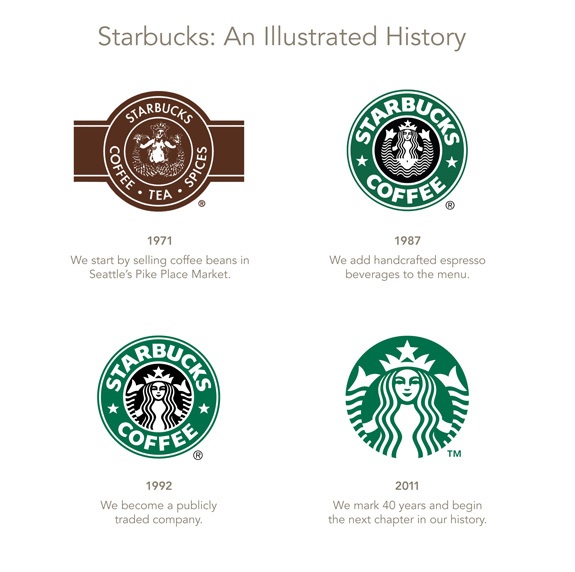
Starbucks was established since 1971 and its company logo has changed two times ever since.  In 2011, Howard Schultz, the CEO of Starbucks, decided to change their logo for the third time, from a Siren sitting inside a green ring that says “Starbucks Coffee” to a logo keeping the Siren but without the ring and the words.

In response to Noelle’s blog, I also agree with her that the new logo with only the Siren could be confusing to customers.  According to Howard, the purpose of the new logo is to re-establish Starbucks image to a brand that provides beyond coffee products.  Therefore, the new logo removed the words “Starbucks Coffee” to avoid confusion to the consumers when they purchase non-coffee products from Starbucks.  However, I think Starbucks should keep their name in the logo like they did for all these years.  First, it is not wise to remove the brand name that took years to be recognized globally.  Second, unlike Nike’s swoosh that is easily identifiable, a Siren could be hard to identify as “Starbucks” right away.  It is a mistake on Starbucks part to assume that their Siren speaks out to their customers as Starbucks instantly.  As a loyal customer of Starbucks, I recognize the green and the Siren but it took me a while to process the new logo.  Since loyal customers already have trouble relating the logo to the brand name, wouldn’t it be harder for new customers?   Therefore, I believe that Starbucks should have just removed “coffee” and kept their brand name.  This way, consumers will not have to guess which brand and they also will not be confused when they buy non-coffee products – which complements with Howard’s concept of having their customers “think beyond coffee”.

Categories
Marketing

Looking for your own Red Band story?

This week during my marketing class, I was shocked when my marketing professor decided to Skype in the middle of the lecture.  And little did I know that the person we are all Skyping with is George Moen, the President of Blenz Coffee!!!!  There is even a video recorded shown below:
YouTube Preview Image
Thanks to our amazing marketing professor Elaine, we have an opportunity to get first-hand information about the marketing behind the Blenz Red Band campaign.  This idea of Red band is brilliant and innovative in a sense that they took advantage of the social media, which directly targets all the tech savvies in this generation.  Also, this idea is a great gimmick for Valentine’s day and it captures many people’s attention, because many people especially teenagers and young adults (their target market) look forward to a memorable Valentine’s day.  But what if you have no one to spend it with?  Blenz is telling you to simply go get a coffee with a Red Band that indicates your single status, and in turn, it will attract other people that has the Red Band too!  And thus, increasing your chance of meeting someone special at Blenz.

Therefore, Blenz Red Band is successful because they are right on for their target market and they set apart from competitors like Starbucks when they chose to do their marketing through the social media.  Also, Blenz is different from their competitors in that they focused on creating this dating gimmick for Valentine’s day, while Starbucks only focuses on making specialty drinks and did not come up with any gimmicks.  Personally, Blenz Red Band campaign absolutely worked for me and I am very interested in getting a coffee there and hopefully a Red Band story….hehehe

YouTube Preview Image

Search for more videos at the Blenz Red Band’s Youtube Channel!!

Categories
Marketing

If only there is Doritos Tablet…

I started wondering about the old commercials that I’ve seen before and which ones appealed to me, and right of the bat I thought of the Doritos Face Scrub and Doritos Tablet commercials!

YouTube Preview Image YouTube Preview Image

Both ads are parodies with one on a typical face wash ad and another on the well-known Ipad ad from Apple. Doing a parody always captures people’s attention and as a result, both videos spread around quickly on the social media and network.  In both of these ads, you can see that they are targeting teenagers and young adults.  In the Doritos Tablet ad, it is smart for Doritos to make a parody on Apple’s Ipad commercial knowing that almost every teenager has crazed over the Ipad, which makes it easy for viewers to relate the Doritos Tablet in the context of an Ipad and they would understand the laugh behind it.  This is the same for the Doritos Face Scrub ad.  Thus, doing parodies for the two ads enhance a humorous and “cool” image for Doritos.

The Doritos Tablet ad has a cognitive appeal as each “users” of the tablet were describing its “functions” as well as an affective appeal by making fun of the Ipad.  The face scrub ad has an affective component in that it wrongly tells viewers that the use of Doritos is to clean faces, which brings humor and fun.  The behavioral component of the two ads is the call to action in the end.

Overall, Doritos have succeeded in communicating and capturing the attention of their target market. I was never a fan of Doritos but I enjoyed the humor of both ads, which makes the image that I had in mind for Doritos more “cool” and appealing to me.

Categories
Marketing

The “Snooki Effect”?

Social reference group is an important social factor that affect our purchasing behaviors, so brands would want to hire celebrities that consumers can aspire to be them by owning the same products.  But what happens if the celebrity is Snooki (Nicole Polizzi) from the Jersey Shore?  It wouldn’t be a surprise that people wouldn’t want to associate with Snooki.  So is the brand practically doomed if it were related to a “bad” celebrity?

A blog that I found talks about  the “Snooki effect”, which is a strategy for luxury brands to sabotage their competitors’ image by sending competitors’ merchandise to Snooki in hoping that this will cause anger among consumers since they don’t want to be associated with her.  It’s natural that the “attacked” brands would want to separate themselves from Snooki and also from luxury “posers” who enjoy showing off what they buy.  But perhaps marketers should see this as an opportunity instead?

The fact that the luxury “posers” are constantly bragging and displaying their love for the brands on the social network (i.e. Facebook, Twitter) and that there are pictures of Snooki holding branded handbags all over the social media could be beneficial to the brands’ online presence.  Since the “posers” are already commenting on how good the products are, marketers should generate more conversations along those comments, which enhances the brands’ name.  The “Snooki effect” could be completely backfired as a sabotage tactic if only the marketers know how to seize the opportunity.

I am surprised that an anti-endorsement can actually become a marketing strategy.  Even though it is not as effective as to hiring an aspirational group, but it definitely helps raise attention about the brand in the social media, which presents a potential opportunity for marketers to enhance the brands’ online identity.

Reference: http://www.socialmediaplayground.com/social-media/luxurybrandsandsocialmediaposers/2010/09/08/

Spam prevention powered by Akismet