
What a great job by Advertising agency Del Campo Nazca Saatchi & Saatchi, Argentina!
What a great job by Advertising agency Del Campo Nazca Saatchi & Saatchi, Argentina!

I just thought it was a good and funny ad. Poor guys who think their relationship is over! Also, it reflects something we covered in class which is amazing, no?!
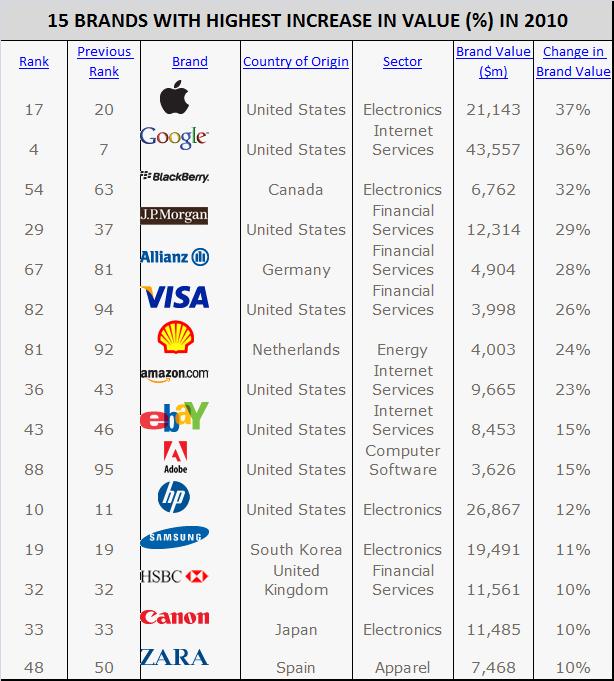
Not so long ago, I revised Chapter 10 from the textbook and noticed Exhibit 10.3 (page 192) which ranked “The World’s Ten Most Valuable Brands” in 2007. It gave me the idea to come up with a similar table for 2010 but for the 15 brands which value has increased the most in the previous year.
I’d like to analyze it. There is nothing scientific about the method I’ll employ. It will mostly be subjective but I’m sure it can show some actual trends among the consuming world!
Out of the 15 brands, 5 are in the Electronics sector, 4 in the Financial Services sector and 3 in the Internet Services sector. Not surprising is the value increase of companies opearating in the ITs. The whole world tends and wants to be connected more and more if not 24/7!! This explains Apple’s and Google’s first and second place in the chart. For Apple, of course, its rise is not solely due to the IT trend’s effects. With its effective marketing strategies, Apple is able to build strong loyalty among its consumers and its number of aficionados is constantly increasing.
More surprising at first sight, perhaps, is the presence of 3 banks, J.P. Morgan, Allianz and HSBC, in the Top 15. One could argue that with the crisis they caused (in part), they don’t deserve to be there. It’s certainly true for many of their competitors but those 3 are major playors in the world which have taken better decisions in the past leading them to go through the economic downturn quite well compared to too many others. Such a behaviour is, in turn, rewarded by the markets and the consumers. This, therefore, could explain the presence of those financial institutions.
As for the future, we may predict that successful IT companies will continue to get more importance and more visibility in the world considering the trend toward technology is not near an end.
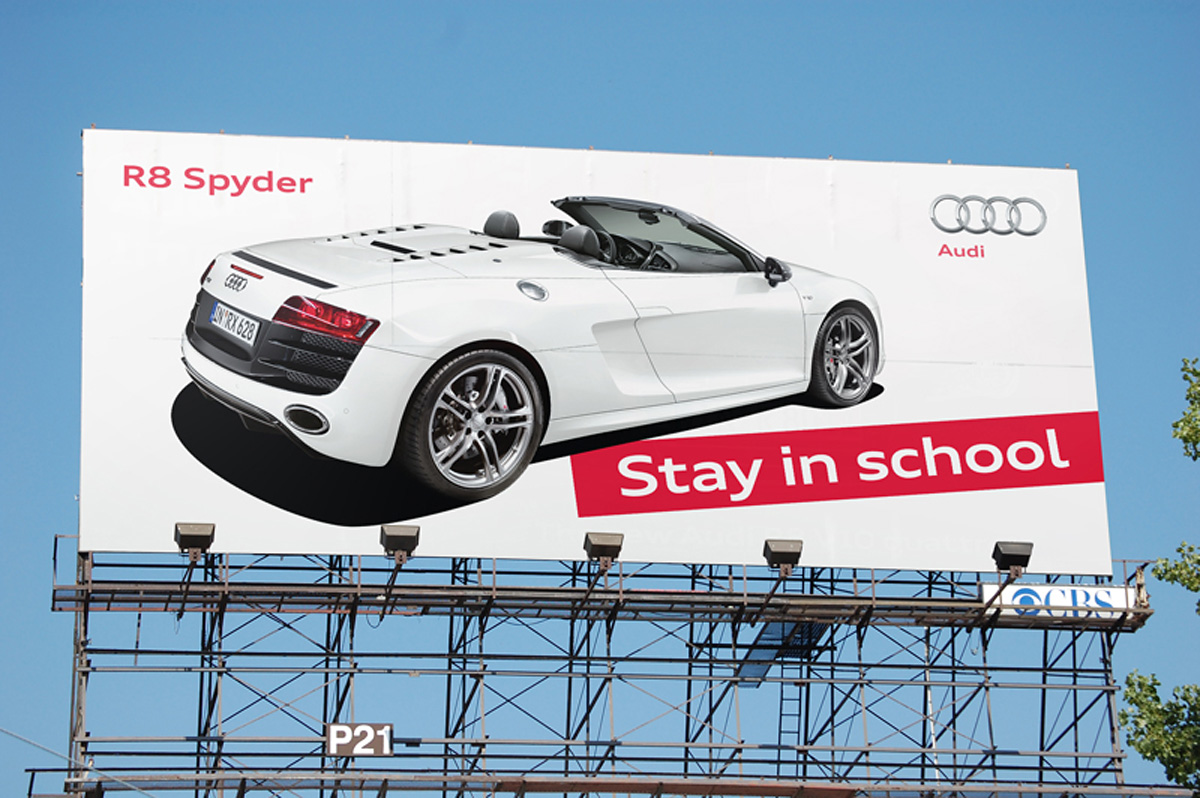
With a starting price of 187,000 CAD, the Audi R8 Spyder is definitely not in the same category as the Honda Civic. I chose to comment on this ad because pricing is our actual topic in class and because the car is awesome!
Even though the price is not indicated on the panel, most people are aware that Audi is a luxury car manufacturer with prices that go along. Also, I think the text on the picture says it all: you better study hard if you want to own this car one day!
I’d now like to discuss Audi’s company objectives and its pricing strategies. As we have seen, four orientations are possible for companies: profit orientation, sales orientation, competitor orientation and customer orientation.
One could say that every car manufacturer is seeking to sell as many cars as they can. Even if Audi is happy when selling many vehicules, it is not sales-orientated for all that. Its prices are clearly not as low as they could be.
In a certain way, Audi is competitor-orientated because it has to be aware of, say, Mercedes’ and BMW’s offerings. But, by setting its prices accordingly to its competitors, it is not “to discourage more competitors from entering the market” (Marketing textbook p.250). The reason is quite simple: it takes a lot more than low prices to be considered and respected as a luxury car maker. In fact, low prices are usually not welcome because it doesn’t fit with the exclusivity concept.
This brings us to the last two orientations that, I believe, characterize Audi’s strategies. It is clearly profit-oriented, as do the other luxury car makers, because its profit margins are important. Particularly on the R8 which is a high-end model, these margins must be quite interesting!
Finally, luxury car manufacturers like Audi have to be customer-oriented because their consumers are seeking for high value in what they buy and, what is even better , they are willing to pay a high premium to the company which offers them the best value. This is why Audi and its competitors offer their clients the opportunity to customize their car more and more.
That is, I’ll definitely “stay in school”!