Categories
Business Ethics

Lose Weight Without Exercising Ethics!

Second only to an interview with Lance Armstrong, the next least believable thing on TV are weight loss commercials. Manipulated before/after shots, exaggerated or false claims, and unrealistic promises have been used by diet marketers for years, but these advertisements can also be considered unethical for what they leave out. In the case of Jessica Simpson and Weight Watchers, it was her entire body minus her face.

In her September 2012 spot entitled Choices made 4 months after starting the program, Simpson, a singer who in recent years has filmed more informercials than she has music videos, announces “it’s working”. However her words are no more convincing than her sister Ashlee‘s lip synching, because she makes the claims without showing the world the evidence that lay just below her neck.

https://www.youtube.com/watch?v=gjIZPftTjbg

What was she hiding? Perhaps showing the new mother’s figure would have shown viewers that, as is the case with regular dieting, Weight Watchers may not be effective for everyone.

Another ethical issue comes to mind when one sees Jessica’s next commercial, in which she announces she has lost 50 pounds. While this may be the case, what isn’t mentioned is that Simpson was helped by high-dollar fitness trainers and nutritionists, something the average consumer does not have access to. In the ad, the former Pizza Hut and Proactiv spokeswoman also announces that she is pregnant, making her endorsement even less relevant since, according to the fine print, pregnant women are not eligible to join.

https://www.youtube.com/watch?feature=player_embedded&v=UxbTnr1Fw0k

Jessica Simpson’s Weight Watchers experience may not be a big fat lie, but one must cut through some fat to get the whole truth.

Categories
Business Ethics

Reebok Forced to Tone it Down


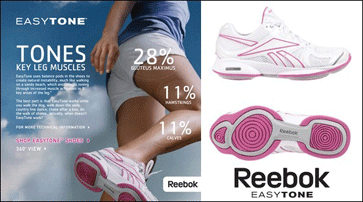
It seems consumers are not the only ones unhappy with the exaggerated or unfounded claims that are often used to advertise fitness products. The latest way to get in shape with minimal effort is walking in “toning footwear”, shoes with specially shaped soles that force muscles to work harder to maintain stability. In 2010, just three years after segment pioneer Skechers released its Shape-ups, toning sneakers became a billion dollar market. But while shoe shoppers including Kim Kardashian bought into the idea, the FTC’s Bureau of Consumer Protection was not convinced. After several university studies proved many models offered no more muscle activation than regular sneakers, the producer of one of the worst performing ones, Reebok, has been hit with an unusually severe fine of $25 million. According to the Bureau, the company has been using insufficiently proven claims to market its EasyTones. The money will go towards customer refunds. Meanwhile, Reebok’s competitors are dealing with lawsuits and slumping sales.

While the FTC is right in exposing false data, it is hard to say whether customers who purchased EasyTones deserve full refunds. Stores are full of questionable items and it is up to the consumer to do his research. Moreover, while they may not tone, shoes like Shape-ups and EasyTones have other benefits such as comfort. Is the customer entitled to a full refund based on one feature not working quite as promised?


Categories
Business Ethics

Bauer’s Business Blunder


Struggling retailers like Eddie Bauer rely on sales to clear out inventory at seasons' end (image from leeloveshottrends.com)

Think it’s impossible to offend customers with lower prices? Think again.

Bellevue, Washington based outdoor clothing retailer Eddie Bauer sparked anger and criticism last November when it announced its Canadian outlets would put on their own version of the successful Veterans’ Day sale that happens on the week of November 11th at U.S stores. As this holiday is traditionally a prelude to Black Friday, the country’s busiest shopping day, American consumers don’t object to the 75% discount on fall items.

It seems that Canadian consumers, however, don’t see it as ethical to commercialize a day honoring veterans. The announcement of EB’s “Remembrance Day Sale” sparked outrage among veterans, who’s distaste quickly spread across social media websites and the media, generating a lot of negative attention for the company.

What this story exemplifies is how business ethics can vary dramatically between two seemingly similar markets. Apparently the marketing department at Eddie Bauer was not sensitive to the difference between Veterans Day, and Canada’s more solemn Remembrance Day. Despite the rough start, the promotion was rebranded and went on as scheduled.


Spam prevention powered by Akismet