What is a better way to promote the product than giving it for a public test. While screaming “our glass is unbreakable” doesn’t really sound convincing, put the glass in the bus stop and say – break it! Yes, come on , break it and you can take the money! $3 million in cash! Well, that is really convincing!
PowerSmart
The most ridiculous thing about wasting power is that for some reason we don’t think it is ridiculous.
I had wondered that why BC hydro who sells power would launch such a huge marketing campaign pursuing people use less power. I do believe the reason should be far more beyond being environmental friendly or being green.
This advertisement itself, I think, it is effective in achieving its goal of power smart. At least to me, after watching this ad on TV over and over again, I did turn off lights more often when I do not them. This ad creates a sense of remorse. For companies who want to sell more to consumers, they want to eliminate or at least buyer’s remorse as best as they can. BC Hydro wants people purchase less their product, electricity, and then they create buyer’s remorse. Wondering if this argument makes any sense?
Brainstorming the reason of BC Hydro launches this campaign of PoweSsmart, it should be a capacity problem, or cost issue. Possibly, BC Hydro is almost at capacity, so they would not able to provide more electricity with their existing power generating facilities and the fixed cost of produce additional capacity is tremendous!! Then, BC Hydro launched PowerSmart Campaign, a campaign which is good for the company and good for the society. Such a win-win situation, Why not?
The Story of Electronics
I would like to talk about the delivery or the style of this video rather than commenting on the topic.
All “The Story of Stuff” videos have a consistent design, simple and clear. It is reasonable to believe that the group behind “The Story of Stuff” is still in the introduction stage. The ideas, messages and the life styles they are promoting is new to most people.
Like the video Tamar showed in class, Google Docs in plain English, The Story of Electronics, actually the serious of the story of stuff, is very effective in communicating to its target audience. The theory or concept behind is relatively complex, by using funny animations, simple design, and plain language, the message can be easily absorbed by audience.
The story of bottled water. Success of marketing, but TRADEGY of society.
Alex Diep talked this video in his post, Bottled Water – The Sad Truth. Bottled water was used as an example for packaging in class. Generally marketing about bottled water is very successful, and the water industry id highly profitable. The normal profit margin is about 50% to 200%!
Tony Clarke, wrote in “Bottled water companies just swimming in profits,” Coca-Cole’s bottled is directly from the tap water, and then they sell one-litre Dasani for around for $1.70 to consumers. It has been estimated that for the same $1.70, Coca-Cola can obtain up to 34,000 litres of water from the public tap water system which have already been developed and paid by the taxpayers.
The story of bottled water astonishes people about environmental damages caused by bottled water industry, but on the other hand, we need to admit the marketing done by bottled water companies is hugely successful despite any ethical issues.
Demand manufactured by bottled water companies through successful marketing campaign but involving strategies scaring, seducing, and misleading consumers. Smartwarer is one of them, promoting “spring water is for swimming, smart water is for drinking!” You’ll found out how ridiculous it is after watching the video, The story of bottled water.
A Logo
To be honest, I haven’t read any classmates’ blog until today. It is really FUN and relaxing reading others’ posts; there are a lot of insightful and interesting points and a lot of great videos. I should have checked classmates’ posting from the beginning. It’s a great place to visit when I get tired from my accounting study or business writing. Anyway, it is never too late to discover that.
Logo is a very important topic, several posts talked about that.
In Susan’s post, Not Just a Logo, , and Sonal’s post, Company couture, , they all pointed out logo conveys company identify, and is a great to communicate with the target consumers. Definitely, logo is a powerful tool. For example, the amazon logo, is extremely clean and simple, but is very powerful and meaningful. This arrow looks like a smile, but more than a smile. It says that amazon.com has everything from a to z and it also represents the smile brought to the customer’s face. When I saw amazon’s logo, I just had a feeling that if a company is very into its logo design, and want to communicate their strength to consumers through its logo, the company should be ready to provide outstanding and valuable service to consumers.
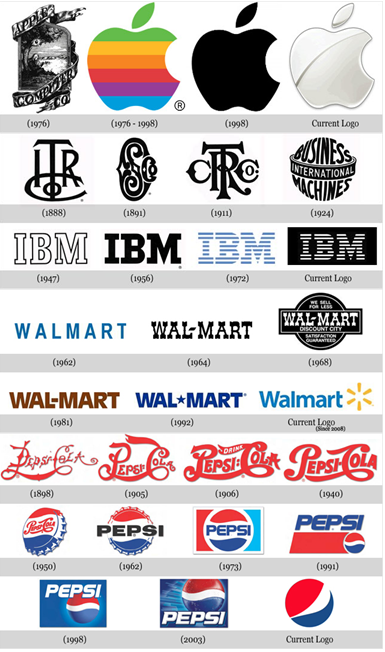
However, a good logo changes overtime to match with company’s changing strategy to archive the perfect identification. Apple logo’s evolution, as Sonal mentioned in her bolg, is a perfect example. There are other successful examples of logo evolution, such as IBM, WalMart, and Pepsi.
Gap Inc. , however, was not successful in introducing of the new logo. Gap’s new logo was really short-lived, and Gap switched back to the familiar blue box only a few days after unveiling it online, because an outpouring of protest on Facebook and Twitter. Just as Julia said in her blog, A New Brand Statement, she wouldn’t stop shopping at the Gap because she dislikes the new logo. Neither do I. The new logo, I think, is not that bad as it is simple and clear, though I still like the old one. But I am not sure why I preferred the old one? Just because I am more familiar with that one? Maybe.
Harley Experience
Harley-Davidson is a motorcycle company that sells Harley Experience image along with its heavyweight motorcycle. Harley symbolizes American culture, reflects a prestige lifestyle, and customers appreciate Harley’s value of individuality, freedom, and adventure, and wants a Harley bike as they feel they are connected with Harley in terms of features and lifestyle. There used to be years of waiting list for a Harley bike.
Positioning its motorcycle with a distinctive brand image of Harley Experience, and reinforcing this image though Harley Owners’ Group (HOG), Harley has successful rooted its brand into American’s culture, won customers over, and built a sustainable competitive advantage. Harley also uses the method of building loyal customer base to sustain its advantage over competitors. It retains loyal customers through HOG and outstanding customer service provided by the company and its dealers.
In today’s competitive market, it is extremely important to distinct our product with that of competitors. Often, the physical features are easy to imitate, but things like brand image takes time and money to build. Harley took its advantage of brand equity, succeeded and pioneered the US market. The sustainable competitive advantage derived from clear and distinct image is the most important reason that many motorcycle companies simply buys an existing brand that customers feel connected with when they are trying to enter and explore the India motorcycle market.
However, if Harley wants to approach a different segment with different style preference, their image of representing a certain style may drive those potential customers away. They simply think Harley doesn’t fit before even have a try. So, when deploring the different a segment, Harley may need to create a new brand with a new image, apart from Harley brand, to be competitive.
Multi Brands
Unilever and P&G are worldwide well known personal product marketers and own hundreds of brands. Why they develop so many brands?
Take P&G hair products for example, includes brands like Head & Shoulders, Rejoice, Pantene, Herbal Essences, Gillette, and Wella with each brand promotes one specific and unique feature.
Just as different people want to drink different beverages because of different reasons at different times in different places. People want to use hair product with different features under different circumstances. Thus, P&G develops different hair products to fulfill people’s various needs to gain the most market share.
With one brand and one unique feature, P&G successfully wins consumers with different needs. For example, Head & Shoulders is famous for its anti-dandruff feature. Through its market campaign and advertising, people have linked the brand Head & Shoulders with an image of anti-dandruff in their mind. Anytime, they need anti-dandruff, there is a very greater chance, they will choose to buy Head & Shoulders.
Also, owning multiple brands under one category, P&G avoids lots of competition. Whether consumers buy Pantene, Wella, or Head &Shoulders, P&G’s sale figure rises.
Their multi brand strategy (Multi Brand Strategy refers to a marketing strategy under which two or more than two similar products of a firm are marketed under Different Brand names. In most of the cases, these products are competing ones and are marketed under the Brand Names which are completely unrelated) enables P&G to reache the largest amount of consumers.
Coke or Pepsi
For more than a century, Coke and Pepsi competed for the world’s beverage market, and most intensely in the carbonated soft drink industry. The fierce and endless cola wars actually accelerated the flourish of these two giant companies, creating a win-win situation at the cost of small competitors. Their massive campaign strategy excluded potential entrants entering the huge profitable soft drink industry. It requires a lot of money and a long period of time to build brand image and loyalty through marketing campaign and advertising. Small competitors were not able to reach the economics of scale on the marketing spending due to the low sales volume. Retailers are reluctant to provide their limited and valuable shelf spaces to new entrants as retailers have enjoyed significant margins on Coke and Pepsi already. Through “joint efforts” under the shield of competition, Coke and Pepsi created high barrier to enter and defeated small competitors, acting as Duopoly, which ensured their absolute control over price. It is one of reasons that “carbonated sugar water”, the so called cola, brings billions of dollars to Coke and Pepsi.
Hello world!
Welcome to UBC Blogs. This is your first post. Edit or delete it, then start blogging!