Categories
Uncategorized

The Cola Wars – 2011 Edition

I came across a thought-provoking post “Too much taste to be called a Zero” from Raissa Cheu’s blog , detailing the latest ad for Pepsi Max (a 0-calorie drink) with not-so-subtle blows at its main competitor, Coca-Cola. She raises some interesting observations about how the ad differentiates Pepsi from Coca-Cola (who sells an almost identical product) by using Snoop Dog endorsement, the image of the Coca-Cola employee drinking Pepsi, and also the slogan “TOO MUCH TASTE TO BE CALLED A ZERO” – another direct attack at Coke’s “Coke Zero” product. I do believe that Coke and Pepsi are among the companies that employ the most blatant brand comparisons in their advertising in order to differentiate themselves. Currently, according to Beverage Digest’s 2008 report, PepsiCo’s U.S. market share is 30.8 percent, while The Coca-Cola Company’s is 42.7 percent.

Let’s take a look at a chart I’ve made detailing some major initiatives by both Brands to differentiate themselves – sometimes using direct measures to discredit the competition.
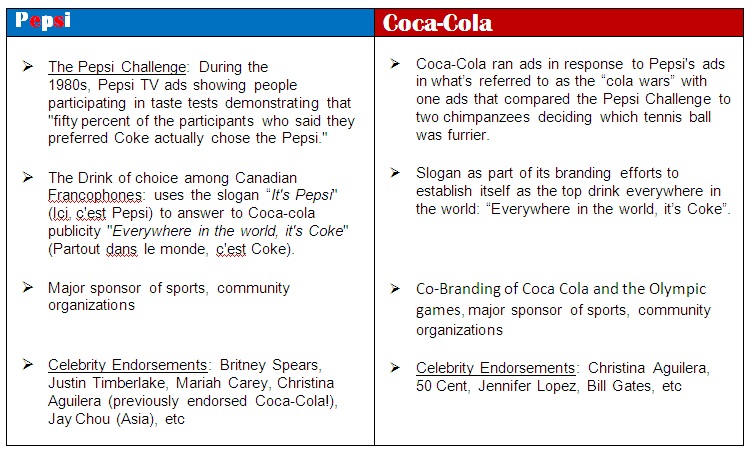
The position of these two companies is that they are constantly competing for market share in a sort of “Tug-of-War” or “Cola War”. Almost identical product, identical prices, and similar marketing strategies that often are made in direct response to the other’s strategy. Perhaps new strategies are needed to reinvigorate and add innovation to the cola brands – perhaps brand extensions such as merchandise, or products such as sparkling fruit soda, cider, ice cream, stylish reusable bottles, etc ?

On an side note, some food for thought: in relation to Tamar’s lecture today on the disadvantages of having a Genericized brands (i.e. Kleenex) – Is Coca-Cola (or Coke) a genericized brand, as carbonated soft drinks are sometimes referred to as ‘coke” by the general population? And what effects did it have on Coca-Cola as a brand?
Categories
Uncategorized

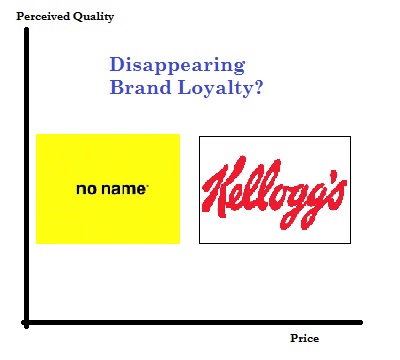
The Future of Brand Loyalty

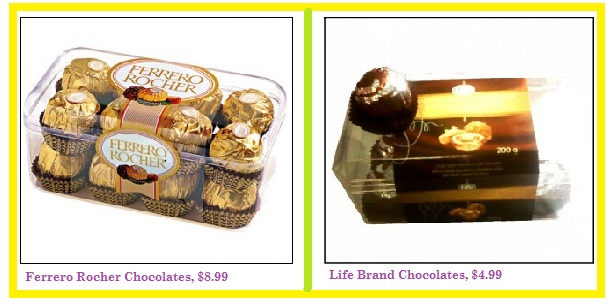
A few days ago, I purchased a box of Ferrero Rocher chocolates at Shoppers Drug Mart for $8.99 – a little exorbitant for a little box of chocolates. But I’ve seen their glamorous TV ads and had consumed it with satisfaction previously, so I was assured that I’d bought a good product at a reasonable price.

However – a few days later, I spotted the same type of chocolates from the store’s in-house LIFE Brand, retailing for $4.99. As you can see below – the packaging and style are almost identical, and there was no difference in taste. And I thought – why would I buy Ferrero Rocher chocolates to eat if I can get an identical product at around half its price? For gift-giving, Ferrero Rocher may be more appropriate, but the Life Brand ones will be my chocolate of choice for my own consumption.

Brandchannel.com’s post, Tracking the Generational Shift in Brand Loyalty
discusses this trend of wavering brand loyalty among consumers and raises some interesting questions. Marketers have always emphasized the importance of creating brand loyalty and even taking it one step further by creating incentive programs for loyalty. However, this long-held concept is about to face a reality check as a recent AMP Agency study showed that “a meager 3% of consumers surveyed in this age group [of 25 – 49] said they’re loyal to a particular brand”. The reason? Consumers are spending time and effort into researching products online before purchasing – 94% of those surveyed agreed that their purchases were positively influenced by research. The study notes that certain product categories such as electronics are subject to prior online research (64% of consumers) than others, like food or fashion (25% of consumers).

Extracted from brandchannel.com

What does this new direction in consumer behavior mean for consumer product corporations around the world? It means that for these companies– this new behavior of “contemporary loyalty” means that they can no longer solely rely on advertising to boost sales. Consumers have “seized control and are more open to the wide choices in the marketplace”. The advertising claims must be backed up by solid, good quality, and reasonably-priced products, which in turn results in positive reception from consumers and product reviewers alike. This trend is especially acute during recessions, as research shows that 65% of US consumers have bought more generic brands to save money.

Many are willing to pay premium prices of over $100 for a Lululemon hoodie, and over $1000 for a Mac. Do they buy it merely because of strong brand loyalty (and effective branding), or perceived quality and reviews? And what about your purchases of things like dish detergent? Soft drinks? Backpacks? To what extent are you brand-loyal, for which products, and why?

Categories
Uncategorized

The McWorld Phenomenon

McDonalds has been the leading global fast food chain for decades, but as seen in its aggressive efforts in the recent years, it has no plans to sit comfortably in its #1 spot. It has set ambitious goals on continuous global growth and gaining new markets – and its efforts have paid off as it reports consistent significant global sales increases. It has even given coffee giant Starbucks a run for its money.

Let’s take a look at McDonald’s major initiatives over the past few years that have strengthened its brand, attracted new market segments, and added value to its products.

1) Introducing McCafe: In early 2010, McDonalds planned to open more than 1000 McCafés within its outlets in Europe, with comfortable furnishing to compete with Starbucks to become the #1 coffee seller in Europe. It has an advantage in avoiding high investment costs by having the cafes within existing outlets and undercutting Starbucks by price. Store revenues rise by 20 – 25% on average after adding McCafe. In 2010, in the US, it added McCafe in all 13,900 locations, introduced free Wifi, and expanded its coffee drink menu.

McDonald's popular Rice Burger (Asia only).
2) Innovation in adapting menu offering to different countries: Effective market research has resulted in new (and profitable) offerings on its menu. In Taiwan, its Rice burger (introduced in 2005) has been so successful that it was introduced to other Asian countries. At McDonalds around the world, you can find pasta, poutine, souvlaki, and much more.

3) Healthy and Fast Food: catering to a more health-conscious society: McDonalds became the first fast food restaurant to provide nutritional info on most of its packaging in 2006. In the same year, it also added more salads, juices, yogurt parfaits, fruits, and bottled water. It introduced Fruit Smoothies in July 2010, reporting the highest increase in sales of the year.

4) Demographic Outreach: Addressing moms’ concerns over health and nutrition for their children, it introduced “Mom’s Quality Correspondents” in 2008: where moms are given access to McDonald’s food supply system and share about their (positive) experiences on the US website. In June 2010, it launched its first ad for gay customers in France.

5) Go where the crowd is – Winter Olympics 2010: As an official sponsor, its marketing strategy fully embraced the Winter Olympics with Twitter, special menu offerings, its McDonalds Olympic Champion Crew and Kids Program, and attracting athlete endorsements from J.R. Celski, Patrick Denee, Patrick Chan and Alexandre Bilodeau.

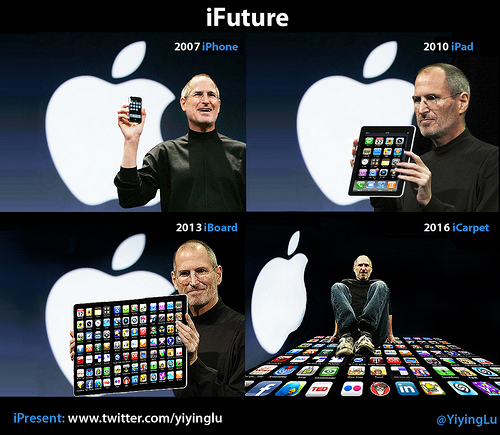
This humorous picture about Apple illustrates a never-ending innovative spirit, that McDonalds also possesses in its Marketing Strategy. It makes us wonder - what's next?.

Spam prevention powered by Akismet