02/27/21

Linking Assignment – Erin Marranca

Click on the image below to access Erin’s blog.
While being very serious about my studies, I also really appreciate the coursemates (and instructors) who are not afraid to share their human side online. Such seemingly small actions as sharing a smile or a positive comment, turning on the camera, posting a picture of oneself on the blog – can reduce the transactional distance and increase the feeling of immediacy and belonging.

Erin was one of such positive people during the evening video meetings, which immediately drew me to her blog. Of course, the picture was there, accompanied by a warm informal greeting.

Authoring Tool

Like me, Erin chose to host her work on UBC Blogs. Some of Erin’s literacies that stand out are:

  • Logo design, Website design, Remixing

Some implicit skills that her webspace conveys are:

  • Attention to detail, Creativity, Imagination

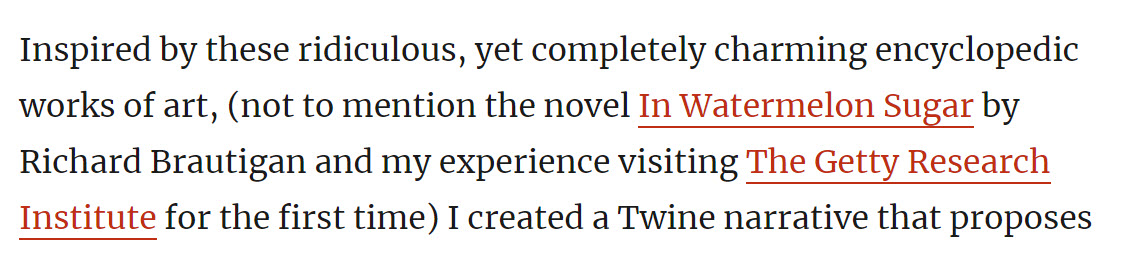
Erin’s textual architecture deserves a special mention. Erin is very advanced at using hypertext – all of her posts are multilinear and interactive, giving the reader the freedom to explore a variety of pathways (Bolter, 2001). She really owns the course materials, interlinking the new information with her rich intellectual word.
Twine Task

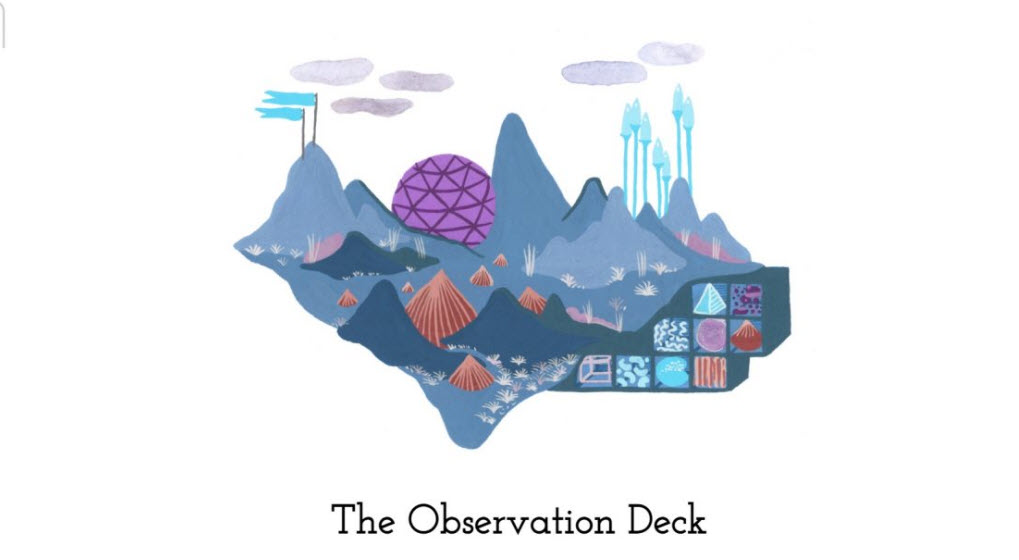
Erin’s Twine game is a virtual gallery, which is not surprising, taking into account her background in print and book media, as we learn in her Task 4 post. Unlike my Twine, which is a story with a few possible scenarios, Erin is inviting her visitor to a virtual exhibition, which feels very spatial, due to her narrative style, the skillful use of hyperlinks, and the accompanying visuals created by Erin. I personally went back and explored each of the places in her imaginary world and only wished there were more places to go to.
It’s at times like this that I feel sad that we study online, without a chance to see one another in person, chat together over a cup of coffee, and get a closer look at each other’s story.

References:

Bolter, J. D. (2001). Hypertext and the Remediation of Print. In Writing space: Computers, hypertext, and the remediation of print. Routledge.

02/27/21

Linking Assignment – Marwa K

Click on the image below to access Marwa’s blog.

I’ve known Marwa since winter 2020 when we studied in ETEC 524 together. Later, in the fall of 2020, we collaborated on the final project in another course. Being one of a small number of ESL learners in the program, I can relate to Marwa’s journey as a student at many levels. One obvious connection is that we are both immigrant women, bringing linguistic and cultural diversity to our learning community. On the other hand, precisely due to these differences, we at times might feel marginalized.

Authoring Tool

Marwa and I are both using UBC Blogs to host our content.

The first thing that I noticed about Marwa’s webspace is that she designed her own logo, which speaks to her literacy as a coder/web designer, and also the willingness to take time to make things look polished and put together.

Next, she creates an organized, well-designed space for her reader by using different design elements, such as text boxes and icons. She also added the ‘About’ page to introduce her reader to the blog and herself, the author – something I haven’t included in my blog due to time constraints.

Taking into consideration the course limitations, such as the inability to talk with the classmates, or the lack of weekly forums (so grateful for that!), Marwa communicates with others by leaving comments on their blogs. She also takes time to revisit the blogs and add to the discussions started in the comment boxes – something that is hard to keep track of, in my opinion, but Marwa is doing it masterfully.

To sum up, I feel grateful and honored to be studying alongside Marwa. Her commitment to lifelong learning is contagious, and I have learned a lot from her.

References:

Cazden, C., Cope, B., Fairclough, N., Gee, J., Kalantzis, M., Kress, G., Luke, A., Luke, C., Michaels, S. and Nakata, M. (1996). A pedagogy of multiliteracies: Designing social futures. Harvard educational review, 66(1), pp.60-92.

02/27/21

Task 7: Mode-bending

While reading the New London Groups’ article (Cazden et al., 1996) I paused many times to think about my ESL students and how a lot of learning materials they encounter, including digital ones, are predominantly text-based. My students are adult newcomers to Canada, and as their teacher, I have a bit of influence on how they perceive the culture and values of the new society, as well as their role in it. With the technologies of meaning rapidly changing, teaching “mere literacy” is no longer enough. It is my responsibility as a teacher to help my learners embrace their “multiliteracies”.

I was also thinking about my little daughter and the multiliteracies she is going to have in her lifetime, some of which probably do not even exist yet. As her parent, my role will be to support her learning so that she becomes an effective citizen and an active designer of her social future.

With that in mind, I tried to create my presentation to account for the “increasing multiplicity and integration of significant modes of meaning-making, where the textual is also related to the visual, the audio, the spatial, the behavioral” (Cazden et al., 1996, p. 64). Inspired by the New London Group’s discussion of the power of diversity and the importance of maintaining own voice in the increasingly globalized world, I overcame the initial desire to record a voiceless interactive video. Instead, I decided to narrate the video and let my accent be heard, first, because it is a part of who I am, and second, because it adds to the diversity of our learning community.

Creating the multimode presentation proved to be a challenging task. Just finding the way to position my camera to capture only the table and my arms took quite a bit of effort. Next, I added the intro and outro images and traditions, downloaded and cropped a free soundtrack, and applied noise reduction to my audio file – none of which I had done before. All of that was done to accommodate viewers with diverse needs and preferences, by including the video, audio, and textual (open captions) forms of representation. This was also a personal attempt to increase my own digital literacy and become “well-versed in different semiotic modes, visual, textual, and verbal” (Dobson & Willinsky, 2009, p. 298).

References:

Cazden, C., Cope, B., Fairclough, N., Gee, J., Kalantzis, M., Kress, G., Luke, A., Luke, C., Michaels, S. and Nakata, M. (1996). A pedagogy of multiliteracies: Designing social futures. Harvard educational review, 66(1), pp.60-92.

Dobson, T., & Willinsky, J. (2009). Digital Literacy. In D. Olson & N. Torrance (Eds.), The Cambridge Handbook of Literacy (Cambridge Handbooks in Psychology, pp. 286-312). Cambridge: Cambridge University Press.

02/19/21

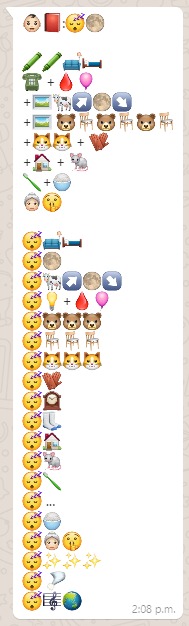
Task 6 – An emoji story

In my everyday life, I am used to externalizing my thoughts and code my meanings through writing. The challenge this week was to use the affordances of a different mode – images, to code a message that I would normally disseminate through the mode of writing (Kress, 2005).

As Bolter (2001) claims, the prose and print of today are attempting to remediate the use of images, by readjusting the ratio between text and image. This week, we were challenged to push this idea to the extreme, and code a full message without using a single printed word, moving from “pure text to pure pictorialism” (p. 52). 

We played with the limited choice of emojis on hand to arrange them in space in the way that we would normally arrange words. Even though we were working with images, the affordances of depictions, such as size, placement, or colors were limited (Kress, 2005). An additional challenge was that being constrained to using emojis, we were not able to name the relations between the concepts, such as states, belonging, past or present tense, etc. Instead, we had to find a way to use the limited affordances of the medium – the text box – to position the images in space in order to represent those relationships for our audience. 

I chose to work with a baby book for this task. What makes young children’s literature unique is that images have a much more important role in it, compared to text. In fact, some storybooks that my daughter owns, are completely wordless, allowing for a certain degree of freedom of interpretation. Another great thing about infant books, just like our emoji stories, is that they can be understood by young readers around the world, regardless of the language they speak.

My strategy was to code the whole story using emojis to represent words, so that someone who has only heard or read it once, could use these visual notes to retell the story, as close to the original as possible. I felt like an inventor of the alphabet – I had to decide whether I was going to use emoji to represent a single phoneme, a morpheme, or the whole word (Schmandt-Besserat, 2009). Perhaps, if my goal was to create a long-term solution, I would have taken the length to create an alphabet (e.g. using an image of an apple for the letter A, and a bear for B, etc.). However, I wanted to stay away from the habitual mode of representation and use the affordances of the emojis as they were designed – to represent a concept or a whole word.


To conclude, this task made me wonder if picture writing is indeed going to replace text, and how that will affect our thinking and our behaviors if it does. Looking forward to learning more on remediation of reading and the effect it has on our thinking in the next few weeks. 


References:

Bolter, J. D. (2001). The Breakout of the Visual. In Writing space: Computers, hypertext, and the remediation of print (2nd ed.). Mahwah, N.J: Lawrence Erlbaum Associates. doi:10.4324/9781410600110

Kress (2005), Gains and losses: New forms of texts, knowledge, and learning. Computers and Composition, Vol. 2(1), 5-22.

Schmandt-Besserat, D. (2009). “Origins and Forms of Writing.” In Bazerman, C. (Ed.). Handbook of research on writing: History, society, school, individual, text. New York, NY: Routledge.


02/14/21

Task 5 – Twine Task

The Process

Being very new to hypertext writing and HTML, I initially tried to create my game entirely on paper. However, as the complexity of my story was increasing, the limited affordances of a pencil and eraser quickly became apparent. Thus, I was forced to switch to the computer, which became my ‘clerk’ helping me to externalize my thoughts in “symbolized concepts” (Englebart, 1963, p. 6).  Not only I was able to focus on little steps without having to remember every iteration I already had written in my game, but due to the permanence of the computer text, I was also able to test-run, revise, and edit the game as many times as I wanted. It is hard to argue with Englebart (1963) that such use of technology increased the level of the information I could handle, shortened the time, and thus, turned me into an “augmented” story designer.

I wrote a game about myself and the choices that I make every day, representing these choices through hyperlinks. Twine makes these choices visible to myself, the author, and you, my reader, who is invited to take a journey into that space (Bolter, 2001).


The Game

Readings, assignments, deadlines – they are a part of every graduate student’s life. Many struggle with balancing school, career, family, and self-care.  

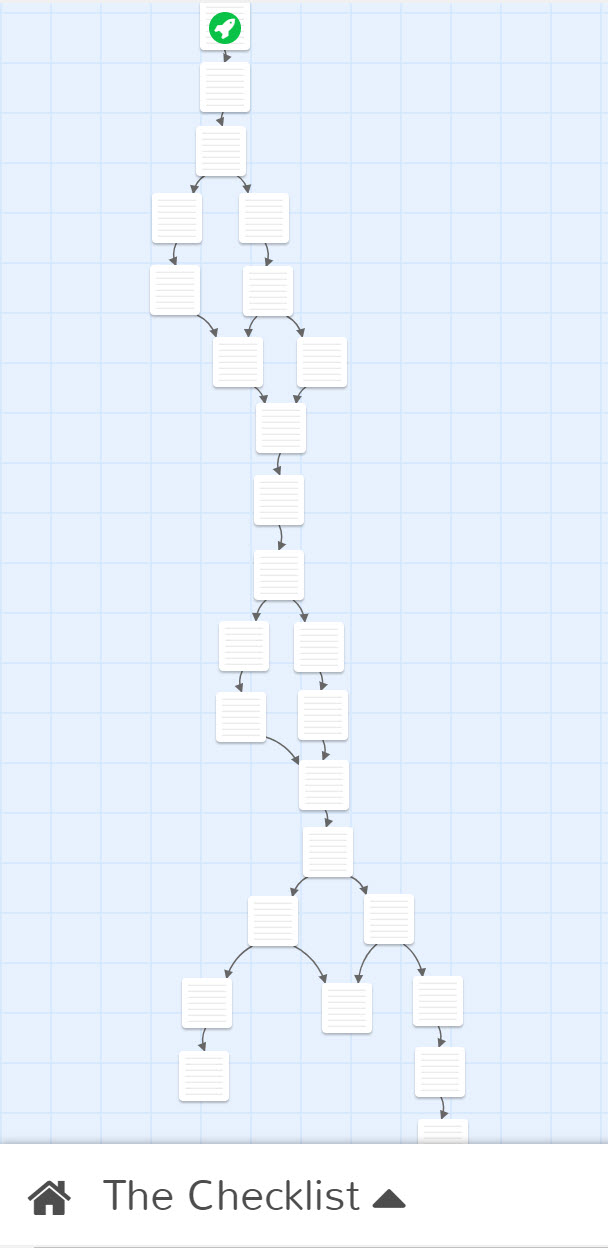
What choices would you make if you were a graduate student? Try the game to understand what choices and decisions students face. There are several options, but only one path leads to the successful completion of the game.

Click the link below to download the game on your computer. Extract the HTML file and run it in your browser. Good luck!

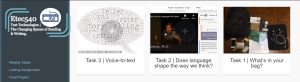
The Checklist


References

Bolter, J. D. (2001). Hypertext and the Remediation of Print. In Writing space: Computers, hypertext, and the remediation of print. Routledge.
Englebart, D. (1963). A conceptual framework for the augmentation of man’s intellect. In Hawerton, P.W. and Weeks, D.C. (Eds.), Vistas in information handling, Volume I: The augmentation of man’s intellect by machine. Washington, DC: Spartan Books.

02/2/21

Task 4 – Potato Printing

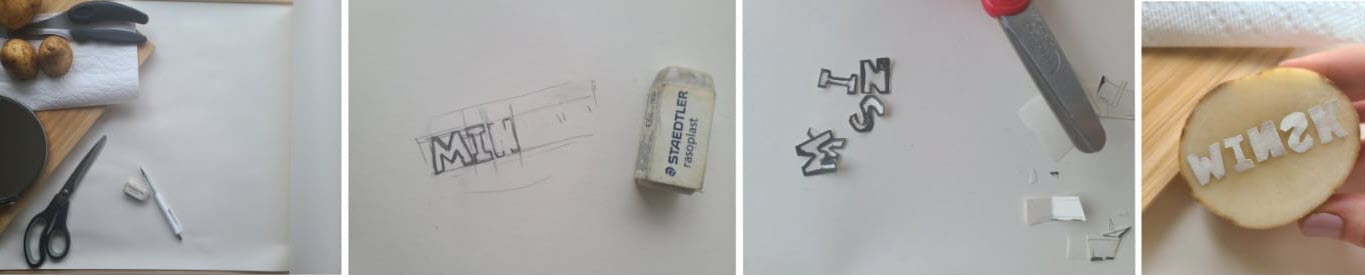
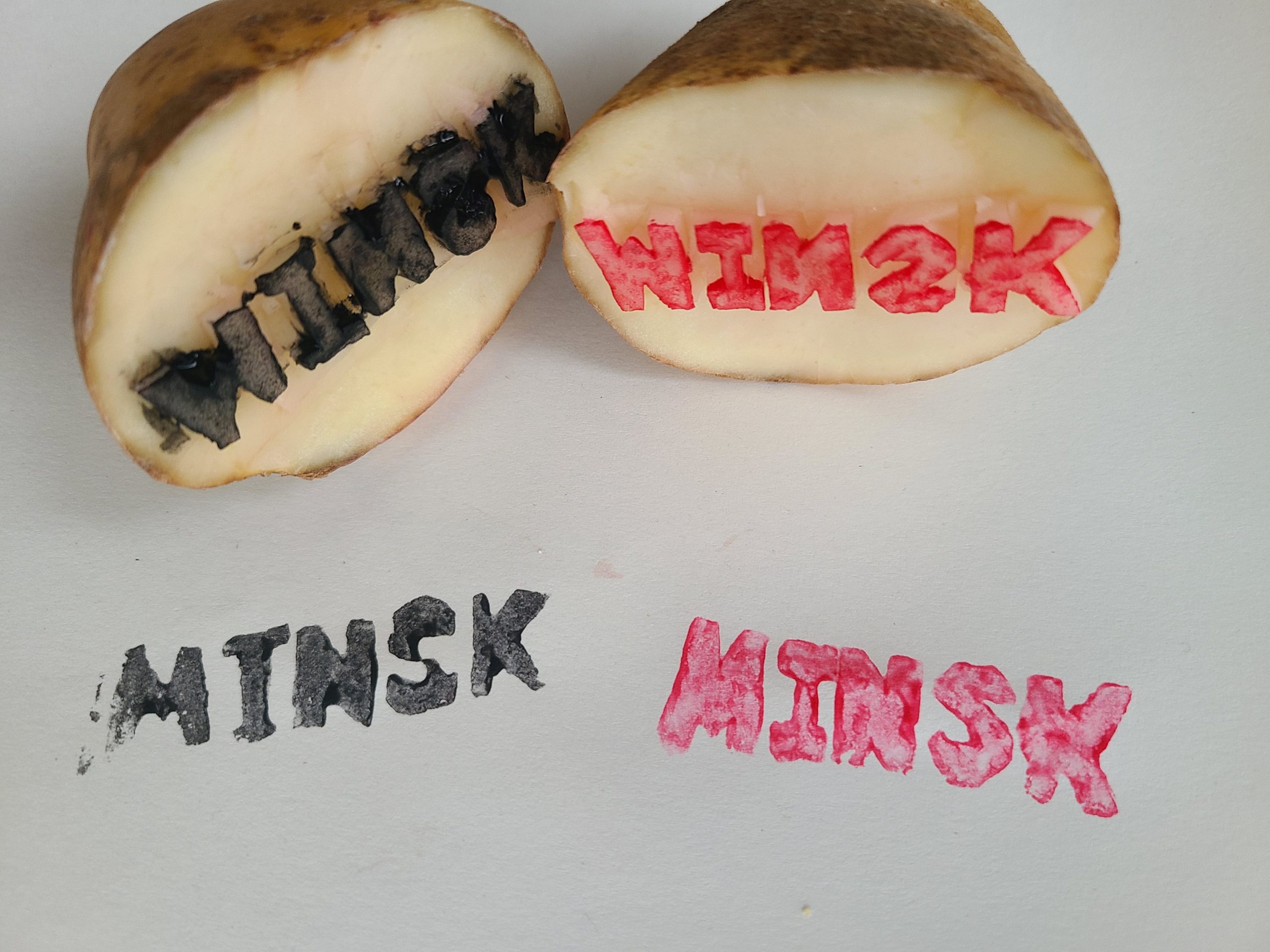
Prior to starting the assignment, I spent a considerable amount of time thinking of a word I was about to bring to material life (Haas, 2013). Besides the time and effort I was going to invest in the process, I also wanted to select a special and meaningful word to share with the world. In the end, I chose to carve the name of the city where I spent my youth and got educated – Minsk. (Ironically, my home country Belarus is often humorously referred to as ‘Potato Land’).

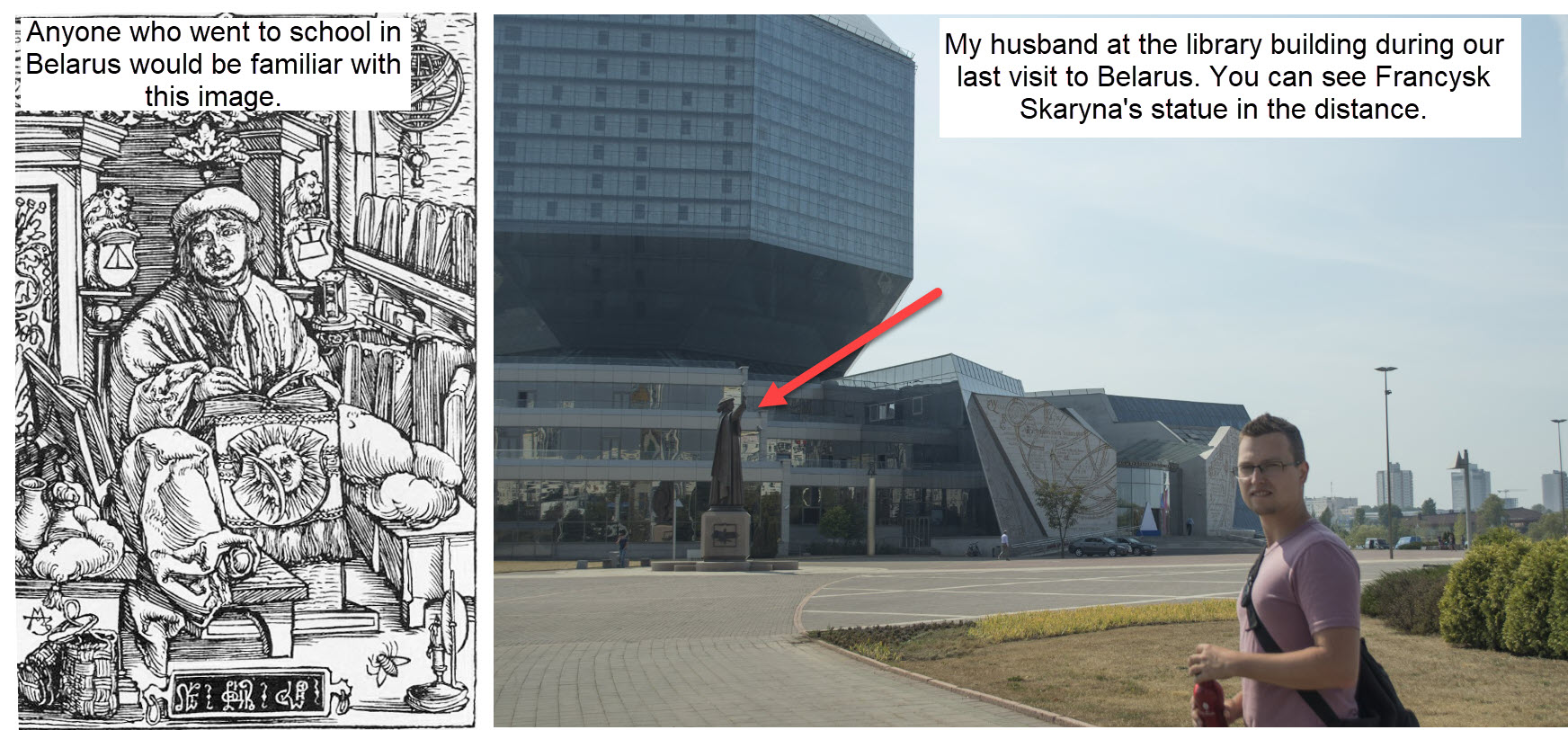
When I think of studying Belarusian history and culture at school, I immediately reminded of Francysk Skaryna, the first book printer in Eastern Europe. His contribution to our culture was so important that a busy street in the capital city, Minsk, is named after him. When the new library building was finished a few years ago, a statue of Francysk Skaryna was placed in front of it.

It took me just over an hour to create two stamps – 40 minutes for the first one, and 20 for the second one. Even though the second stamp took half the time to make, if my goal was to print a leaflet or a poster, the process would have probably taken me a few days.

Most of the letters in my word consist of straight lines intersecting at different angles. The letter shapes in the English alphabet go back to the original alphabet invented in Lebanon in 1700 BCE (Schmandt-Besserat, 2009). While carving the letters with my craft knife, I visualized our ancestors incising the first letters on tablets, and appreciated the simplicity of the shapes.

While ‘potato press’ printing was calming and the resulting letters look unique and beautiful, the handcrafting process did take a lot of time. The temporal investment, coupled with eye fatigue and the inconsistent results makes me feel grateful and relieved that we live in a world where handwriting is remediated by print technologies (Bolter, 2001) and access to education is not limited to a wealthy few.

P.S. A video clip of my daughter Alexandra trying to pronounce the word ‘Minsk’ for the first time. Soon she will start to understand that the signs she sees on paper match the sounds of language, and the words these sounds represent carry semantic meaning. For now, though, she is only starting to develop her orality, and her thinking is not yet affected by writing (Haas, 2013).


References

Bolter, Jay David. (2001). Writing space: Computers, hypertext, and the remediation of print [2nd edition]. Mahwah, NJ: Lawrence Erlbaum.

Haas, C. (2013). “The Technology Question.” In Writing technology: Studies on the materiality of literacyLinks to an external site.. Routledge. (pp. 3-23)

Schmandt-Besserat, D. (2009). “Origins and Forms of Writing.” In Bazerman, C. (Ed.). Handbook of research on writing: History, society, school, individual, text.Links to an external site. New York, NY: Routledge.

02/1/21

Linking Assignment – Chelan H

Click on the image below to access Chelan’s blog.

I chose to write about Chelan’s webspace because it differs from mine in a number of ways.

Authoring Tool

The most important difference is that Chelan chose to host the site on Google Sites, not UBC blogs. My experience with blogging is very limited, but I found WordPress to be not the most intuitive technology. While I do not know if the lack of WordPress literacy was part of Chelan’s decision to choose Google Sites, I can see how that gives her certain advantages. For once, Google Sites are easy to use, and the result is a clean and easy-to-navigate webspace. It also offers unlimited storage and is free to use (Steele, 2020). Also, should Chelan decide to keep adding other pages for other courses that she takes in MET program, she will end up with a good ePortfolio containing samples of her intellectual productions.

Affordances of the Authoring Tool

One limitation of the Google sites is that they do not have a blog engine, and so do not afford comments. While not impossible, adding a comment box would require some coding knowledge, and they are either not free or contain ads. At the same time, with our course not offering weekly discussion forums on Canvas, leaving comments on each other’s blog spaces is pretty much the only way to communicate with each other. For example, I really wanted to comment with my guess for Task 6, but I could not (Is it The Lion King?).

References

Steele, H. (2020, July 8). Google Sites vs WordPress: Which is Better? Superbwebsitebuilders. https://superbwebsitebuilders.com/google-sites-vs-wordpress/