Prior to starting the assignment, I spent a considerable amount of time thinking of a word I was about to bring to material life (Haas, 2013). Besides the time and effort I was going to invest in the process, I also wanted to select a special and meaningful word to share with the world. In the end, I chose to carve the name of the city where I spent my youth and got educated – Minsk. (Ironically, my home country Belarus is often humorously referred to as ‘Potato Land’).
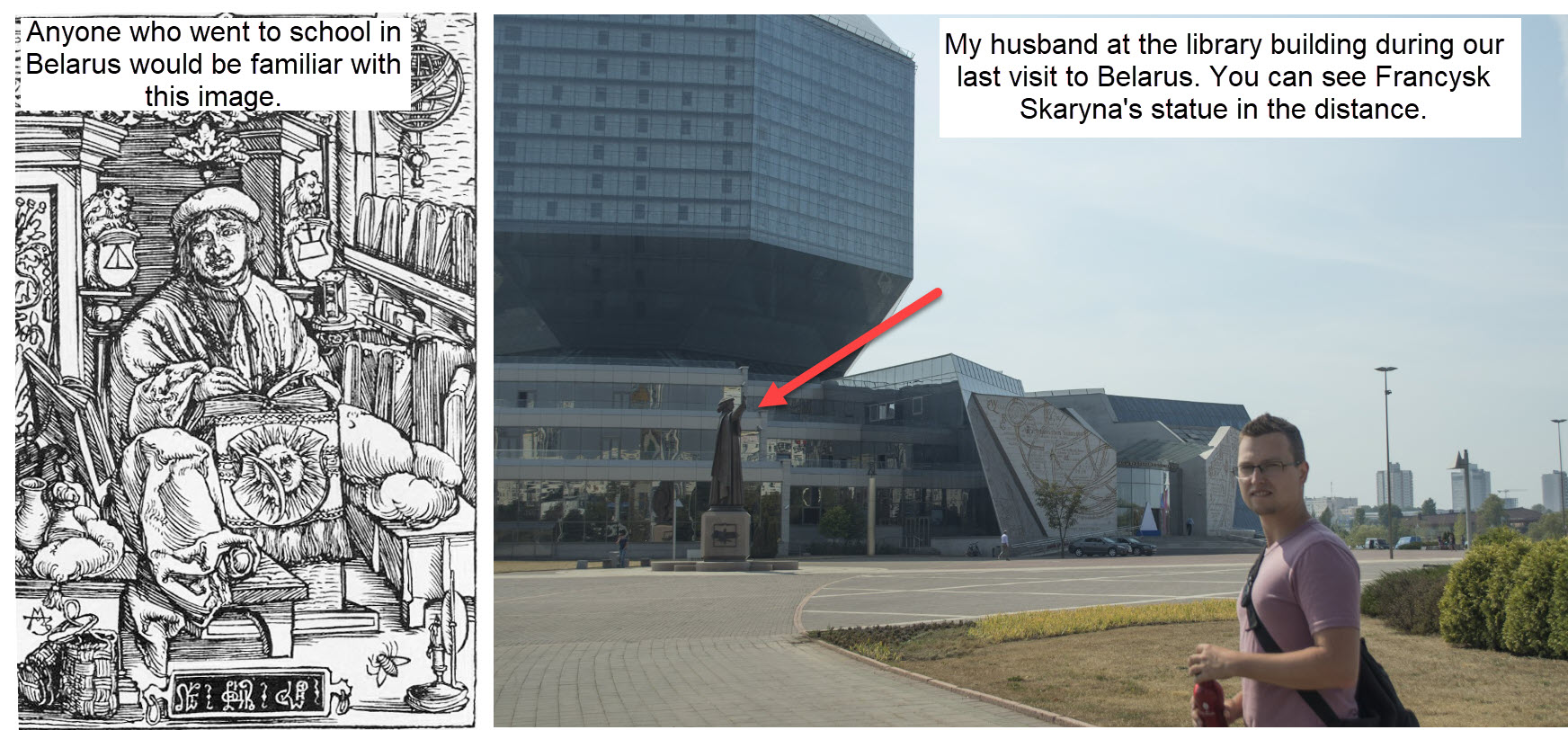
When I think of studying Belarusian history and culture at school, I immediately reminded of Francysk Skaryna, the first book printer in Eastern Europe. His contribution to our culture was so important that a busy street in the capital city, Minsk, is named after him. When the new library building was finished a few years ago, a statue of Francysk Skaryna was placed in front of it.
It took me just over an hour to create two stamps – 40 minutes for the first one, and 20 for the second one. Even though the second stamp took half the time to make, if my goal was to print a leaflet or a poster, the process would have probably taken me a few days.
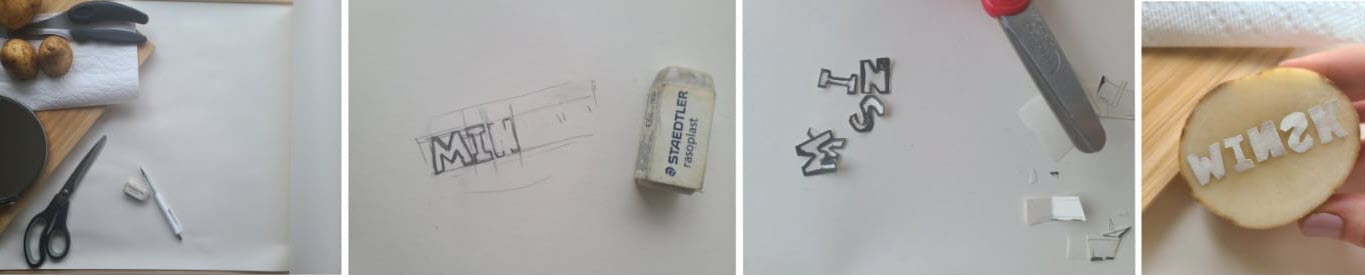 Most of the letters in my word consist of straight lines intersecting at different angles. The letter shapes in the English alphabet go back to the original alphabet invented in Lebanon in 1700 BCE (Schmandt-Besserat, 2009). While carving the letters with my craft knife, I visualized our ancestors incising the first letters on tablets, and appreciated the simplicity of the shapes.
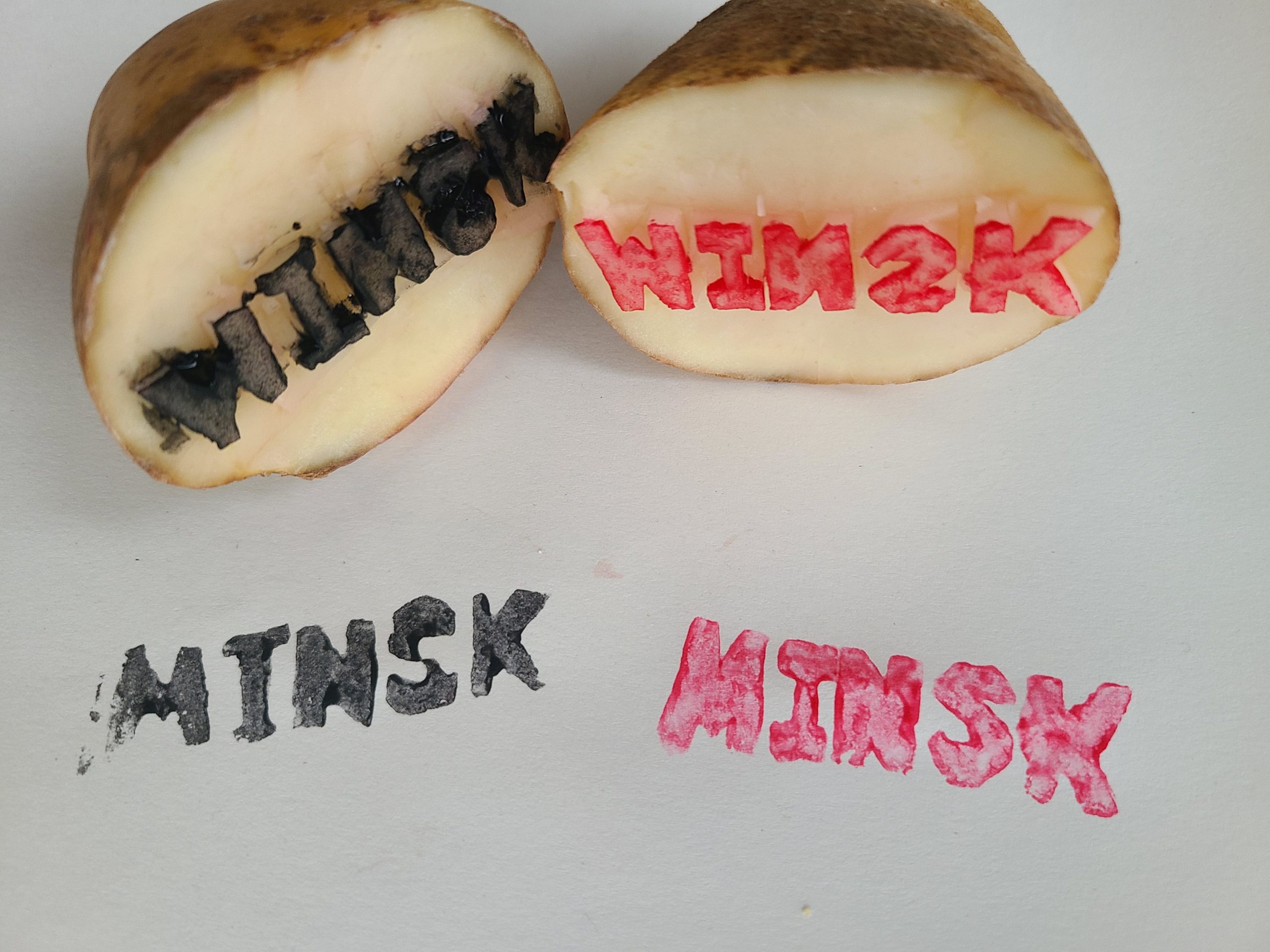
While ‘potato press’ printing was calming and the resulting letters look unique and beautiful, the handcrafting process did take a lot of time. The temporal investment, coupled with eye fatigue and the inconsistent results makes me feel grateful and relieved that we live in a world where handwriting is remediated by print technologies (Bolter, 2001) and access to education is not limited to a wealthy few.
P.S. A video clip of my daughter Alexandra trying to pronounce the word ‘Minsk’ for the first time. Soon she will start to understand that the signs she sees on paper match the sounds of language, and the words these sounds represent carry semantic meaning. For now, though, she is only starting to develop her orality, and her thinking is not yet affected by writing (Haas, 2013).
References
Bolter, Jay David. (2001). Writing space: Computers, hypertext, and the remediation of print [2nd edition]. Mahwah, NJ: Lawrence Erlbaum.
Haas, C. (2013). “The Technology Question.” In Writing technology: Studies on the materiality of literacy. Routledge. (pp. 3-23)
Schmandt-Besserat, D. (2009). “Origins and Forms of Writing.” In Bazerman, C. (Ed.). Handbook of research on writing: History, society, school, individual, text. New York, NY: Routledge.
Olga, I’m glad you took the time and risk to do the potato printing; it is so much fun to watch your daughter’s video too. Thank you for sharing it.
Your choice is very different from what I decided to do since I knew upfront that I am not a skilled carver, and the result will be a total mess. One point that caught my attention is the time you took to make your first stamp. I wonder how much time would it take if the process is repeated on a bigger scale and for more than a 5-letter word. I don’t want to do the Math, but it is a lengthy and tedious process.
Indeed, we should be thankful to be born at a time with the mechanization of writing when printing can be quickly composed and shared with minimum effort. Have you considered experimenting with the potato print on any personal items (bag -t-shirt)?
Olga. Nice to see you again yesterday. Your potato matrix is so cute! I always enjoy seeing object-making on a small scale. Also, your daughter is so cute! That video would be a funny piece to match with the spoken language topic in Week 2 – as well as reminiscent of me trying to learn German.
Hi Olga,
I found very interesting how you approached this task, starting by thoughtfully choosing your word. Minsk. I was very clever to do the whole word in one potato stamp, I decided to do one letter per stamp. I really like how you documented your process and involved your daughter in the process. I did one of my linking assignments connecting with your potato printing.